1. PRESS RELEASE
Mon 2nd March 2009; For Immediate Release
“Criticism of Israel is not Racist”
Four Palestinian human rights campaigners look set to be charged with “racially motivated conduct” after the activists welcomed the Procurator Fiscal’s motion to drop the original Breac h of the Peace charge in favour of the more serious one at Edinburgh Sheriff Court today.
The campaigners, all members of the Scottish Palestine Solidarity Campaign (SPSC), were arrested last August after disrupting an Edinburgh Festival concert by Israeli musicians, the Jerusale Quartet, and were due to be tried next week. Along with a fifth SPSC campaigner, Mick Napier, due to appear in court at a later date, the four stood up one at a time during the performance and made statements such as “End the Siege of Gaza”, and “Boycott Israel!”
“We had been ready to argue that our non-violent action does not constitute Breach of the Peace because our intention was to highlight and therefore help prevent the atrocities being committed by the sponsors of the Jerusalem Quartet – the state of Israel”, said Sofiah Macleod, Secretary of the SPSC, and one of the four accused.
“However, we welcome the opportunity to fight instead the absurd charge of “racially motivated conduct”; it is the state of Israel, and Zionism, the political ideology upon which it is founded, that is racist. We will resist any attempt to de-legitimise the Palestinian struggle for justice and to criminalise the growing campaign of boycott and divestment from Israel.”
Local Jewish writer and journalist, Marion Woolfson, is honorary president of the SPSC, an organisation that supports the right of the Palestinian people as a whole to self-determination. Before the concert, she had called on Edinburgh Festival organisers to rescind the invitation to the Israeli musicians. In a letter to the Queen’s Hall venue, she wrote, “I simply cannot understand why you should have invited the representatives of a country that practices ethnic cleansing and a form of apartheid which even those who have lived in South Africa have said is worse than anything thought up by the former rulers of their country.”
Woolfson described the latest charges against her fellow campaigners as “ridiculous”, and continued, “the anti-Semitism charge is the last resort of those who try to defend the indefensible. This is the equivalent of labelling all those who criticised and boycotted the white-supremacist state of Apartheid South Africa as anti-white.”
Campaign Chair, Mick Napier, said, “We thank the Procurator Fiscal for providing us with the forum to explain that opposition to the violent, racist state of Israel is motivated by a commitment to universal human rights. We support the Palestinian people faced with Zionist savagery and we are contemptuous of attempts to smear such a struggle for justice with the taint of racism. I hope these charges are not quietly dropped and we will have the opportunity to meet our critics in open court.”
ENDS.
Notes for editors:
1. The Scottish Palestine Solidarity Campaign started in autumn 2000 in response to the Palestinian second uprising against Israeli occupation (intifada). For further information, contact:
Campaign Chair: Mick Napier 0131 620 0052; 07958 002 591
Email: chair@scottishpsc.org.uk
Website: www.scottishpsc.org.uk
2. The Scottish Palestine Solidarity Campaign protested the event at the Queen's Hall, 87-89 Clerk Street, on Friday 29th Aug from 10am.
3. General Background
The Jerusalem Quartet performs around the world as cultural ambassadors for Israel, and in celebration of Israel’s founding amidst the bloody ethnic cleansing of Palestine in 1948.
The state of Israel inflicted the ‘Nakbah’, or catastrophe, upon Palestinians, expelling hundreds of thousands who today are still refused their rights under international law to return to their home. The crimes committed against the Palestinian people did not end in 1948. With daily theft of land and resources, Israel continues to push forward its policy of replacing the Palestinian people with Jewish immigrants from around the world.
4. Marion Woolfson is the author of many books and articles including:
Prophets in Babylon: Jews in the Arab World, London, 1980, Faber and Faber;
5. For details of the 9 July 2005 call by Palestinian Civil Society for Boycott, Divestment and Sanctions against Israel Until it Complies with International Law and Universal Principles of Human Rights, see:
http://www.badil.org/Boycott-Statement.htm
6. The protest was endorsed by the Palestinian Campaign for the Academic and Cultural Boycott of Israel (PACBI): http://www.pacbi.org/campaign_statement.htm
The Palestinian Campaign for the Academic and Cultural Boycott of Israel (PACBI) fully endorses the Scottish Palestine Solidarity Campaign's call on the Edinburgh Festival to withdraw its invitation to the Jerusalem Quartet. Members of this Israeli Quartet began their career
with active service in the Israeli army, where they served as 'Distinguished Musicians,' enjoying the sponsorship of mainstream Israeli cultural institutions such as the Jerusalem Foundation, which regards them as 'prestigious cultural ambassadors, representing Israel and Jerusalem.'
From the beginning, the Quartet's international tours have been actively promoted by the Israeli government. As such, and since the Quartet has not taken any clear position on the various forms of oppression of the Palestinian people, PACBI supports the Scottish PSC's call to boycott the Jerusalem Quartet as an institution that is complicit in maintaining Israel's occupation and oppression of the Palestinian people.
7. Hundreds of international civil society organizations and networks endorsed the Position Paper titled “United Against Apartheid, Colonialism and Occupation: Dignity & Justice for the Palestinian People” on the International Day of Solidarity with the Palestinian People. The strategic position paper was launched as a basis for anti-racist intervention at and beyond the UN Durban Review Conference.
For more information: http://www.badil.org/Publications/Press/2008/press495-08.htm
Read the Position Paper: English-BNC_Position_Paper-Durban_Review.pdf
2. Scottish PSC Event:
South Africa & Palestine: Long Roads to Freedom
Ronnie Kasrils
GLASGOW: Friday 20 March, 6pm, Room 514, Graham Hills Building, Strathclyde University (Joint meeting with Action Palestine, University of Strathclyde)
EDINBURGH: Sat 21 March, 2pm, Augustine Church Centre
(tickets £3 for Edinburgh event, email campaign@scottishpsc.org.uk to register - Glasgow event is free)
During the years of apartheid rule in South Africa, Ronnie Kasrils was actively involved with the banned ANC, its military wing Umkonto we Sizwe and the South African Communist Party. Hunted by the Security police, he was described by them as armed and dangerous. In the first ten years of a democratic South Africa Kasrils served as Deputy Defence Minister (1994 to 1999), as Minister of Water Affairs and Forestry (1999 to 2004) and then as Minister for Intelligence Services (2004 to 2008). Kasrils is an activist in the Palestine Solidarity Committee, South Africa.
Join Scottish PSC- we are all volunteers with no paid staff - or make a financial donation to help us continue campaigning work:
Send a cheque to:
Scottish Palestine Solidarity Campaign
c/o Peace & Justice Centre
2 Princes Street
Edinburgh EH2 4BJ
secretary@scottishpsc.org.uk
SPSC is affiliated to the Palestine Solidarity Campaign (UK) www.palestinecampaign.org
Boycott israHell!

Бойкот на израел и печелещите от окупацията! Boycott israHell and those who profit from occupation!
Monday, March 2, 2009


March 2, 2009
Last Thursday, President Obama sent his FY2010 budget outline to Congress and we were pleasantly surprised to see that it contained no mention of military aid to Israel.
To read the budget outline, click here (http://www.gpoaccess.gov/usbudget/fy10/pdf/fy10-newera.pdf). (Skip ahead to p.87 for the section on the Department of State and other international programs.)
Last Tuesday, President Obama addressed a joint session of Congress to
explain his budget outline. His only reference to Israel was a reiteration of his Administration's priority "To seek progress toward a secure and lasting peace between Israel and her neighbors". To read President Obama's remarks to Congress - http://www.whitehouse.gov/the_press_office/Remarks-of-President-Barack-Obama-Address-to-Joint-Session-of-Congress/
Does this mean that President Obama will not include $2.775 billion in military aid to Israel when he delivers his actual detailed budget request to Congress in April as expected? That's highly doubtful.
But the absence of any mention of it in the budget outline or the President's address to Congress does mean that military aid to Israel is becoming a political liability, something that is now downplayed and no longer trumpeted.
If our analysis is correct, then what accounts for this shift? Undoubtedly it is our growing movement to hold Israel accountable for its misuse of U.S.weapons to commit horrific human rights abuses against Palestinians.
Since last Monday, together we have sent more than 7,000 letters to President Obama calling for an investigation into Israel's misuse of U.S. weapons and a reconsideration of budget requests for more weapons. More letters have been sent by supporters of the Muslim American Society Freedom Foundation, Progressive Democrats of America, United for Peace and Justice, the Council for the National Interest, and others, in a coordinated campaign that we organized.
On a related note, we also attended a Capitol Hill briefing by Rep. Barney Frank last Tuesday. Rep. Frank has a great proposal to cut military spending by 25%. Unfortunately, when we challenged him on reining in spending on military aid to Israel and holding it accountable for its misuse of U.S.weapons, he ducked our question. Watch the short video on the left.
Keep up the pressure—it’s working!—by taking action below.
TAKE ACTION
1. Thank President Obama for not including military aid to Israel (http://salsa.democracyinaction.org/o/641/t/2439/campaign.jsp?campaign_KEY=26705) in his budget outline. Send a letter (http://salsa.democracyinaction.org/o/641/t/2439/campaign.jsp?campaign_KEY=26705) to the President today asking him to investigate Israel’s prior misuses of U.S. weapons against Palestinians and to reconsider his anticipated request for additional weapons in his upcoming detailed budget. To send your letter, please click here (http://salsa.democracyinaction.org/o/641/t/2439/campaign.jsp?campaign_KEY=26705).
2. Organize to challenge U.S. military aid to Israel in your community. Even as we begin to see glimmers of hope that the United States is considering changing its policy of unconditional support for Israel and holding it accountable for its human rights abuses of Palestinians, we have to organize on a long-term, sustained basis
to make this happen.
Since February 2008, we have sent more than 1,000 organizing packets to people and organizations all over the country to educate and mobilize people in their communities to challenge military aid to Israel. Check out our Google map below showing the locations where people are organizing.
Sign up today as a volunteer organizer with us and we’ll send you an organizing packet complete with postcards, petitions, and fact
sheets.
Sign up today!
3. Learn more about U.S. military aid to Israel and its dire impact on
Palestinians. Watch our recent Capitol Hill policy briefing, “Armed and Dangerous: Weapons Transfers to Israel during the Bush Administration,” and download a PowerPoint presentation on the topic by clicking here (http://endtheoccupation.org/article.php?id=1820).
Also, be sure to read Amnesty International’s report, “Fueling
Conflict: Foreign Arms Supplies to Israel/Gaza (http://www.amnesty.org/en/library/asset/MDE15/012/2009/en/3301b5c0-189b-4ba2-9bca-68e116fd590f/mde150122009en.pdf),” released on February 23. In the report, Amnesty International details the role U.S. weapons played in Israel’s recent war on the occupied Gaza Strip and calls for an arms embargo.
Finally, check out this Huffington Post article by Robert Naiman of Just
Foreign Policy, entitled, “Conditioning Part of U.S. Aid to Israel on Implementation of U.S. Policy (http://www.huffingtonpost.com/robert-naiman/conditioning-part-of-us-a_b_167321.html).” 4. Make a tax-deductible contribution (http://endtheoccupation.org/article.php?list=type&type=149) to support this work. If you value the work that we do to challenge U.S. military aid to Israel, then please consider making a generous one-time contribution or join our Olive Branch Club and make a recurring monthly donation.(http://endtheoccupation.org/article.php?list=type&type=149)
Last Thursday, President Obama sent his FY2010 budget outline to Congress and we were pleasantly surprised to see that it contained no mention of military aid to Israel.
To read the budget outline, click here (http://www.gpoaccess.gov/usbudget/fy10/pdf/fy10-newera.pdf). (Skip ahead to p.87 for the section on the Department of State and other international programs.)
Last Tuesday, President Obama addressed a joint session of Congress to
explain his budget outline. His only reference to Israel was a reiteration of his Administration's priority "To seek progress toward a secure and lasting peace between Israel and her neighbors". To read President Obama's remarks to Congress - http://www.whitehouse.gov/the_press_office/Remarks-of-President-Barack-Obama-Address-to-Joint-Session-of-Congress/
Does this mean that President Obama will not include $2.775 billion in military aid to Israel when he delivers his actual detailed budget request to Congress in April as expected? That's highly doubtful.
But the absence of any mention of it in the budget outline or the President's address to Congress does mean that military aid to Israel is becoming a political liability, something that is now downplayed and no longer trumpeted.
If our analysis is correct, then what accounts for this shift? Undoubtedly it is our growing movement to hold Israel accountable for its misuse of U.S.weapons to commit horrific human rights abuses against Palestinians.
Since last Monday, together we have sent more than 7,000 letters to President Obama calling for an investigation into Israel's misuse of U.S. weapons and a reconsideration of budget requests for more weapons. More letters have been sent by supporters of the Muslim American Society Freedom Foundation, Progressive Democrats of America, United for Peace and Justice, the Council for the National Interest, and others, in a coordinated campaign that we organized.
On a related note, we also attended a Capitol Hill briefing by Rep. Barney Frank last Tuesday. Rep. Frank has a great proposal to cut military spending by 25%. Unfortunately, when we challenged him on reining in spending on military aid to Israel and holding it accountable for its misuse of U.S.weapons, he ducked our question. Watch the short video on the left.
Keep up the pressure—it’s working!—by taking action below.
TAKE ACTION
1. Thank President Obama for not including military aid to Israel (http://salsa.democracyinaction.org/o/641/t/2439/campaign.jsp?campaign_KEY=26705) in his budget outline. Send a letter (http://salsa.democracyinaction.org/o/641/t/2439/campaign.jsp?campaign_KEY=26705) to the President today asking him to investigate Israel’s prior misuses of U.S. weapons against Palestinians and to reconsider his anticipated request for additional weapons in his upcoming detailed budget. To send your letter, please click here (http://salsa.democracyinaction.org/o/641/t/2439/campaign.jsp?campaign_KEY=26705).
2. Organize to challenge U.S. military aid to Israel in your community. Even as we begin to see glimmers of hope that the United States is considering changing its policy of unconditional support for Israel and holding it accountable for its human rights abuses of Palestinians, we have to organize on a long-term, sustained basis
to make this happen.
Since February 2008, we have sent more than 1,000 organizing packets to people and organizations all over the country to educate and mobilize people in their communities to challenge military aid to Israel. Check out our Google map below showing the locations where people are organizing.
Sign up today as a volunteer organizer with us and we’ll send you an organizing packet complete with postcards, petitions, and fact
sheets.
Sign up today!
3. Learn more about U.S. military aid to Israel and its dire impact on
Palestinians. Watch our recent Capitol Hill policy briefing, “Armed and Dangerous: Weapons Transfers to Israel during the Bush Administration,” and download a PowerPoint presentation on the topic by clicking here (http://endtheoccupation.org/article.php?id=1820).
Also, be sure to read Amnesty International’s report, “Fueling
Conflict: Foreign Arms Supplies to Israel/Gaza (http://www.amnesty.org/en/library/asset/MDE15/012/2009/en/3301b5c0-189b-4ba2-9bca-68e116fd590f/mde150122009en.pdf),” released on February 23. In the report, Amnesty International details the role U.S. weapons played in Israel’s recent war on the occupied Gaza Strip and calls for an arms embargo.
Finally, check out this Huffington Post article by Robert Naiman of Just
Foreign Policy, entitled, “Conditioning Part of U.S. Aid to Israel on Implementation of U.S. Policy (http://www.huffingtonpost.com/robert-naiman/conditioning-part-of-us-a_b_167321.html).” 4. Make a tax-deductible contribution (http://endtheoccupation.org/article.php?list=type&type=149) to support this work. If you value the work that we do to challenge U.S. military aid to Israel, then please consider making a generous one-time contribution or join our Olive Branch Club and make a recurring monthly donation.(http://endtheoccupation.org/article.php?list=type&type=149)
Blair calls for new Gaza strategy

Blair visited a school in the northern town of Beit Hanoun [Reuters]
Tony Blair has told Al Jazeera during his first visit to Gaza as Middle East envoy that a "different strategy" is needed to rebuild the territory following Israel's 22-day war on the Strip.
He said on Sunday there "was trauma, but a determination to rebuild".
But he said: "We need a different strategy for Gaza, one that helps the people who want a better life and a better future ... [including] rebuilding infrastructure so that basic life can continue.
"We need to work on getting pledges and get money in ... [and] get the politics right because ... it is not just about the amount of money pledged, it is also about resolving the political impasse," he said.
No solution to the Israeli-Palestinian conflict would be reached until a "credible negotiation process, changes in the West Bank" and a "different, better strategy" for Gaza were in place, Blair added.
'Israeli obligations'
Asked in an interview how we will deal with a right-wing government in Israel led by Benyamin Netanyahu, the leader of the right-wing Likud party, Blair said that Israel had to fulfill its obligations.
"We have to work with whoever the Israeli people elect, let's test it out not just assume it won’t work.
Exclusive interview
Blair discusses Gaza future
"I have discussed the three points [above] and he [Netanyahu] understands we need to take it to a two-state solution."
Blair's trip is the latest in a number of high-level visits to Gaza since Israel ended its offensive in mid-January and comes a day ahead of a donors' conference in Sharm el-Sheikh, Egypt, on how to reconstruct the Palestinian territory.
The visit is Blair's first to Gaza in the 18 months since he became envoy under the Middle East peacebroker "Quartet" of the United States, Russia, the European Union and the United Nations.
Marwan Bishara, Al Jazeera's senior political analyst, said: "Blair is the last key Western leader to come to Gaza because it was his last chance on the eve of the Sharm el-Sheikh summit.
"The problem is that the diplomatic process has been going into a recession. Now it is in total depression - the person who has been giving the most of the false loans and bad credit to the Israelis is Tony Blair. He has been giving Israel credit by which they have built illegal settlements in the West Bank.
"Blair had been the person who said that the question of Palestine had to be resolved in order to solve problems across the [wider] Middle East," he said.
"He was the person most interested in the issue of Palestine - but he was the last leader to show up there."
Reconstruction conference
Blair met Gaza community representatives, but not members of Hamas, Matthew Doyle, his spokesman said.
He visited a UN school in the northern town of Beit Lahiya, where he met local businessmen to discuss reconstruction efforts in the coastal territory, but did not go to the areas hardest hit by Israel during its offensive.
In depth
Analysis and features from Gaza after the war
His visit came as Hillary Clinton, the US Secretary of State, arrived in Egypt for the one-day conference on post-conflict recovery in Gaza.
Donors meeting in Sharm el-Sheik on Monday will be asked to fund a $2.8 billion reconstruction plan designed by Salam Fayyad, the Palestinian prime minister, who wants a large part of the money to be channelled through the West Bank-based government.
Other aid, such as for rebuilding homes, would go directly to Gazans' bank accounts.
The Palestinian Authority already administers foreign aid and has been sending $120 million to Gaza each month to cover civil servants' salaries.
Ban Ki-moon, the UN secretary general and Nicholas Sarkozy, the French president, are also expected to attend the meeting.
Hamas plan
Hamas, which has not been invited to the conference in Egypt, has prepared its own reconstruction plan.
Fawzi Barhoum, a spokesman for Hamas, said the group in control of Gaza would be co-operative.
"We will provide all the logistical help to the donors to implement this huge project," he said.
"We are not asking anyone to send money into our accounts."
More than 1,300 Palestinians, at least of a third of that number women and children, died during the war on Gaza, which Israel launched with the stated aim of preventing rocket fire from fighters based in the coastal territory.
At least 13 Israelis, three of them civilians, were killed.
http://english.aljazeera.net/news/middleeast/2009/03/200931132514286358.html
US shuns Hamas in Gaza aid pledge

Clinton is expected to make the pledges at a donors' conference on Monday [AFP]
The United States is set to pledge $900m for the Palestinians at a donors' conference in Egypt, but only a third of that will go towards reconstruction in the Gaza Strip and none of the money will go to Hamas, who rule the territory.
Robert Wood, a spokesman for the US state department, said the US would pledge $300m at Monday's conference on reconstructing Gaza, to meet "urgent" humanitarian needs in the territory after Israel's military onslaught in December.
Wood said the $300m would be funnelled through the UN and other organisations.
"Hamas is not getting any of this money," Wood told reporters in the Egyptian coastal resort of Sharm el-Sheik, where Hillary Clinton, the US secretary of state, arrived on Sunday on the first leg of a week-long trip to the Middle East and Europe.
The remaining $600m will be pledged to the Western-backed Palestinian Authority (PA) led by Mahmoud Abbas, the Palestinian president.
'Sidestepping the issue'
Analysis and features from Gaza after the war
Washington wants the conference to bolster the authority of Abbas, whose PA governs the Israeli-occupied West Bank but holds no sway in Gaza after Hamas routed forces loyal to Abbas and seized the territory in June 2007.
Marc Gopin, from the Institute for Conflict Analysis and Resolution at George Mason University, told Al Jazeera that the donors' conference was "an attempt to demonstrate humanitarian concern".
But, he added, there was "no real addressing of the political fallout in the long run, as to whether there's going to be reconciliation between Fatah and Hamas and whether in fact this aid can really ever get in".
"They can't even get in humanitarian aid at this point because the [Israeli] blockade is so severe.
"I think it really sidesteps the whole issue of what the negotiations really were about in terms of breaking the blockade, which is more properly what [US Middle East envoy] George Mitchell should be working on," he said.
Saree Makdisi, the author of Palestine Inside Out: An Everyday Occupation, told Al Jazeera that "it sure looks like more of the same" US policy and that there was no difference between Clinton's stance and that of her predecessor, Condoleezza Rice.
"The most surprising thing isn't that there's no difference, it's that there's no difference in spite of the fact that the [incoming] Israeli government has taken an even more belligerent stand" against the Palestinians and on honouring international law, he said.
Reconstruction plan
Donors meeting in Sharm el-Sheik will also be asked to fund a $2.8bn reconstruction plan designed by Salam Fayyad, the Palestinian prime minister, who wants a large part of the money to be channelled through the West Bank-based government.
Other aid, such as for rebuilding homes, would go directly to Gazans' bank accounts.
The Palestinian Authority already administers foreign aid and has been sending $120m to Gaza each month to cover civil servants' salaries.
Ban Ki-moon, the UN secretary general and Nicholas Sarkozy, the French president, are also expected to attend the meeting.
Hamas, which has not been invited to the conference in Egypt, has prepared its own reconstruction plan.
'Different strategy needed'
Exclusive interview

Blair's trip is his first to Gaza since he became Middle East envoy [AFP]
Blair discusses Gaza future
Meanwhile, Tony Blair, the former British prime minister, told Al Jazeera during his first visit to Gaza as Middle East envoy, that a "different strategy" was needed to rebuild the territory following Israel's 22-day war on the strip.
Blair said on Sunday that there "was trauma, but a determination to rebuild".
But he added: "We need a different strategy for Gaza, one that helps the people who want a better life and a better future ... [including] rebuilding infrastructure so that basic life can continue.
"We need to work on getting pledges and get money in...[and] get the politics right because...it is not just about the amount of money pledged, it is also about resolving the political impasse."
No solution to the Israeli-Palestinian conflict will be reached until a "credible negotiation process, changes in the West Bank" and a "different, better strategy" for Gaza are in place, Blair added.
'Painful response'
Asked in an interview how we will deal with a right-wing government in Israel led by Benyamin Netanyahu, the leader of the Likud party, Blair said that Israel had to fulfil its obligations.
"We have to work with whoever the Israeli people elect. Let's test it out, not just assume it won’t work.
"I have discussed the three points [above] and he [Netanyahu] understands we need to take it to a two-state solution."
Blair's trip is his first to Gaza in the 18 months since he became envoy to the Middle East for the "Quartet" group of peace negotiators comprising the US, UN, EU and Russia.
More than 1,300 Palestinians, at least of a third of that number women and children, died during the war on Gaza, which Israel launched with the stated aim of preventing rocket fire from fighters based in the coastal territory.
At least 13 Israelis, three of them civilians, were killed.
However, rocket fire is still occurring and Ehud Olmert, the Israeli prime minister, on Sunday vowed a "painful" response if the attacks on southern Israel did not stop.
The rockets "will be answered with a painful, harsh, strong and uncompromising response from the security forces", he said at the start of a weekly cabinet meeting.
Donors discuss rebuilding Gaza

Conditions will be attached to the $300m Hillary Clinton, left, is set to hand over for Gaza [AFP]
International donors meeting in Egypt are expected to pledge billions of dollars to
rebuild the Gaza Strip after it was battered during Israel's 22-day offensive earlier this year.
Opening the conference in Sharm el-Sheikh on Tuesday, Hosni Mubarak, the Egyptian president, urged donors to give generously, but said aid would not compensate for the 1,300 Palestinian lives lost during the war.
"I reach to you with an appeal from the heart to declare tangible pledges," he said.
Up to 75 countries and international organisations are being asked to fund a $2.8bn reconstruction plan designed by Salam Fayyad, the Palestinian prime minister, who wants a large part of the money to be channelled through the West Bank-based Palestinian Authority.
Ahead of Tuesday's conference, the US state department announced that Washington would contribute $300m to meet "urgent" humanitarian needs in Gaza.
International goodwill
It remains unclear though how the planned reconstruction of Gaza will be undertaken. The territory is controlled by Hamas and Israel has said it will refuse to approve projects that could benefit the group.
"We definitely don't want to see the goodwill of the international community exploited by Hamas and serve Hamas's extremist purposes," Mark Regev, an Israeli government spokesman, said. Hamas took full control of Gaza in June 2007 after driving out security forces loyal to Mahmoud Abbas, the Palestinian Authority president and leader of the rival Fatah group. Hamas, which has not been invited to the conference in Egypt and is labelled a "terrorist" group by the US and the EU, has prepared its own reconstruction plan.
"We are welcoming anyone who wants to reconstruct Gaza, but without any political terms on Hamas or on the Palestinian people," Osama Hamdan, a Beirut-based Hamas official, told Al Jazeera.
Israel's blockade of the territory continues to prevent supplies, including construction materials, from crossing into Gaza.
'Humanitarian concern'
Marc Gopin, from the Institute for Conflict Analysis and Resolution at George Mason University, told Al Jazeera that the donors' conference was "an attempt to demonstrate humanitarian concern".
The Ramallah-based Palestinian Authority (PA) says $2.8bn is needed to rebuild Gaza.
A total of $2.25bn has already been pledged by Saudi Arabia ($1bn), Qatar ($250m), Algeria ($100m) and the US ($900m).
The US says its financial assistance cannot be channelled through Gaza's Hamas-run government.
Israel has barred entry of material which it says may have military use, such as cement and steel rods.
But, he said, there was "no real addressing of the political fallout in the long run, as to whether there's going to be reconciliation between Fatah and Hamas and whether in fact this aid can really ever get in".
"They can't even get in humanitarian aid at this point because the [Israeli] blockade is so severe."
Mubarak also told delegates at the conference that the "priority is to reach a truce between Israel and Palestinians". The Israeli assault on the Gaza Strip ended after Israel called a halt to the fighting on January 18. Hamas announced its own ceasefire
the following day.
More than 1,300 Palestinians, including women and children, died during the war on Gaza, which Israel launched with the stated aim of preventing rocket fire from fighters based in the coastal territory. At least 13 Israelis, three of them civilians, were also killed. However, rocket fire has continued and Ehud Olmert, the outgoing Israeli prime minister, on Sunday vowed a "painful" response if the attacks on southern Israel did not stop.
US pledge
Hillary Clinton, on her first visit to the Middle East since becoming the US secretary of state, said on Friday that the US aid, which will include another $600m for the Palestinian Authority, would depend on how well the Palestinians meet conditions imposed by the so-called Quartet of the United States, the European Union, the United Nations and Russia. "I will be announcing a commitment to a significant aid package, but it will only be spent if we determine that our goals can be furthered rather than undermined or subverted," she told Voice of America radio.
Robert Wood, a spokesman for the US state department, said the $300m would be funnelled through the UN and other organisations. "Hamas is not getting any of this money," he told reporters.
Saree Makdisi, the author of Palestine Inside Out: An Everyday Occupation, told Al Jazeera that "it sure looks like more of the same" US policy and that there was no difference between Clinton's stance and that of Condoleezza Rice, her predecessor. "The most surprising thing isn't that there's no difference, it's that there's no difference in spite of the fact that the [incoming] Israeli government has taken an even more belligerent stand" against the Palestinians and on honouring international law, he said.
Source: Al Jazeera and agencies
Sunday, March 1, 2009
CALL FOR ACADEMIC AND CULTURAL BOYCOTT OF ISRAEL
Palestinian Campaign for the Academic and Cultural Boycott of Israel (PACBI)
CALL FOR ACADEMIC AND CULTURAL BOYCOTT OF ISRAEL
Whereas Israel’s colonial oppression of the Palestinian people, which is based on Zionist ideology, comprises the following:
· Denial of its responsibility for the Nakba -- in particular the waves of ethnic cleansing and dispossession that created the Palestinian refugee problem -- and therefore refusal to accept the inalienable rights of the refugees and displaced stipulated in and protected by international law;
· Military occupation and colonization of the West Bank (including East Jerusalem) and Gaza since 1967, in violation of international law and UN resolutions;
· The entrenched system of racial discrimination and segregation against the Palestinian citizens of Israel, which resembles the defunct apartheid system in South Africa;
Since Israeli academic institutions (mostly state controlled) and the vast majority of Israeli intellectuals and academics have either contributed directly to maintaining, defending or otherwise justifying the above forms of oppression, or have been complicit in them through their silence,
Given that all forms of international intervention have until now failed to force Israel to comply with international law or to end its repression of the Palestinians, which has manifested itself in many forms, including siege, indiscriminate killing, wanton destruction and the racist colonial wall,
In view of the fact that people of conscience in the international community of scholars and intellectuals have historically shouldered the moral responsibility to fight injustice, as exemplified in their struggle to abolish apartheid in South Africa through diverse forms of boycott,
Recognizing that the growing international boycott movement against Israel has expressed the need for a Palestinian frame of reference outlining guiding principles,
In the spirit of international solidarity, moral consistency and resistance to injustice and oppression,
We, Palestinian academics and intellectuals, call upon our colleagues in the international community to comprehensively and consistently boycott all Israeli academic and cultural institutions as a contribution to the struggle to end Israel’s occupation, colonization and system of apartheid, by applying the following:
Refrain from participation in any form of academic and cultural cooperation, collaboration or joint projects with Israeli institutions;
Advocate a comprehensive boycott of Israeli institutions at the national and international levels, including suspension of all forms of funding and subsidies to these institutions;
Promote divestment and disinvestment from Israel by international academic institutions;
Work toward the condemnation of Israeli policies by pressing for resolutions to be adopted by academic, professional and cultural associations and organizations;
Support Palestinian academic and cultural institutions directly without requiring them to partner with Israeli counterparts as an explicit or implicit condition for such support.
Endorsed by:
Palestinian Federation of Unions of University Professors and Employees; Palestinian General Federation of Trade Unions; Palestinian NGO Network, West Bank; Teachers’ Federation; Palestinian Writers’ Federation; Palestinian League of Artists; Palestinian Journalists’ Federation; General Union of Palestinian Women; Palestinian Lawyers’ Association; and tens of other Palestinian federations, associations, and civil society organizations.
PACBI, P.O. Box 1701, Ramallah, Palestine; info@BoycottIsrael.ps; http://www.pacbi.org
CALL FOR ACADEMIC AND CULTURAL BOYCOTT OF ISRAEL
Whereas Israel’s colonial oppression of the Palestinian people, which is based on Zionist ideology, comprises the following:
· Denial of its responsibility for the Nakba -- in particular the waves of ethnic cleansing and dispossession that created the Palestinian refugee problem -- and therefore refusal to accept the inalienable rights of the refugees and displaced stipulated in and protected by international law;
· Military occupation and colonization of the West Bank (including East Jerusalem) and Gaza since 1967, in violation of international law and UN resolutions;
· The entrenched system of racial discrimination and segregation against the Palestinian citizens of Israel, which resembles the defunct apartheid system in South Africa;
Since Israeli academic institutions (mostly state controlled) and the vast majority of Israeli intellectuals and academics have either contributed directly to maintaining, defending or otherwise justifying the above forms of oppression, or have been complicit in them through their silence,
Given that all forms of international intervention have until now failed to force Israel to comply with international law or to end its repression of the Palestinians, which has manifested itself in many forms, including siege, indiscriminate killing, wanton destruction and the racist colonial wall,
In view of the fact that people of conscience in the international community of scholars and intellectuals have historically shouldered the moral responsibility to fight injustice, as exemplified in their struggle to abolish apartheid in South Africa through diverse forms of boycott,
Recognizing that the growing international boycott movement against Israel has expressed the need for a Palestinian frame of reference outlining guiding principles,
In the spirit of international solidarity, moral consistency and resistance to injustice and oppression,
We, Palestinian academics and intellectuals, call upon our colleagues in the international community to comprehensively and consistently boycott all Israeli academic and cultural institutions as a contribution to the struggle to end Israel’s occupation, colonization and system of apartheid, by applying the following:
Refrain from participation in any form of academic and cultural cooperation, collaboration or joint projects with Israeli institutions;
Advocate a comprehensive boycott of Israeli institutions at the national and international levels, including suspension of all forms of funding and subsidies to these institutions;
Promote divestment and disinvestment from Israel by international academic institutions;
Work toward the condemnation of Israeli policies by pressing for resolutions to be adopted by academic, professional and cultural associations and organizations;
Support Palestinian academic and cultural institutions directly without requiring them to partner with Israeli counterparts as an explicit or implicit condition for such support.
Endorsed by:
Palestinian Federation of Unions of University Professors and Employees; Palestinian General Federation of Trade Unions; Palestinian NGO Network, West Bank; Teachers’ Federation; Palestinian Writers’ Federation; Palestinian League of Artists; Palestinian Journalists’ Federation; General Union of Palestinian Women; Palestinian Lawyers’ Association; and tens of other Palestinian federations, associations, and civil society organizations.
PACBI, P.O. Box 1701, Ramallah, Palestine; info@BoycottIsrael.ps; http://www.pacbi.org
5th Annual Israeli Apartheid Week
5th Annual Israeli Apartheid Week
* Actions and Callouts
***** March 1-8, 2009 - 5th Annual Israeli Apartheid Week ******
Israeli Apartheid Week 2009: NEW Video Trailer!
http://www.youtube.com/watch?v=q2Owx2j_fcs
Despite the on-going attempts by university administrations to silence and repress Palestine solidarity activism on campuses, Israeli Apartheid Week 2009 promises to be more successful than ever.
Israeli Apartheid Week (IAW) is taking place in more than 40 cities across the globe (the number of cities is growing daily). This year, IAW happens in the wake of Israel's brutal military assault on the people of Gaza. In Toronto, the birthplace of IAW, a full week of lectures, films, and actions will make the point that these latest massacres further confirm the true nature of Israeli Apartheid. The theme for IAW 2009 in Toronto is "Standing United with the People of Gaza", events will take place at the University of Toronto, Ryerson University and York University. IAW 2009 will continue to build and strengthen the growing Boycott, Divestment, and Sanctions (BDS) movement at a global level.
We are very proud to announce our two Toronto keynote speakers for IAW 2009:
- Omar Barghouti is an independent Palestinian researcher, commentator and human rights activist. He is a founding member of the Palestinian campaign of boycott, divestment and sanctions (BDS) to force Israel to uphold international law and universal human rights. He holds a bachelor's and master's degrees in electrical engineering from Columbia University, NY. He contributed to the philosophical volume, "Controversies and Subjectivity" (John Benjamins, 2005) and to "The New Intifada: Resisting Israel's Apartheid" (Verso Books, 2001). He advocates an ethical vision for a unitary, secular democratic state in historic Palestine.
- Ronnie Kasrils was born in Johannesburg, South Africa, 1938. Grandparents Jewish immigrants from Czarist Russia (Lithuania). Joined ANC 1960 after Sharpeville massacre. This led to a lifetime of political activism. Was a member of ANC's military wing at its inception in 1961. Became chief of military intelligence, operated from exile in neighbouring African states and clandestinely in South Africa. For many years member of both ANC and Communist Party national executive committees. Appointed deputy minister of defence in South
Africa's first democratic government (1994-99); Minister of Water Affairs and Forestry (1999-2004); Minister Intelligence Services (2004-2008). Has retired from government and devotes himself to writing, lecturing and Palestine solidarity. Autobiography "Armed & Dangerous" (publisher Jonathan Ball, Johannesburg). Married to a fellow struggle veteran and has two adult sons.
Each evening of IAW 2009 has a specific theme and expert speakers on different topics. Mark your calendars with the different topics for each evening:
ALL EVENING EVENTS BEGIN AT 7pm @ Ryerson and the University of Toronto St.George Campus (http://toronto.apartheidweek.org/) ALL DAY-TIME EVENTS BEGIN AT 12:30pm @ York University (http://toronto.apartheidweek.org/node/147)
Monday, March 2: Resisting Apartheid: Boycott, Divestment and Sanctions
Our keynote speaker, Omar Barghouti will launch Israeli Apartheid Week 2009.
Library Building Room: LIB072
Ryerson Univesity
350 Victoria St.
Tuesday, March 3: Education Under Occupation
A panel discussion on the challenges faced by students in Palestine and by indigenous students here on Turtle Island as they fight for their right to education while living under occupation. Featuring: Thaer Aliwaiwi, Yafa Jarrar and Karolyn Givogue
Walberg Building, Room 116
University of Toronto
184-200 College Street
Hosted by SAIA- UT, a working group of OPIRG – Toronto
Wednesday, March 4: Gaza: Breaking the Siege
A panel discussion focused on the recent military assault and on-going Siege on Gaza. Speakers will provide historical background information and commentary on the current situation in Gaza. Featuring: Laila El-Haddad and Jon Elmer
Walberg Building, Room 116
University of Toronto
184-200 College Street
Hosted by SAIA- UT, a working group of OPIRG – Toronto
Thursday, March 5: Globalization, Labour and Poverty in Palestine and First Nations communities in Canada
A panel discussion on the economic situation in Palestine and Canada's financial and military ties to Israeli Apartheid. Speakers will also draw links between Apartheid in Israel and the economic exploitation of First Nations communities in Canada. Featuring: Leila Farsakh, Robert Lovelace and David McNally
Koffler Institute Room 108
569 Spadina Avenue
Hosted by SAIA- UT, a working group of OPIRG – Toronto
Friday, March 6: Turtle Island, South Africa to Palestine : The Struggle Continues
The final night of Israeli Apartheid Week 2009 will focus on lessons from South African Apartheid and the on-going struggles of the
Palestinian people and indigenous people on Turtle Island. Featuring: Mike Krebs and Ronnie Kasrils
Ted Rogers School of Management, Ryerson University - TRS1067
575 Bay Street
Saturday, March 7: International Women's Day - Rally and March
Rally: 11am OISE Auditorium, 252 Bloor St. West
March: Join the Coalition Against Israeli Apartheid and allies as we march under the banner "Standing United with the Women of Gaza". Contingent will meet at 12:45pm at the corner of Bloor St. West and
Bedford Rd (next to OISE). Look for banners and Palestinian flags!
Full schedule with speakers' biographies is available at
www.apartheidweek.org
Israeli Apartheid Week Toronto is organized by: Students Against Israeli Apartheid U of T (a working group of OPIRG), Students Against Israeli Apartheid York, and Solidarity for Palestinian Human Rights Ryerson.
Israeli Apartheid Week Toronto is endorsed by the following organizations:
* Canadian Arab Federation
* Palestine House
* Coalition Against Israeli Apartheid
* Caribbean Studies Student Union (UofT)
* Equity Studies Student Union (UofT)
* Health Studies Student Union (UofT)
* CUPE Ontario International Solidarity Committee
* CUPE Local 3907
* CUPE Local 3903
* CAW Sam Gindin Chair in Social Justice and Democracy
* Not In Our Name: Jewish Voices Opposing Zionism
* Critical Area Studies Collective (UofT)
* Centre for Middle Eastern Studies
* No One Is Illegal
* Ontario Coalition Against Poverty
* Always Question (UofT)
* Canadian Forum for Justice and Peace in Sri Lanka
* Barrio Nuevo
* NOCOPS (Newly Organized Coalition Opposing Police in Schools)
* Women in Solidarity with Palestine
* Common Cause
* Faculty for Palestine
* Palestine House Youth Program
* Filipino Canadian Youth Alliance-Ontario
* Toronto Women's Bookstore
* SPHR National
* Latin America Solidarity Network
To ENDORSE Israeli Apartheid Week in Toronto, to make a DONATION or GET INVOLVED with the organizing please email saia@riseup.net.
* Actions and Callouts
***** March 1-8, 2009 - 5th Annual Israeli Apartheid Week ******
Israeli Apartheid Week 2009: NEW Video Trailer!
http://www.youtube.com/watch?v=q2Owx2j_fcs
Despite the on-going attempts by university administrations to silence and repress Palestine solidarity activism on campuses, Israeli Apartheid Week 2009 promises to be more successful than ever.
Israeli Apartheid Week (IAW) is taking place in more than 40 cities across the globe (the number of cities is growing daily). This year, IAW happens in the wake of Israel's brutal military assault on the people of Gaza. In Toronto, the birthplace of IAW, a full week of lectures, films, and actions will make the point that these latest massacres further confirm the true nature of Israeli Apartheid. The theme for IAW 2009 in Toronto is "Standing United with the People of Gaza", events will take place at the University of Toronto, Ryerson University and York University. IAW 2009 will continue to build and strengthen the growing Boycott, Divestment, and Sanctions (BDS) movement at a global level.
We are very proud to announce our two Toronto keynote speakers for IAW 2009:
- Omar Barghouti is an independent Palestinian researcher, commentator and human rights activist. He is a founding member of the Palestinian campaign of boycott, divestment and sanctions (BDS) to force Israel to uphold international law and universal human rights. He holds a bachelor's and master's degrees in electrical engineering from Columbia University, NY. He contributed to the philosophical volume, "Controversies and Subjectivity" (John Benjamins, 2005) and to "The New Intifada: Resisting Israel's Apartheid" (Verso Books, 2001). He advocates an ethical vision for a unitary, secular democratic state in historic Palestine.
- Ronnie Kasrils was born in Johannesburg, South Africa, 1938. Grandparents Jewish immigrants from Czarist Russia (Lithuania). Joined ANC 1960 after Sharpeville massacre. This led to a lifetime of political activism. Was a member of ANC's military wing at its inception in 1961. Became chief of military intelligence, operated from exile in neighbouring African states and clandestinely in South Africa. For many years member of both ANC and Communist Party national executive committees. Appointed deputy minister of defence in South
Africa's first democratic government (1994-99); Minister of Water Affairs and Forestry (1999-2004); Minister Intelligence Services (2004-2008). Has retired from government and devotes himself to writing, lecturing and Palestine solidarity. Autobiography "Armed & Dangerous" (publisher Jonathan Ball, Johannesburg). Married to a fellow struggle veteran and has two adult sons.
Each evening of IAW 2009 has a specific theme and expert speakers on different topics. Mark your calendars with the different topics for each evening:
ALL EVENING EVENTS BEGIN AT 7pm @ Ryerson and the University of Toronto St.George Campus (http://toronto.apartheidweek.org/) ALL DAY-TIME EVENTS BEGIN AT 12:30pm @ York University (http://toronto.apartheidweek.org/node/147)
Monday, March 2: Resisting Apartheid: Boycott, Divestment and Sanctions
Our keynote speaker, Omar Barghouti will launch Israeli Apartheid Week 2009.
Library Building Room: LIB072
Ryerson Univesity
350 Victoria St.
Tuesday, March 3: Education Under Occupation
A panel discussion on the challenges faced by students in Palestine and by indigenous students here on Turtle Island as they fight for their right to education while living under occupation. Featuring: Thaer Aliwaiwi, Yafa Jarrar and Karolyn Givogue
Walberg Building, Room 116
University of Toronto
184-200 College Street
Hosted by SAIA- UT, a working group of OPIRG – Toronto
Wednesday, March 4: Gaza: Breaking the Siege
A panel discussion focused on the recent military assault and on-going Siege on Gaza. Speakers will provide historical background information and commentary on the current situation in Gaza. Featuring: Laila El-Haddad and Jon Elmer
Walberg Building, Room 116
University of Toronto
184-200 College Street
Hosted by SAIA- UT, a working group of OPIRG – Toronto
Thursday, March 5: Globalization, Labour and Poverty in Palestine and First Nations communities in Canada
A panel discussion on the economic situation in Palestine and Canada's financial and military ties to Israeli Apartheid. Speakers will also draw links between Apartheid in Israel and the economic exploitation of First Nations communities in Canada. Featuring: Leila Farsakh, Robert Lovelace and David McNally
Koffler Institute Room 108
569 Spadina Avenue
Hosted by SAIA- UT, a working group of OPIRG – Toronto
Friday, March 6: Turtle Island, South Africa to Palestine : The Struggle Continues
The final night of Israeli Apartheid Week 2009 will focus on lessons from South African Apartheid and the on-going struggles of the
Palestinian people and indigenous people on Turtle Island. Featuring: Mike Krebs and Ronnie Kasrils
Ted Rogers School of Management, Ryerson University - TRS1067
575 Bay Street
Saturday, March 7: International Women's Day - Rally and March
Rally: 11am OISE Auditorium, 252 Bloor St. West
March: Join the Coalition Against Israeli Apartheid and allies as we march under the banner "Standing United with the Women of Gaza". Contingent will meet at 12:45pm at the corner of Bloor St. West and
Bedford Rd (next to OISE). Look for banners and Palestinian flags!
Full schedule with speakers' biographies is available at
www.apartheidweek.org
Israeli Apartheid Week Toronto is organized by: Students Against Israeli Apartheid U of T (a working group of OPIRG), Students Against Israeli Apartheid York, and Solidarity for Palestinian Human Rights Ryerson.
Israeli Apartheid Week Toronto is endorsed by the following organizations:
* Canadian Arab Federation
* Palestine House
* Coalition Against Israeli Apartheid
* Caribbean Studies Student Union (UofT)
* Equity Studies Student Union (UofT)
* Health Studies Student Union (UofT)
* CUPE Ontario International Solidarity Committee
* CUPE Local 3907
* CUPE Local 3903
* CAW Sam Gindin Chair in Social Justice and Democracy
* Not In Our Name: Jewish Voices Opposing Zionism
* Critical Area Studies Collective (UofT)
* Centre for Middle Eastern Studies
* No One Is Illegal
* Ontario Coalition Against Poverty
* Always Question (UofT)
* Canadian Forum for Justice and Peace in Sri Lanka
* Barrio Nuevo
* NOCOPS (Newly Organized Coalition Opposing Police in Schools)
* Women in Solidarity with Palestine
* Common Cause
* Faculty for Palestine
* Palestine House Youth Program
* Filipino Canadian Youth Alliance-Ontario
* Toronto Women's Bookstore
* SPHR National
* Latin America Solidarity Network
To ENDORSE Israeli Apartheid Week in Toronto, to make a DONATION or GET INVOLVED with the organizing please email saia@riseup.net.
Amnesty report into weapons use in Gaza
Call for weapons embargo on both sides
Amnesty's report on weapons used by both sides in Gaza finds much to condemn.
http://www.amnesty.org/en/library/asset/MDE15/012/2009/....html
The group is particularly hard on the U.S., having found numerous remains of American munitions -- including white phosphorus shells from Pine Bluff Arsenal, and a Hellfire missile made in Orlando.
Another weapon which bothers Amnesty is a mysterious munition, filled with cubic particles.
This type of ultra-precise strike capability is supposed to limit collateral damage and civilian casualties.
So we turn once again to Garlasco's comment, from an earlier conflict:
"It is unfortunate that these weapons are being developed specifically for use in densely populated areas which may negate the intended effect."
The BBC has produced a case-study on the use of weapons by the IDF during the recent onslaught on the population of Gaza.
http://news.bbc.co.uk/2/hi/middle_east/7905320.stm
Human Rights Watch described how the IDF used flechette shells contain several thousand razor-sharp, nail-like metal darts, each about 4cm long. The shells explode in the air scattering the darts over the surrounding area - in a cone-shaped pattern 300m long and 90m wide.
"The black darts can still be seen in the walls above the spot where Wafa Abu Jarad, aged 21 and three months pregnant, was fatally injured on 5 January 2009, outside their home on a residential street near Beit Hanoun in northern Gaza ."
Wired presents an in-depth technical analysis of the probable weapon which produced horrific injuries when used by Israeli forces indiscriminately against the civilian population of Gaza.
http://blog.wired.com/defense/2009/02/gazas-deadly-cu.html
A candidate is the Spike missile, made by the Israeli company Rafael originally designed as an anti-tank missile. A trailing fiber-optic cable relays video back to the operator meaning that he/she can see exactly the civilian/military nature of the target before the weapon detonates.
Marc Garlaso of Human Rights Watch previously noted the Spike's use in Gaza, describing it as "a special missile that is made to make very high-speed turns, so if you have a target that is moving and running away from you, you can chase him with the weapon."
The Spike has a shaped charge warhead, which produces a narrow jet of metal at very high velocity. This is excellent for slicing through armor, but does little damage to anything not immediately in front of the missile.
To turn an anti-tank missile into a general purpose one capable of damaging other targets (such as people or soft vehicles), the answer is invariably to add a "fragmentation sleeve."
The fragmentation is enhanced by embossing -- cutting grooves into the sleeve. But the best method is to pre-form the fragments, typically producing tiny cubes like those shown.
The end result is a missile which hits the ground almost vertically after the pop-up, leaving a narrow deep hole as described, and spraying the area with small cubic shrapnel.
Predictably pro-Zionist groups have attempted to discredit the report. For instance the Anti-Defamation League (ADL) called the report "pernicious and biased" because it presents Israeli actions propaganda-free and calls for an arms embargo.
http://www.adl.org/PresRele/IslME_62/5473_62.htm
The report has been similarly denounced by Mark Regev on behalf of the Israeli government
http://news.bbc.co.uk/2/hi/middle_east/7904929.stm
"We tried to be as surgical as humanly possible in a difficult combat situation," he said.
Again Regev's comments should be viewed very critically for truthfulness in the light of the fact that the spike missile provides video feedback to the operator right up to the moment of impact.
Mr Regev criticised Amnesty's methodology, saying the report's authors used what he called "tainted" data provided by Hamas.
He said Israel was conducting its own investigation into whether any of its munitions were used outside international law.
Hamas also criticised the report's findings as "unjust and unfair".
"It [the report] equates between the criminal and the victim," said Hamas spokesman Fawzi Barhoum.
"There is not a single country in the world which exports weapons to the Hamas movement. At the same time main countries, big countries and superpowers are exporting nuclear and phosphorus weapons, as well as weapons of mass destruction, to the Zionist occupier [Israel]."
The IDF has taken heed of the international criticism and has been gathering "evidence" in preparation for anticipated war-crimes tribunals. The group of legal experts reviewing the footage is called, most unfortunately, an "Incrimination Team."
http://blog.wired.com/defense/2009/01/israeli-combat.html
Amnesty's report on weapons used by both sides in Gaza finds much to condemn.
http://www.amnesty.org/en/library/asset/MDE15/012/2009/....html
The group is particularly hard on the U.S., having found numerous remains of American munitions -- including white phosphorus shells from Pine Bluff Arsenal, and a Hellfire missile made in Orlando.
Another weapon which bothers Amnesty is a mysterious munition, filled with cubic particles.
This type of ultra-precise strike capability is supposed to limit collateral damage and civilian casualties.
So we turn once again to Garlasco's comment, from an earlier conflict:
"It is unfortunate that these weapons are being developed specifically for use in densely populated areas which may negate the intended effect."
The BBC has produced a case-study on the use of weapons by the IDF during the recent onslaught on the population of Gaza.
http://news.bbc.co.uk/2/hi/middle_east/7905320.stm
Human Rights Watch described how the IDF used flechette shells contain several thousand razor-sharp, nail-like metal darts, each about 4cm long. The shells explode in the air scattering the darts over the surrounding area - in a cone-shaped pattern 300m long and 90m wide.
"The black darts can still be seen in the walls above the spot where Wafa Abu Jarad, aged 21 and three months pregnant, was fatally injured on 5 January 2009, outside their home on a residential street near Beit Hanoun in northern Gaza ."
Wired presents an in-depth technical analysis of the probable weapon which produced horrific injuries when used by Israeli forces indiscriminately against the civilian population of Gaza.
http://blog.wired.com/defense/2009/02/gazas-deadly-cu.html
A candidate is the Spike missile, made by the Israeli company Rafael originally designed as an anti-tank missile. A trailing fiber-optic cable relays video back to the operator meaning that he/she can see exactly the civilian/military nature of the target before the weapon detonates.
Marc Garlaso of Human Rights Watch previously noted the Spike's use in Gaza, describing it as "a special missile that is made to make very high-speed turns, so if you have a target that is moving and running away from you, you can chase him with the weapon."
The Spike has a shaped charge warhead, which produces a narrow jet of metal at very high velocity. This is excellent for slicing through armor, but does little damage to anything not immediately in front of the missile.
To turn an anti-tank missile into a general purpose one capable of damaging other targets (such as people or soft vehicles), the answer is invariably to add a "fragmentation sleeve."
The fragmentation is enhanced by embossing -- cutting grooves into the sleeve. But the best method is to pre-form the fragments, typically producing tiny cubes like those shown.
The end result is a missile which hits the ground almost vertically after the pop-up, leaving a narrow deep hole as described, and spraying the area with small cubic shrapnel.
Predictably pro-Zionist groups have attempted to discredit the report. For instance the Anti-Defamation League (ADL) called the report "pernicious and biased" because it presents Israeli actions propaganda-free and calls for an arms embargo.
http://www.adl.org/PresRele/IslME_62/5473_62.htm
The report has been similarly denounced by Mark Regev on behalf of the Israeli government
http://news.bbc.co.uk/2/hi/middle_east/7904929.stm
"We tried to be as surgical as humanly possible in a difficult combat situation," he said.
Again Regev's comments should be viewed very critically for truthfulness in the light of the fact that the spike missile provides video feedback to the operator right up to the moment of impact.
Mr Regev criticised Amnesty's methodology, saying the report's authors used what he called "tainted" data provided by Hamas.
He said Israel was conducting its own investigation into whether any of its munitions were used outside international law.
Hamas also criticised the report's findings as "unjust and unfair".
"It [the report] equates between the criminal and the victim," said Hamas spokesman Fawzi Barhoum.
"There is not a single country in the world which exports weapons to the Hamas movement. At the same time main countries, big countries and superpowers are exporting nuclear and phosphorus weapons, as well as weapons of mass destruction, to the Zionist occupier [Israel]."
The IDF has taken heed of the international criticism and has been gathering "evidence" in preparation for anticipated war-crimes tribunals. The group of legal experts reviewing the footage is called, most unfortunately, an "Incrimination Team."
http://blog.wired.com/defense/2009/01/israeli-combat.html
Dublin Gaza Demonstration
Series of paintings
Paintings based on a Gaza demonstration

Coffin
These paintings are based on one Gaza demonstration that took place in January in Dublin. They encompass a wide range of symbols associated with the struggle of the Palestinians: the flag, speeches, symbolic coffin, the press and the Israeli Embassy.
Related Link: http://gaelart.net/gazademonstration.html

Embassy

Flag

Speaker

Trinity
Paintings based on a Gaza demonstration
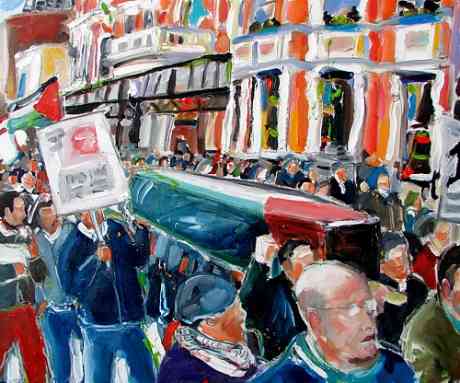
Coffin
These paintings are based on one Gaza demonstration that took place in January in Dublin. They encompass a wide range of symbols associated with the struggle of the Palestinians: the flag, speeches, symbolic coffin, the press and the Israeli Embassy.
Related Link: http://gaelart.net/gazademonstration.html
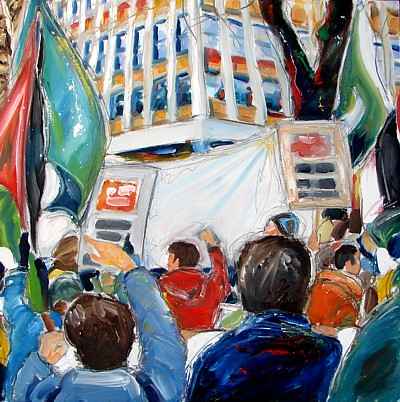
Embassy
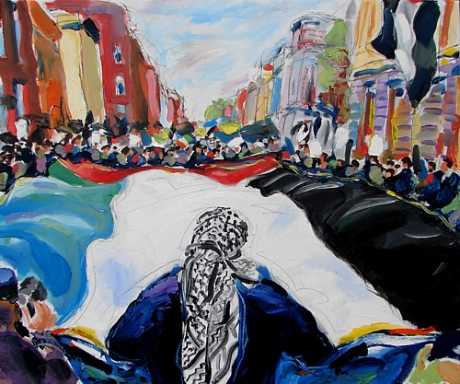
Flag
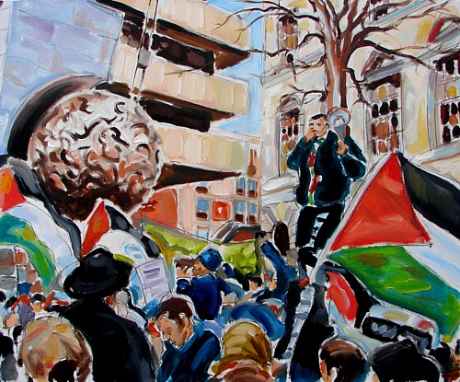
Speaker
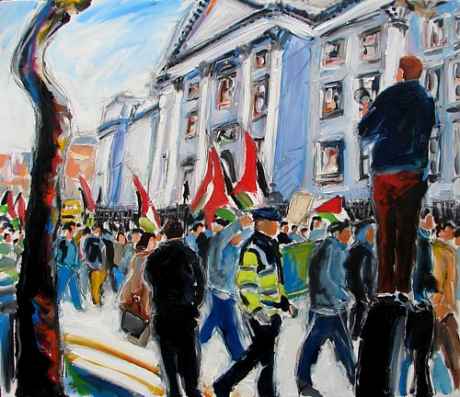
Trinity
The Democracy of Israel
The Democracy of Israel
by Rezbi on March 1, 2009
A look at (some of) the wonderfully democratic history of the state of Israel.
The Israelis regard it as a model for the World.
by Rezbi on March 1, 2009
A look at (some of) the wonderfully democratic history of the state of Israel.
The Israelis regard it as a model for the World.
Saturday, February 28, 2009

design by Jesus Barraza ©
CALL to JOIN
The U.S. Campaign for the Academic and Cultural Boycott of Israel Mission Statement:
Responding to the call of Palestinian civil society to join the Boycott, Divestment and Sanction movement against Israel, we are a U.S. campaign focused specifically on a boycott of Israeli academic and cultural institutions, as delineated by PACBI (Palestinian Campaign for the Academic and Cultural Boycott of Israel):
“In light of Israel’s persistent violations of international law, and Given that, since 1948, hundreds of UN resolutions have condemned Israel’s colonial and discriminatory policies as illegal and called for immediate, adequate and effective remedies, and Given that all forms of international intervention and peace-making have until now failed to convince or force Israel to comply with humanitarian law, to respect fundamental human rights and to end its occupation and oppression of the people of Palestine, and In view of the fact that people of conscience in the international community have historically shouldered the moral responsibility to fight injustice, as exemplified in the struggle to abolish apartheid in South Africa through diverse forms of boycott, divestment and sanctions;
Inspired by the struggle of South Africans against apartheid and in the spirit of international solidarity, moral consistency and resistance to injustice and oppression, We, representatives of Palestinian civil society, call upon international civil society organizations and people of conscience all over the world to impose broad boycotts and implement divestment initiatives against Israel similar to those applied to South Africa in the apartheid era. We appeal to you to pressure your respective states to impose embargoes and sanctions against Israel. We also invite conscientious Israelis to support this Call, for the sake of justice and genuine peace.
These non-violent punitive measures should be maintained until Israel meets its obligation to recognize the Palestinian people’s inalienable right to self-determination and fully complies with the precepts of international law by:
1. Ending its occupation and colonization of all Arab lands and dismantling the Wall;
2. Recognizing the fundamental rights of the Arab-Palestinian citizens of Israel to full equality; and
3. Respecting, protecting and promoting the rights of Palestinian refugees to return to their homes and properties as stipulated in UN
resolution 194.”
[For more information: http://www.pacbi.org /campaign_statement.htm]
PACBI and the entire movement for boycott, divestment, and sanctions (representing the overwhelming majority among Palestinian civil society parties, unions, networks and organizations) emphasize fundamental Palestinian rights, sanctioned by international law and universal human rights principles that ought to be respected by Israel to end the boycott. We struggle to achieve an end to Israel’s three-tiered injustice and oppression:
1) occupation and colonization in the 1967-occupied Palestinian territory;
2) denial of the refugees’ rights, paramount among which is their right to return to their homes of origin, as per UN General Assembly Resolution 194; and 3) the system of racial discrimination, or apartheid, to which Palestinian (all non-Jewish) citizens of Israel are subjected to.
The principles guiding the PACBI campaign and the three goals outlined above are also points of unity for the US Campaign for the Academic and Cultural Boycott of Israel (USCACBI). We believe it is time to take a public, principled stance in support of equality, self-determination, human rights (including the right to education), and true democracy, especially in light of the censorship and silencing of the Palestine question in U.S. universities, as well as U.S. society at large. There can be no academic freedom in Israel/ Palestine unless all academics are free and all students are free to pursue their academic desires.
If you are committed to these principles of unity, and wish to work
on a campaign of boycotting academic and cultural institutions guided by this approach, please join our campaign. [See information below.]
Urgent Appeal:
We are also responding to the Open Letter to International Academic Institutions from the Right to Education campaign at Birzeit University in Palestine (January 17, 2009), calling on the international academic community, unions and students “to show support and solidarity with the people of Gaza by calling upon their respective governments to impose immediate boycott, divestment and sanctions against the state of Israel.”
Gaza is but the latest incident in a series of ongoing massacres–from Deir Yassin (1948 ) to Kafr Kassim (1956) to Jenin (2002) to the wars on Lebanon (from 1980s to 2006)—which demonstrate a pattern of violence by a state which will not end its violations of international law without international pressure. As academics working in the U.S., we wish to focus on campaigns in our universities and in institutions of higher education to advocate for compliance with the academic and cultural boycott, a movement that is growing internationally across all segments of global civil society.
This call for an academic and cultural boycott parallels the call in the non-academic world for divestment, boycott and sanctions by trade
unions, churches, and other civil society organizations in countries such as the United States, Canada, Italy, Ireland, Norway, the United Kingdom, Brazil, South Africa, and New Zealand.
Endorsement:
As educators and scholars of conscience in the United States, we fully support this call. We urge our colleagues, nationally, regionally, and internationally, to stand up against Israel’s ongoing scholasticide and to support the non-violent call for academic boycott, disinvestment, and sanctions.
If you wish to endorse this call for an academic and cultural boycott, please email us at: uscom4acbi [at] gmail.com. If you are willing to indicate your support publicly, please send us your name and institutional/organizational affiliation (for identification purposes only).
For more information on actions suggested by the boycott campaign,
please join one of the discussion groups linked on the top right-hand
corner of this website.
Actions you can take:
Since Israeli academic institutions (mostly state-controlled) and the vast majority of Israeli intellectuals and academics have either contributed directly to maintaining, defending or otherwise justifying
the above forms of oppression, or have been complicit in them through their silence, we call upon our colleagues to comprehensively and consistently boycott all Israeli academic and cultural institutions as a contribution to the struggle to end Israel’s occupation, colonization and system of apartheid, by engaging in the following actions. We aim at the full implementation of all these steps. However, recognizing that different actions may be feasible and appropriate under the many different academic and political circumstances that pertain in US institutions, we urge our colleagues to undertake as many of the following initiatives as possible:
1. Support Palestinian academic and cultural institutions directly without requiring them to partner with Israeli counterparts as an explicit or implicit condition for such support;
2. Encourage your university and college administrations to institute funding for scholarship sand fellowships for Palestinian students;
3. Request your administration/president to issue a public statement censuring Israeli destruction of and interference with Palestinian schools and universities, archives and research centers, both in Gaza and throughout occupied Palestine.
4. Work toward the condemnation of Israeli policies by pressing for resolutions to be adopted by academic, professional and cultural associations and organizations;
5. Organize teach-ins or similar events with campus and community organizations at which the campaign for the economic, cultural and academic boycott of Israel can be fully and openly discussed;
6. Refrain from participation in any form of academic and cultural cooperation, collaboration or joint projects with Israeli institutions;
7. Advocate a comprehensive boycott of Israeli institutions at the national and international levels, including suspension of all forms of funding and subsidies to these institutions;
8. Promote divestment and disinvestment from Israel by academic institutions, and place pressure on your own institution to suspend all ties with Israeli universities, including collaborative projects, study abroad, funding and exchanges.
http://usacbi.wordpress.com/
ISRAEL: Something bad is happening to us
Saturday, February 28, 2009
ISRAEL: Something bad is happening to us
Insomniac: Damn right.
http://www.haaretz.com/hasen/spages/957536.html
By Haaretz Editorial
Three years ago, the CBS television network broadcast photos of American soldiers abusing prisoners in the Abu Ghraib prison in Iraq. The horrifying pictures led to the trials of eight soldiers, dismissals and a storm of outrage in America. At the trial of one prison guard, who was sentenced to eight years in jail, a psychologist gave his evaluation: that the man was an entirely ordinary person, without any particular violent tendencies, who served as a guard for many years in civilian life but never behaved sadistically toward American prisoners. The situation of occupier and occupied, as opposed to that of citizen versus citizen, causes ordinary people to become violent and lose restraint. At Abu Ghraib, the trial found, there was institutionalized contempt at every level. The prison guards understood that "this is the way to behave here."
Last night, the investigative television program "Fact" broadcast pictures of our own Abu Ghraib affair. It is doubtful whether a country that has grown used to 40 years of occupation, and the stories that accompany it, will be shocked. We have become accustomed to treating the Palestinians as inferior people. Generations come and go, and new soldiers abuse the residents of occupied Hebron in almost the same manner. Stories similar to those broadcast last night were exposed by the Breaking the Silence group three years ago. The saying "occupation corrupts" has become a slogan of the left instead of a warning signal to everyone.
This time, it was regular soldiers in the Kfir Brigade. They exposed their backsides and sexual organs to Palestinians, pressed an electric heater to the face of a young boy, beat young boys senseless, recorded everything on their mobile phones and sent it to their friends. One of their "mischievous acts" was to test how long a Palestinian who was being choked could survive without breathing. When he passed out, the experiment was stopped. The soldiers described activities to "break the routine" that consisted entirely of abuse. It was enough for a boy "to look at us the wrong way" for him to be beaten.
Earlier, at the trial of First Lieutenant Yaakov Gigi, officers spoke of burnout, of "something bad happening to the brigade," of a Wild West, of a moral crisis. The commander of the brigade, Colonel Itai Virov, said "we failed on several parameters." His words reflect a denial of the depth of the failure. This continuing routine, far from the eyes of the commanders, must lead to a series of investigations, and perhaps to dismissals as well. It is unconscionable for the head of the Hebron Brigade, the division commander, the GOC Central Command and even the chief of staff to ignore the ongoing behavior of soldiers in the brigade responsible for routine security in the West Bank. Colonel Virov admitted that there was a conspiracy of silence in the brigade - in other words, a norm of abuse and its concealment. To change norms, one has to shock and be shocked, not be satisfied with a few imprisonments and empty words about a loss of values.
Perfectly ordinary people, as the American psychologist said of the Abu Ghraib abusers, are capable of behaving like monsters when they receive a message from the top that it is permissible to abuse, beat, choke, burn, make people miserable and generally do anything that man's evil genius is capable of inventing to others who are under their control. Something bad is happening to us, they are saying in the Kfir Brigade. That "something" is the occupation.
ISRAEL: Something bad is happening to us
Insomniac: Damn right.
http://www.haaretz.com/hasen/spages/957536.html
By Haaretz Editorial
Three years ago, the CBS television network broadcast photos of American soldiers abusing prisoners in the Abu Ghraib prison in Iraq. The horrifying pictures led to the trials of eight soldiers, dismissals and a storm of outrage in America. At the trial of one prison guard, who was sentenced to eight years in jail, a psychologist gave his evaluation: that the man was an entirely ordinary person, without any particular violent tendencies, who served as a guard for many years in civilian life but never behaved sadistically toward American prisoners. The situation of occupier and occupied, as opposed to that of citizen versus citizen, causes ordinary people to become violent and lose restraint. At Abu Ghraib, the trial found, there was institutionalized contempt at every level. The prison guards understood that "this is the way to behave here."
Last night, the investigative television program "Fact" broadcast pictures of our own Abu Ghraib affair. It is doubtful whether a country that has grown used to 40 years of occupation, and the stories that accompany it, will be shocked. We have become accustomed to treating the Palestinians as inferior people. Generations come and go, and new soldiers abuse the residents of occupied Hebron in almost the same manner. Stories similar to those broadcast last night were exposed by the Breaking the Silence group three years ago. The saying "occupation corrupts" has become a slogan of the left instead of a warning signal to everyone.
This time, it was regular soldiers in the Kfir Brigade. They exposed their backsides and sexual organs to Palestinians, pressed an electric heater to the face of a young boy, beat young boys senseless, recorded everything on their mobile phones and sent it to their friends. One of their "mischievous acts" was to test how long a Palestinian who was being choked could survive without breathing. When he passed out, the experiment was stopped. The soldiers described activities to "break the routine" that consisted entirely of abuse. It was enough for a boy "to look at us the wrong way" for him to be beaten.
Earlier, at the trial of First Lieutenant Yaakov Gigi, officers spoke of burnout, of "something bad happening to the brigade," of a Wild West, of a moral crisis. The commander of the brigade, Colonel Itai Virov, said "we failed on several parameters." His words reflect a denial of the depth of the failure. This continuing routine, far from the eyes of the commanders, must lead to a series of investigations, and perhaps to dismissals as well. It is unconscionable for the head of the Hebron Brigade, the division commander, the GOC Central Command and even the chief of staff to ignore the ongoing behavior of soldiers in the brigade responsible for routine security in the West Bank. Colonel Virov admitted that there was a conspiracy of silence in the brigade - in other words, a norm of abuse and its concealment. To change norms, one has to shock and be shocked, not be satisfied with a few imprisonments and empty words about a loss of values.
Perfectly ordinary people, as the American psychologist said of the Abu Ghraib abusers, are capable of behaving like monsters when they receive a message from the top that it is permissible to abuse, beat, choke, burn, make people miserable and generally do anything that man's evil genius is capable of inventing to others who are under their control. Something bad is happening to us, they are saying in the Kfir Brigade. That "something" is the occupation.
Suspend EU-Israel Association Agreement
Target: The European Parliament, The European Union
Sponsored by: The Peace Cycle
Note: English first, French follows.
We call on the EU to suspend the EU-Israel Association Agreement until Israel respects human rights and International Law.
The EU is Israel's biggest importer of goods, and its second biggest exporter. In 2006 the total traded between the EU and Israel amounted to 23.5 BILLION Euros.
The EU-Israel Association Agreement forms the legal basis for this relationship which gives Israel preferential trade terms with EU countries.
Article 2 of the Agreement states that these relations shall be based on respect for human rights and democratic principles which must guide internal and international policy.
The EU is therefore obligated under this Article to suspend the EU-Israel Association Agreement whilst Israel is in breach of human rights.
The Peace Cycle has travelled to the Occupied Palestinian Territories and witnessed first hand the many abuses of human rights by the Israeli Authorities, including:
** Loss of freedom of movement of the Palestinian people by the placement of checkpoints and earth mounds at strategic locations within the Occupied Territories, making travel between villages and towns often impossible and inhibiting the movement of trade across the territories.
** Israeli-only roads that prohibit use by Palestinian cars and passengers thereby making their journeys far longer than necessary, and often impossible.
** Demolition of Palestinian houses by the Israeli authorities resulting in the heartbreaking loss of family homes and possessions, and destroying their sense of security and belonging.
** Theft of Palestinian land in order to build the separation wall; a barrier deemed illegal by the International Court of Justice, and which has served to further limit freedom of movement and cause loss of trade, resulting in high unemployment and extreme poverty levels.
** Refugee camps where families have been waiting for sixty years to return to their lost homes or to have compensation addressed.
** The uprooting of millions of olive trees, a symbol of Palestinian life, to make way for continuous Israeli settlement building on stolen Palestinian lands, despite the settlements having been deemed illegal and even though cessation of this activity is clearly defined in the latest peace initiative at Annapolis.
** Countless more acts of Israeli aggression towards the Palestinian people, which continue daily, and remain unchallenged on the pretext of security.
What the Peace Cycle has witnessed illustrates the abuses of human rights that at different times over many years have been judged to be illegal by international courts across the world. Yet the EU does nothing visible to bring Israel to account. Whilst this abuse goes on, the EU-Israel Association Agreement has allowed trade with Israel to flourish, with the addition of the EU-Israel Action Plan in 2005-2008 that has allowed for even closer partnerships to develop.
We call for an immediate suspension of the EU-Israel Association Agreement and any further trade between Israel and EU Member States in protest against Israel's continued violation of human rights of the Palestinian people.
This measure of protest should be maintained until Israel ends the illegal occupation of the Occupied Palestinian Territories and the siege of Gaza and fully complies with international human rights law.
THE PEACE CYCLE WILL PERSONALLY HAND THIS PETITION TO THE EUROPEAN PARLIAMENT, BRUSSELS, ON TUESDAY 31ST MARCH 2009
http://www.thepeacecycle.com/
Nous demandons a l'UE de suspendre l'Accord d'Association UE - Israel jusqu'a ce qu Israel respecte des droits de l'homme et le droit international.
Israel est le plus grand importateur de marchandises e l'UE, et son deuxieme plus grand exportateur. En 2006 le total commercialise entre l'UE et Israel s'est eleve a 23.5 milliards d'euros. L'Accord d'Association UE - Israel forme la base juridique de cette relation donnant a Israel un cadre commercial preferentiel avec des pays de l'UE. L'article 2 de l'Accord mentionne que ces relations doivent etre basees sur le respect des droits de l'homme et des principes democratiques qui doivent guider la politique interne et internationale.
L'UE est donc obligee selon cet Article de suspendre l'accord d'association UE - Israel tant qu'Israel est en infraction vis a vis des droits de l'homme.
Les velos de la paix ont voyage dans territoires palestiniens occupes et ont ete temoin directs de nombreux abus des droits de l'homme par les autorites israeliennes, incluant :
** Perte de la liberte de circulation des Palestiniennes a cause de la mise en place de points de controle et de monticules de la terre aux endroits strategiques a l'interieur des territoires occupes, rendant le voyage entre les villages et les villes souvent impossibles et empechant le mouvement du commerce dans les territoires.
** Routes permises seulement aux Israeliens, interdites aux voitures palestiniennes et a leurs passagers rendant leur trajets bien plus long que necessaire, et souvent impossible.
** Demolition des maisons palestiniennes par les autorites israeliennes ayant pour resultat la perte dechirante de maisons familiales et de possessions, detruisant leur sensation de securite et d'appartenance.
** Vol des terre palestiniennes afin de construire le mur de separation ; une barriere consideree illegale par la Cour internationale de Justice, et qui a servi a limiter encore davantage la libre circulation, causant la mort du commerce, resultant en un taux de chomage eleve et des seuils de pauvrete extremes.
** Camps de refugie ou des familles attendent depuis soixante ans pour retourner a leurs maisons perdues ou pour recevoir une compensation.
** Le deracinement de millions d'oliviers, symbole de la vie palestinienne, pour faire la place a la colonisation continue israelienne sur les terres palestiniennes volees, bien que les colonies soient considerees illagales et meme si l'arret de cette activite est clairement definie dans la derniere initiative de paix a Annapolis.
** Innombrables actes d'agression israelienne envers les palestiniens, qui continuent quotidiennement, et demeurent incontestes sous pretexte de securite.
Nous reclamons une suspension immediate de l'Accord d'Association UE - Israel et de tous autres commerces entre Israel et les Etats membres de d'UE en protestation contre les violations continues des droits de l'homme des palestiniens par Israel.
Cette mesure de protestation devra etre maintenue jusqu'a ce qu'Israel mette fin a l'occupation illagale des territoires palestiniens occupes et au siege de Gaza et respecte entierement le droit international de droits de l'homme.
http://www.thepeacecycle.com/
We the undersigned call for an immediate suspension of the EU-Israel Association Agreement and any further trade between Israel and EU Member States in protest against Israels continued violation of human rights of the Palestinian people.
The EU-Israel Association Agreement forms the legal basis for trade between the EU and Israel.
Article 2 of the Agreement states that these relations shall be based on respect for human rights and democratic principles which must guide internal and international policy.
The EU is therefore obligated under this Article to suspend the EU-Israel Association Agreement whilst Israel is in breach of human rights.
We, the Peace Cycle, have travelled to the Occupied Palestinian Territories and witnessed first hand the many abuses of human rights by the Israeli Authorities, including:
%uFFFD Loss of freedom of movement of the Palestinian people by the placement of checkpoints and earth mounds at strategic locations within the Occupied Territories, making travel between villages and towns often impossible and inhibiting the movement of trade across the territories.
%uFFFD Israeli-only roads that prohibit use by Palestinian cars and passengers thereby making their journeys far longer than necessary, and often impossible.
%uFFFD Demolition of Palestinian houses by the Israeli authorities resulting in the heartbreaking loss of family homes and possessions, and destroying their sense of security and belonging.
%uFFFD Theft of Palestinian land in order to build the separation wall; a barrier deemed illegal by the International Court of Justice, and which has served to further limit freedom of movement and cause loss of trade, resulting in high unemployment and extreme poverty levels.
%uFFFD Refugee camps where families have been waiting for sixty years to return to their lost homes or to have compensation addressed.
%uFFFD The uprooting of millions of olive trees, a symbol of Palestinian life, to make way for continuous Israeli settlement building on stolen Palestinian lands, despite the settlements having been deemed illegal and even though cessation of this activity is clearly defined in the latest peace initiative at Annapolis.
%uFFFD Countless more acts of Israeli aggression towards the Palestinian people, which continue daily, and remain unchallenged on the pretext of security.
What the Peace Cycle has witnessed illustrates the abuses of human rights that at different times over many years have been judged to be illegal by international courts across the world. Yet the EU does nothing visible to bring Israel to account. Whilst this abuse goes on, the EU-Israel Association Agreement has allowed trade with Israel to flourish, with the addition of the EU-Israel Action Plan in 2005-2008 that has allowed for even closer partnerships to develop.
We believe the EU has a duty to uphold International Human Rights Law, and therefore it should suspend the EU-Israel Association Agreement, and this measure of protest should be maintained until Israel ends the illegal occupation of the Occupied Palestinian Territories and the siege of Gaza and fully complies with international human rights law.
The Peace Cycle will personally deliver this petition to the European Parliament in Brussels on Tuesday 31st March 2009.
Thank you for taking the time to read this petition.
http://www.thepeacecycle.com/
signature goal: 25,000
14,391 signatures!
Sponsored by: The Peace Cycle
Note: English first, French follows.
We call on the EU to suspend the EU-Israel Association Agreement until Israel respects human rights and International Law.
The EU is Israel's biggest importer of goods, and its second biggest exporter. In 2006 the total traded between the EU and Israel amounted to 23.5 BILLION Euros.
The EU-Israel Association Agreement forms the legal basis for this relationship which gives Israel preferential trade terms with EU countries.
Article 2 of the Agreement states that these relations shall be based on respect for human rights and democratic principles which must guide internal and international policy.
The EU is therefore obligated under this Article to suspend the EU-Israel Association Agreement whilst Israel is in breach of human rights.
The Peace Cycle has travelled to the Occupied Palestinian Territories and witnessed first hand the many abuses of human rights by the Israeli Authorities, including:
** Loss of freedom of movement of the Palestinian people by the placement of checkpoints and earth mounds at strategic locations within the Occupied Territories, making travel between villages and towns often impossible and inhibiting the movement of trade across the territories.
** Israeli-only roads that prohibit use by Palestinian cars and passengers thereby making their journeys far longer than necessary, and often impossible.
** Demolition of Palestinian houses by the Israeli authorities resulting in the heartbreaking loss of family homes and possessions, and destroying their sense of security and belonging.
** Theft of Palestinian land in order to build the separation wall; a barrier deemed illegal by the International Court of Justice, and which has served to further limit freedom of movement and cause loss of trade, resulting in high unemployment and extreme poverty levels.
** Refugee camps where families have been waiting for sixty years to return to their lost homes or to have compensation addressed.
** The uprooting of millions of olive trees, a symbol of Palestinian life, to make way for continuous Israeli settlement building on stolen Palestinian lands, despite the settlements having been deemed illegal and even though cessation of this activity is clearly defined in the latest peace initiative at Annapolis.
** Countless more acts of Israeli aggression towards the Palestinian people, which continue daily, and remain unchallenged on the pretext of security.
What the Peace Cycle has witnessed illustrates the abuses of human rights that at different times over many years have been judged to be illegal by international courts across the world. Yet the EU does nothing visible to bring Israel to account. Whilst this abuse goes on, the EU-Israel Association Agreement has allowed trade with Israel to flourish, with the addition of the EU-Israel Action Plan in 2005-2008 that has allowed for even closer partnerships to develop.
We call for an immediate suspension of the EU-Israel Association Agreement and any further trade between Israel and EU Member States in protest against Israel's continued violation of human rights of the Palestinian people.
This measure of protest should be maintained until Israel ends the illegal occupation of the Occupied Palestinian Territories and the siege of Gaza and fully complies with international human rights law.
THE PEACE CYCLE WILL PERSONALLY HAND THIS PETITION TO THE EUROPEAN PARLIAMENT, BRUSSELS, ON TUESDAY 31ST MARCH 2009
http://www.thepeacecycle.com/
Nous demandons a l'UE de suspendre l'Accord d'Association UE - Israel jusqu'a ce qu Israel respecte des droits de l'homme et le droit international.
Israel est le plus grand importateur de marchandises e l'UE, et son deuxieme plus grand exportateur. En 2006 le total commercialise entre l'UE et Israel s'est eleve a 23.5 milliards d'euros. L'Accord d'Association UE - Israel forme la base juridique de cette relation donnant a Israel un cadre commercial preferentiel avec des pays de l'UE. L'article 2 de l'Accord mentionne que ces relations doivent etre basees sur le respect des droits de l'homme et des principes democratiques qui doivent guider la politique interne et internationale.
L'UE est donc obligee selon cet Article de suspendre l'accord d'association UE - Israel tant qu'Israel est en infraction vis a vis des droits de l'homme.
Les velos de la paix ont voyage dans territoires palestiniens occupes et ont ete temoin directs de nombreux abus des droits de l'homme par les autorites israeliennes, incluant :
** Perte de la liberte de circulation des Palestiniennes a cause de la mise en place de points de controle et de monticules de la terre aux endroits strategiques a l'interieur des territoires occupes, rendant le voyage entre les villages et les villes souvent impossibles et empechant le mouvement du commerce dans les territoires.
** Routes permises seulement aux Israeliens, interdites aux voitures palestiniennes et a leurs passagers rendant leur trajets bien plus long que necessaire, et souvent impossible.
** Demolition des maisons palestiniennes par les autorites israeliennes ayant pour resultat la perte dechirante de maisons familiales et de possessions, detruisant leur sensation de securite et d'appartenance.
** Vol des terre palestiniennes afin de construire le mur de separation ; une barriere consideree illegale par la Cour internationale de Justice, et qui a servi a limiter encore davantage la libre circulation, causant la mort du commerce, resultant en un taux de chomage eleve et des seuils de pauvrete extremes.
** Camps de refugie ou des familles attendent depuis soixante ans pour retourner a leurs maisons perdues ou pour recevoir une compensation.
** Le deracinement de millions d'oliviers, symbole de la vie palestinienne, pour faire la place a la colonisation continue israelienne sur les terres palestiniennes volees, bien que les colonies soient considerees illagales et meme si l'arret de cette activite est clairement definie dans la derniere initiative de paix a Annapolis.
** Innombrables actes d'agression israelienne envers les palestiniens, qui continuent quotidiennement, et demeurent incontestes sous pretexte de securite.
Nous reclamons une suspension immediate de l'Accord d'Association UE - Israel et de tous autres commerces entre Israel et les Etats membres de d'UE en protestation contre les violations continues des droits de l'homme des palestiniens par Israel.
Cette mesure de protestation devra etre maintenue jusqu'a ce qu'Israel mette fin a l'occupation illagale des territoires palestiniens occupes et au siege de Gaza et respecte entierement le droit international de droits de l'homme.
http://www.thepeacecycle.com/
We the undersigned call for an immediate suspension of the EU-Israel Association Agreement and any further trade between Israel and EU Member States in protest against Israels continued violation of human rights of the Palestinian people.
The EU-Israel Association Agreement forms the legal basis for trade between the EU and Israel.
Article 2 of the Agreement states that these relations shall be based on respect for human rights and democratic principles which must guide internal and international policy.
The EU is therefore obligated under this Article to suspend the EU-Israel Association Agreement whilst Israel is in breach of human rights.
We, the Peace Cycle, have travelled to the Occupied Palestinian Territories and witnessed first hand the many abuses of human rights by the Israeli Authorities, including:
%uFFFD Loss of freedom of movement of the Palestinian people by the placement of checkpoints and earth mounds at strategic locations within the Occupied Territories, making travel between villages and towns often impossible and inhibiting the movement of trade across the territories.
%uFFFD Israeli-only roads that prohibit use by Palestinian cars and passengers thereby making their journeys far longer than necessary, and often impossible.
%uFFFD Demolition of Palestinian houses by the Israeli authorities resulting in the heartbreaking loss of family homes and possessions, and destroying their sense of security and belonging.
%uFFFD Theft of Palestinian land in order to build the separation wall; a barrier deemed illegal by the International Court of Justice, and which has served to further limit freedom of movement and cause loss of trade, resulting in high unemployment and extreme poverty levels.
%uFFFD Refugee camps where families have been waiting for sixty years to return to their lost homes or to have compensation addressed.
%uFFFD The uprooting of millions of olive trees, a symbol of Palestinian life, to make way for continuous Israeli settlement building on stolen Palestinian lands, despite the settlements having been deemed illegal and even though cessation of this activity is clearly defined in the latest peace initiative at Annapolis.
%uFFFD Countless more acts of Israeli aggression towards the Palestinian people, which continue daily, and remain unchallenged on the pretext of security.
What the Peace Cycle has witnessed illustrates the abuses of human rights that at different times over many years have been judged to be illegal by international courts across the world. Yet the EU does nothing visible to bring Israel to account. Whilst this abuse goes on, the EU-Israel Association Agreement has allowed trade with Israel to flourish, with the addition of the EU-Israel Action Plan in 2005-2008 that has allowed for even closer partnerships to develop.
We believe the EU has a duty to uphold International Human Rights Law, and therefore it should suspend the EU-Israel Association Agreement, and this measure of protest should be maintained until Israel ends the illegal occupation of the Occupied Palestinian Territories and the siege of Gaza and fully complies with international human rights law.
The Peace Cycle will personally deliver this petition to the European Parliament in Brussels on Tuesday 31st March 2009.
Thank you for taking the time to read this petition.
http://www.thepeacecycle.com/
signature goal: 25,000
14,391 signatures!
The Fifth Annual Israeli Apartheid Week March 1 - 8, 2009
The Fifth Annual Israeli Apartheid Week March 1 - 8, 2009
Mark your calendars - the 5th Annual Israeli Apartheid Week will take place across the globe from March 1-8, 2009!
First launched in Toronto in 2005, IAW has grown to become one of the most important global events in the Palestine solidarity calendar. Last year, more than 25 cities around the world participated in the week's activities, which also commemorated 60 years since the expulsion of the Palestinian people from their homes and land in 1947-1948. IAW 2008 was launched with a live broadcast from the South African township of Soweto by Palestinian leader and former member of the Israeli Knesset, Azmi Bishara.
This year, IAW occurs in the wake of Israel's barbaric assault against the people of Gaza. Lectures, films, and actions will make the point that these latest massacres further confirm the true nature of Israeli Apartheid. IAW 2009 will continue to build and strengthen the growing Boycott, Divestment, and Sanctions (BDS) movement at a global level.
http://apartheidweek.org/
Mark your calendars - the 5th Annual Israeli Apartheid Week will take place across the globe from March 1-8, 2009!
First launched in Toronto in 2005, IAW has grown to become one of the most important global events in the Palestine solidarity calendar. Last year, more than 25 cities around the world participated in the week's activities, which also commemorated 60 years since the expulsion of the Palestinian people from their homes and land in 1947-1948. IAW 2008 was launched with a live broadcast from the South African township of Soweto by Palestinian leader and former member of the Israeli Knesset, Azmi Bishara.
This year, IAW occurs in the wake of Israel's barbaric assault against the people of Gaza. Lectures, films, and actions will make the point that these latest massacres further confirm the true nature of Israeli Apartheid. IAW 2009 will continue to build and strengthen the growing Boycott, Divestment, and Sanctions (BDS) movement at a global level.
http://apartheidweek.org/
Gaza Digs Out

Kevin Frayer / AP
Gone
A family rests on the rubble of their home in Jebaliya.

Xinhua / Zuma
Punctured
Israeli strikes damaged the dome and minaret of this mosque in southern Gaza Sity.
Anja Niedringhaus / AP
Mourning
The cards on the desks in this classroom bear the names of children who were killed in the attacks.
Yannis Behrakis / Reuters
Landscape
A man and two women walk through the village of Mughraqa.
A woman hangs clothes on the balcony of her bullet-ridden apartment building.
Xinhua / Landov
Facade
A woman hangs clothes on the balcony of her bullet-ridden apartment building.
Anja Niedringhaus / AP
Wounded
Ansam Rahel, 10, sustained a head injury in the attacks.
Kevin Frayer / AP
Chamber
Photographs lay among the debris inside the ruins of the Palestinian Legislative Council.
Patrick Baz / AFP / Getty
Lifeline
Before the attacks, the residents of Gaza relied on smuggling tunnels reaching
into Egypt for many of their supplies. Now that the attacks have abated, rebuilding them has become a top priority.
Patrick Baz / AFP / Getty
Border
A bulldozer removes rubble near a tunnel entrance at Rafah.
Kevin Frayer / AP
Gunman
A masked member of Hamas surveys the rubble of a house in Jebaliyah.
Kevin Frayer / AP
Smoldering
A Palestinian man sits in the ruins of his house in the northern Gaza Strip.
Fatah and Hamas: Heading for a Showdown in Lebanon
Fatah and Hamas: Heading for a Showdown in Lebanon
By Andrew Lee Butters and Rami Aysha
Beirut Thursday, Feb. 26, 2009

Hamas militants in Beirut demonstrate against the Israeli incursion in Gaza on Jan.4
Nabil Mounzer / EPA / Corbis
Stacks of portraits of Mahmoud Abbas stand unused, gathering dust in the office of his Fatah movement in Beirut's Shatila Palestinian refugee camp. Posters of Abbas – President of the Palestinian Authority, leader of Fatah and chairman of the Palestine Liberation Organization (PLO) – would normally hang in offices and on street corners throughout Lebanon's 12 Palestinian refugee camps. But ever since Israel's incursion into Gaza earlier this year, Abbas has become politically radioactive to the approximately 400,000 refugees languishing in Lebanon, who were livid at his failure to act in defense of the beleaguered Gazans. "Abbas embarrassed us," says one Fatah official charged with delivering Abbas portraits in the camp. "Sometimes we force people to take the posters, but they never put them up." But Abbas may be about to lose a lot more than pride of place for his portrait in the seething refugee camps.
The stack of unused posters is but a symptom of the collapse of support for Fatah in Lebanon, home to the most politically active population of Palestinians outside the West Bank and Gaza. It was the movement's traditional support there that underscored Abbas' mandate, as chairman of the PLO, to negotiate on behalf of all Palestinians. But the failure of Abbas' negotiation strategy to deliver any meaningful change for the prospects of Lebanon's Palestinian refugees has led many — like their kin in the West Bank and Gaza — to transfer their support to Hamas and other radical Islamist groups. (See pictures of Lebanon in crisis.)
The refugees of Lebanon have always been more militant than their brethren inside the Palestinian territories. Most are descendants of those who fled Israeli forces in Galilee during the war of 1948; since then they have been prevented by Israel from returning to their homes. Having lived for six decades without citizenship or basic civil rights in the squalor and despair of refugee camps in a country that bars refugees from owning property and from entering some 70 professions, they have long provided a fertile recruiting environment for militant groups.
Even Abbas' more popular predecessor as Fatah leader, Yassir Arafat, struggled to sell the Oslo peace process to his supporters in Lebanon, where members of Fatah remained committed to armed struggle to "liberate Palestine" and still run guerrilla-training academies. These days, however, even that hard-line Fatah stance is no longer enough for most Palestinians here. High-ranking officials of Abbas' own party fear that he will trade away their right of return to what is now Israel. "Yassir Arafat went into negotiations with the olive branch in one hand and a weapon in the other hand," says one Beirut Fatah commander. "But all Mahmoud Abbas does is negotiate. He gets nothing, but he keeps negotiating. Palestinians believe in military operations because they want to go back to Palestine. They don't want to negotiate." (Read "After Israel's Election, Palestinians Weigh New Intifadeh.")
Hamas, meanwhile, is continuing to grow. The movement uses its financial backing from Iran and other countries to build clinics, kindergartens and social-services centers in every camp. Hamas supporters also get vouchers for medical care at hospitals run by Hizballah, the Lebanese anti-Israeli militant group that's also supported by Iran. And the refugees hear stories about leaders in the West Bank growing rich from embezzled international aid, while refugees see almost nothing in social services from the Palestinian Authority, which is controlled by Fatah. "Fatah isn't helping people," says the Beirut Fatah commander. "Hamas is taking advantage of this. They are entering deep, deep into the population."
By Andrew Lee Butters and Rami Aysha
Beirut Thursday, Feb. 26, 2009

Hamas militants in Beirut demonstrate against the Israeli incursion in Gaza on Jan.4
Nabil Mounzer / EPA / Corbis
Stacks of portraits of Mahmoud Abbas stand unused, gathering dust in the office of his Fatah movement in Beirut's Shatila Palestinian refugee camp. Posters of Abbas – President of the Palestinian Authority, leader of Fatah and chairman of the Palestine Liberation Organization (PLO) – would normally hang in offices and on street corners throughout Lebanon's 12 Palestinian refugee camps. But ever since Israel's incursion into Gaza earlier this year, Abbas has become politically radioactive to the approximately 400,000 refugees languishing in Lebanon, who were livid at his failure to act in defense of the beleaguered Gazans. "Abbas embarrassed us," says one Fatah official charged with delivering Abbas portraits in the camp. "Sometimes we force people to take the posters, but they never put them up." But Abbas may be about to lose a lot more than pride of place for his portrait in the seething refugee camps.
The stack of unused posters is but a symptom of the collapse of support for Fatah in Lebanon, home to the most politically active population of Palestinians outside the West Bank and Gaza. It was the movement's traditional support there that underscored Abbas' mandate, as chairman of the PLO, to negotiate on behalf of all Palestinians. But the failure of Abbas' negotiation strategy to deliver any meaningful change for the prospects of Lebanon's Palestinian refugees has led many — like their kin in the West Bank and Gaza — to transfer their support to Hamas and other radical Islamist groups. (See pictures of Lebanon in crisis.)
The refugees of Lebanon have always been more militant than their brethren inside the Palestinian territories. Most are descendants of those who fled Israeli forces in Galilee during the war of 1948; since then they have been prevented by Israel from returning to their homes. Having lived for six decades without citizenship or basic civil rights in the squalor and despair of refugee camps in a country that bars refugees from owning property and from entering some 70 professions, they have long provided a fertile recruiting environment for militant groups.
Even Abbas' more popular predecessor as Fatah leader, Yassir Arafat, struggled to sell the Oslo peace process to his supporters in Lebanon, where members of Fatah remained committed to armed struggle to "liberate Palestine" and still run guerrilla-training academies. These days, however, even that hard-line Fatah stance is no longer enough for most Palestinians here. High-ranking officials of Abbas' own party fear that he will trade away their right of return to what is now Israel. "Yassir Arafat went into negotiations with the olive branch in one hand and a weapon in the other hand," says one Beirut Fatah commander. "But all Mahmoud Abbas does is negotiate. He gets nothing, but he keeps negotiating. Palestinians believe in military operations because they want to go back to Palestine. They don't want to negotiate." (Read "After Israel's Election, Palestinians Weigh New Intifadeh.")
Hamas, meanwhile, is continuing to grow. The movement uses its financial backing from Iran and other countries to build clinics, kindergartens and social-services centers in every camp. Hamas supporters also get vouchers for medical care at hospitals run by Hizballah, the Lebanese anti-Israeli militant group that's also supported by Iran. And the refugees hear stories about leaders in the West Bank growing rich from embezzled international aid, while refugees see almost nothing in social services from the Palestinian Authority, which is controlled by Fatah. "Fatah isn't helping people," says the Beirut Fatah commander. "Hamas is taking advantage of this. They are entering deep, deep into the population."
Could Israelis Face War Crimes Charges Over Gaza?
By Tim McGirk
Jerusalem Friday, Jan. 23, 2009

A child's shoe in a classroom at the UN school that was hit by an Israeli strike on January 17, 2009.
Israel likes to believe that its Defense Force is the world's most "moral" army, and it insisted throughout the recent Gaza war that great care was always taken to avoid inflicting civilian casualties. It may surprise and rile many Israelis, then, that their government is trying to protect its citizens from war crimes charges that could be filed in foreign courts over the conduct of hostilities in Gaza. Fearful that Israeli commanders could be targeted for arrest while traveling abroad as private citizens on business or vacation, Attorney General Menachem Mazuz on Tuesday ordered the Israeli media to refrain from revealing the names of any military personnel who took part in the 22-day offensive. Officers involved in the operation who want to travel abroad are now required to first check in with the office of the Judge Advocate, which will determine if the soldier is on a foreign watch list that might lead to his arrest.
Israeli military experts insist that their forces are far more careful to avoid civilian casualties than, say, the U.S. military has been in Iraq and Afghanistan. Still, the high civilian casualty toll in Gaza has put the Israeli military's conduct of operations there under scrutiny, and one senior U.N. official has suggested Israel may have committed "crimes against humanity" in the course of its campaign against Hamas militants hiding among Gaza's civilian population. Palestinian medical sources claim that over 300 children and 100 women were among Gaza's 1,200 fatalities. And the United Nations, Amnesty International, the International Committee for the Red Cross (I.C.R.C.), Human Right Watch, as well as Israeli and Palestinian human rights groups have all been investigating allegations of conduct that violates the laws of war. (See pictures of Israel's ground offensive in Gaza)
Among the allegations being probed are claims that Israel targeted ambulances and medical crews, improperly used incendiary bombs such as white phosphorus in dense civilian areas (a claim also being internally investigated by the Israeli military), prevented the evacuation of wounded carrying white flags, and targeted schools, hospitals, supply convoys and a U.N. compound where over 1,000 civilians had taken shelter. Although Israel dropped thousands of leaflets and made phone calls to targeted buildings warning of impending bombardments, Palestinians argue that they had no safe places in which to take refuge amid Israel's fierce bombardment.
Legal experts doubt that Israelis could be hauled before the International Court of Justice in the Hague, because Israel, like the U.S., is not party to the treaty that created it, and also because the U.S. and European governments would likely prevent such a course of action. What worries authorities in Jerusalem is that many European countries are signatories to a Geneva Convention that allows their courts to arrest and prosecute individuals accused of committing war crimes in other countries. Such legal options, Israel fears, may be used to bring politically motivated charges against its citizens. The daily Yedioth Ahronoth reported Wednesday that Israel's Foreign and Justice ministries have begun drawing up lists of law firms in different European countries that could be enlisted to defend Israelis in any future cases.
Another influential newspaper, the leftist Haaretz, even urged Prime Minister Ehud Olmert to set up an independent inquiry into accusations of war crimes by the Israeli military in Gaza. "Has the IDF (the Israeli Defense Forces) crossed the line according to international law?" the paper wrote. "Was there no other way aside from such widespread killing and destruction?" The editorial argued that Israel needed its own inquiry because "We cannot wait until the world has its say, and perhaps takes legal steps of its own."
Any international inquiry into Israel's wartime behavior might be more palatable to Israelis if it also probed alleged violations of the Geneva Convention by Hamas. Before and during the conflict, Hamas had fired shot rockets into Israeli towns; inside Gaza, according to the Israeli army, the militants had used civilians as "human shields," and had stored weapons in schools, hospitals and mosques — all illegal under Geneva.
But regardless of whether any legal action follows, the probes add to the pall of bitterness hanging over an operation whose ambiguous outcome has left many Israelis questioning just what was achieved by their war in Gaza.
Jerusalem Friday, Jan. 23, 2009

A child's shoe in a classroom at the UN school that was hit by an Israeli strike on January 17, 2009.
Israel likes to believe that its Defense Force is the world's most "moral" army, and it insisted throughout the recent Gaza war that great care was always taken to avoid inflicting civilian casualties. It may surprise and rile many Israelis, then, that their government is trying to protect its citizens from war crimes charges that could be filed in foreign courts over the conduct of hostilities in Gaza. Fearful that Israeli commanders could be targeted for arrest while traveling abroad as private citizens on business or vacation, Attorney General Menachem Mazuz on Tuesday ordered the Israeli media to refrain from revealing the names of any military personnel who took part in the 22-day offensive. Officers involved in the operation who want to travel abroad are now required to first check in with the office of the Judge Advocate, which will determine if the soldier is on a foreign watch list that might lead to his arrest.
Israeli military experts insist that their forces are far more careful to avoid civilian casualties than, say, the U.S. military has been in Iraq and Afghanistan. Still, the high civilian casualty toll in Gaza has put the Israeli military's conduct of operations there under scrutiny, and one senior U.N. official has suggested Israel may have committed "crimes against humanity" in the course of its campaign against Hamas militants hiding among Gaza's civilian population. Palestinian medical sources claim that over 300 children and 100 women were among Gaza's 1,200 fatalities. And the United Nations, Amnesty International, the International Committee for the Red Cross (I.C.R.C.), Human Right Watch, as well as Israeli and Palestinian human rights groups have all been investigating allegations of conduct that violates the laws of war. (See pictures of Israel's ground offensive in Gaza)
Among the allegations being probed are claims that Israel targeted ambulances and medical crews, improperly used incendiary bombs such as white phosphorus in dense civilian areas (a claim also being internally investigated by the Israeli military), prevented the evacuation of wounded carrying white flags, and targeted schools, hospitals, supply convoys and a U.N. compound where over 1,000 civilians had taken shelter. Although Israel dropped thousands of leaflets and made phone calls to targeted buildings warning of impending bombardments, Palestinians argue that they had no safe places in which to take refuge amid Israel's fierce bombardment.
Legal experts doubt that Israelis could be hauled before the International Court of Justice in the Hague, because Israel, like the U.S., is not party to the treaty that created it, and also because the U.S. and European governments would likely prevent such a course of action. What worries authorities in Jerusalem is that many European countries are signatories to a Geneva Convention that allows their courts to arrest and prosecute individuals accused of committing war crimes in other countries. Such legal options, Israel fears, may be used to bring politically motivated charges against its citizens. The daily Yedioth Ahronoth reported Wednesday that Israel's Foreign and Justice ministries have begun drawing up lists of law firms in different European countries that could be enlisted to defend Israelis in any future cases.
Another influential newspaper, the leftist Haaretz, even urged Prime Minister Ehud Olmert to set up an independent inquiry into accusations of war crimes by the Israeli military in Gaza. "Has the IDF (the Israeli Defense Forces) crossed the line according to international law?" the paper wrote. "Was there no other way aside from such widespread killing and destruction?" The editorial argued that Israel needed its own inquiry because "We cannot wait until the world has its say, and perhaps takes legal steps of its own."
Any international inquiry into Israel's wartime behavior might be more palatable to Israelis if it also probed alleged violations of the Geneva Convention by Hamas. Before and during the conflict, Hamas had fired shot rockets into Israeli towns; inside Gaza, according to the Israeli army, the militants had used civilians as "human shields," and had stored weapons in schools, hospitals and mosques — all illegal under Geneva.
But regardless of whether any legal action follows, the probes add to the pall of bitterness hanging over an operation whose ambiguous outcome has left many Israelis questioning just what was achieved by their war in Gaza.
Heartbreak in the Middle East

An Israeli armored personnel carriers move in a field near the border. On Tuesday, January 6, Israel began its fourth day of ground operations in the Gaza Strip.

Palestinians search for bodies in a house destroyed by an Israeli missile strike. According to reports, nearly 600 Palestinians have been killed since Israel launched its 11-day offensive against Hamas in the Gaza Strip.

An Israeli woman walks under the damaged roof of a temporarily closed food market minutes it was hit by a rocket fired by from the Palestinian side of the border.

Medics wheel a Palestinian man wounded in an Israeli strike into Shifa hospital.

An Israeli soldier cries during the funeral for Staff Sergeant Nitai Stern, 21, at the Mount Herzl Military Cemetery.

Jabaliya, Gaza
Relatives mourn a Palestinian killed in an Israeli strike on a United Nations school, where hundreds had sought sanctuary from the attacks. According to the UN, 30 people were killed in the attack.

Sderot, Israel
An Israeli soldier talks with women at the entrance to a bomb shelter in southern Israel.

Gaza City, Gaza
Smoke rises through the sunset on Tuesday. Inside Gaza City, electricity has been shut off and drinking water has become increasingly scarce.

Gaza Border
Israeli Army soldiers take cover as a mobile artillery piece fires towards targets in the southern Gaza Strip.

Jabaliya, Gaza
Palestinians survey the damage caused by an Israeli air strike near the United Nations school.

Sderot, Israel
An Orthodox Jew investigates the scene of a Palestinian rocket attack.

Rafah, Gaza
Palestinians gather in the rubble of a building following an Israeli air strike.

Gaza City, Gaza
A frantic relative of an injured Palestinian arrives at the Shifa hospital.

Jerusalem, Israel
Mourners gather for the funeral procession of Staff Sgt. Dvir Emanueloff, killed during the fighting in Gaza, at Mount Herzl military cemetery.
Palestinians in Lebanon: A Forgotten People
Palestinians in Lebanon: A Forgotten People
By Andrew Lee Butters / Beirut Wednesday, Feb. 25, 2009

SHATTERED LIVES: Families live among ruins, with little hope of ever leaving
Photograph for TIME by Kate Brooks
he ancient hills of Lebanon hold little charm for Abdullah Sulhani and his family. Though they live just a bus ride away from some of the most pleasant countryside on the eastern Mediterranean, they don't dare go out for a picnic or family day trip. This is an exaggerated reading of the risks of living in Lebanon — a turbulent country no doubt, but one which, when not a war zone, is the vacation destination of choice for the Arab world. Sulhani, 85, is Palestinian, though, and his family lives in Shatila, an impoverished refugee camp on the edge of Beirut. Many Lebanese eat, drink and dance away memories of the violent past. But in the dank, swastika-graffitied alleyways of the camps, where four generations of Palestinians have come of age, there's little chance of forgetting. For most of the 220,000 Palestinians living in refugee camps in Lebanon, time has stopped.
More Related
* Fatah and Hamas: Heading for a Showdown in Lebanon
* The Link Between Lebanon and Gaza
* Beirut Finally Routs Bin Laden’s Allies
Sulhani fled his home in Galilee for Beirut in 1948 — the year Israel was founded. Since then, there have been six wars and dozens of violent upheavals in Lebanon, and more often than not Sulhani's family has been caught in the middle. Abdullah's 59-year-old daughter Ahlam is still picking shrapnel out of wounds she received from artillery fire in 1975. The family survived the infamous Shatila massacre of 1982 by sheer luck, fleeing from Lebanese militiamen almost as soon as the slaughter began. When they returned afterwards, most of their neighbors were dead, and there was a body in the living-room closet. One of Ahlam's brothers was later shot in the head by a sniper while washing his hands in their entryway. Their building has been destroyed five times. They keep rebuilding because there's nowhere else to go. (Read "Fatah and Hamas: Heading for a Showdown in Lebanon".)
The recent Israeli operation in Gaza refocused attention on the plight of the thousands of ordinary Palestinians caught between Islamic militant group Hamas and Israel's overwhelming military force. But the Palestinians living in the territories of Gaza and the West Bank aren't the only ones trapped. Like many Palestinians forced from their homes after Israel's birth, Sulhani still has his old house keys. Tax records from the British mandate of Palestine are stored carefully in a schoolgirl's plastic binder. But while a 1948 United Nations resolution calls for Palestinians' "right to return," all who have seriously thought about peace in the Middle East know that Israel will never accept the 4.6 million Palestinian refugees registered with the United Nations in places such as Jordan, Lebanon, Syria, Gaza and the West Bank. Such a demographic tidal wave would sink the Jewish state.
That leaves families such as the Sulhanis caught between a past they can't escape and a future they struggle to shape, renting out the top floors of their building — which technically they don't even own. Like the rest of the 400,000-odd Palestinians in Lebanon, they cannot legally buy a house or apartment and remain barred from some 70 professions. Lebanon's fragile sectarian political system, balanced between Christians and Muslims, has been unable or unwilling to absorb so many Muslim refugees. So neither Sulhani, nor his children, nor his grandchildren, nor his great-grandchildren have Lebanese citizenship, despite the fact that all but the family patriarch were born on Lebanese soil. "My life in this country has been one heartbreak after another," says daughter Ahlam. "I have no good memories."
Jihadi Breeding Grounds
Younger generations have acquired traumas of their own. Nahr al-Bared was once the most pleasant Palestinian camp in Lebanon, located near the northern city of Tripoli where a cold mountain stream meets the sea, and surrounded by orange orchards and banana plantations. Now it is a miniature Stalingrad on the Mediterranean. An uprising in the summer of 2007 by an insurgent jihadist group, Fatah al-Islam, reduced Nahr al-Bared to rubble and made its 31,000 residents homeless. Though most Fatah al-Islam members were not Palestinians but foreign Arabs from places such as Iraq and Saudi Arabia, the lawlessness of the camps — which lie outside the authority of the Lebanese state — make them excellent incubators for extremist groups. And the concrete jungle of Nahr al-Bared was the perfect urban-warfare environment. Just 300 jihadis held their own against more than 11,000 Lebanese army troops for four months.
By Andrew Lee Butters / Beirut Wednesday, Feb. 25, 2009

SHATTERED LIVES: Families live among ruins, with little hope of ever leaving
Photograph for TIME by Kate Brooks
he ancient hills of Lebanon hold little charm for Abdullah Sulhani and his family. Though they live just a bus ride away from some of the most pleasant countryside on the eastern Mediterranean, they don't dare go out for a picnic or family day trip. This is an exaggerated reading of the risks of living in Lebanon — a turbulent country no doubt, but one which, when not a war zone, is the vacation destination of choice for the Arab world. Sulhani, 85, is Palestinian, though, and his family lives in Shatila, an impoverished refugee camp on the edge of Beirut. Many Lebanese eat, drink and dance away memories of the violent past. But in the dank, swastika-graffitied alleyways of the camps, where four generations of Palestinians have come of age, there's little chance of forgetting. For most of the 220,000 Palestinians living in refugee camps in Lebanon, time has stopped.
More Related
* Fatah and Hamas: Heading for a Showdown in Lebanon
* The Link Between Lebanon and Gaza
* Beirut Finally Routs Bin Laden’s Allies
Sulhani fled his home in Galilee for Beirut in 1948 — the year Israel was founded. Since then, there have been six wars and dozens of violent upheavals in Lebanon, and more often than not Sulhani's family has been caught in the middle. Abdullah's 59-year-old daughter Ahlam is still picking shrapnel out of wounds she received from artillery fire in 1975. The family survived the infamous Shatila massacre of 1982 by sheer luck, fleeing from Lebanese militiamen almost as soon as the slaughter began. When they returned afterwards, most of their neighbors were dead, and there was a body in the living-room closet. One of Ahlam's brothers was later shot in the head by a sniper while washing his hands in their entryway. Their building has been destroyed five times. They keep rebuilding because there's nowhere else to go. (Read "Fatah and Hamas: Heading for a Showdown in Lebanon".)
The recent Israeli operation in Gaza refocused attention on the plight of the thousands of ordinary Palestinians caught between Islamic militant group Hamas and Israel's overwhelming military force. But the Palestinians living in the territories of Gaza and the West Bank aren't the only ones trapped. Like many Palestinians forced from their homes after Israel's birth, Sulhani still has his old house keys. Tax records from the British mandate of Palestine are stored carefully in a schoolgirl's plastic binder. But while a 1948 United Nations resolution calls for Palestinians' "right to return," all who have seriously thought about peace in the Middle East know that Israel will never accept the 4.6 million Palestinian refugees registered with the United Nations in places such as Jordan, Lebanon, Syria, Gaza and the West Bank. Such a demographic tidal wave would sink the Jewish state.
That leaves families such as the Sulhanis caught between a past they can't escape and a future they struggle to shape, renting out the top floors of their building — which technically they don't even own. Like the rest of the 400,000-odd Palestinians in Lebanon, they cannot legally buy a house or apartment and remain barred from some 70 professions. Lebanon's fragile sectarian political system, balanced between Christians and Muslims, has been unable or unwilling to absorb so many Muslim refugees. So neither Sulhani, nor his children, nor his grandchildren, nor his great-grandchildren have Lebanese citizenship, despite the fact that all but the family patriarch were born on Lebanese soil. "My life in this country has been one heartbreak after another," says daughter Ahlam. "I have no good memories."
Jihadi Breeding Grounds
Younger generations have acquired traumas of their own. Nahr al-Bared was once the most pleasant Palestinian camp in Lebanon, located near the northern city of Tripoli where a cold mountain stream meets the sea, and surrounded by orange orchards and banana plantations. Now it is a miniature Stalingrad on the Mediterranean. An uprising in the summer of 2007 by an insurgent jihadist group, Fatah al-Islam, reduced Nahr al-Bared to rubble and made its 31,000 residents homeless. Though most Fatah al-Islam members were not Palestinians but foreign Arabs from places such as Iraq and Saudi Arabia, the lawlessness of the camps — which lie outside the authority of the Lebanese state — make them excellent incubators for extremist groups. And the concrete jungle of Nahr al-Bared was the perfect urban-warfare environment. Just 300 jihadis held their own against more than 11,000 Lebanese army troops for four months.
Subscribe to:
Posts (Atom)