Clinton: Israel’s East Jerusalem home demolitions "unhelpful"
04/03/2009
Ramallah – Ma’an – US Secretary of State Hillary Clinton on Wednesday said Israel’s plan to demolish dozens of Palestinian homes in East Jerusalem is “unhelpful.”
"Clearly this kind of activity is unhelpful and not in keeping with the obligations entered into under the Road Map," Clinton said at a Ramallah news conference on Wednesday afternoon.
Israel’s Jerusalem Municipality is moving to demolish over 100 houses and remove the 140 families who live in the Palestinian neighborhood of Silwan in East Jerusalem. The decision is expected to lead to the forced displacement of more than 1,000 Palestinians from their family residences.
"It is an issue that we intend to raise with the government of Israel and the government at the municipal level in Jerusalem," she added, shortly after meeting with Palestinian President Mahmoud Abbas.
The US secretary of state said she would bring up the issue with the new Israeli government, likely to be headed by Likud Party chair Benyamin Netanyahu.
Clinton met earlier with Palestinian Prime Minister Salam Fayyad at the headquarters of the Council of Ministers in Ramallah, but no remarks were immediately available from that meeting.
Clinton arrived in Israel on Monday, where she met with the Israeli president, prime minister-designate and foreign minister, and insisted that America's policy remains a two-state solution to the Palestinian struggle for self-determination.
The US secretary of state said America’s assessment is “that eventually, the inevitability of working towards a two-state solution is inescapable."
The remarks came following meetings alongside both Israeli Prime Minister-designate Benyamin Netanyahu and Foreign Minister Tzipi Livni in Jerusalem on Tuesday.
On Wednesday Clinton reiterated that the United States would be “vigorously engaged” in the peace process, and that she would be “personally engaged.”
“I hold this mission in my heart, not just in my portfolio,” she said.
Netanyahu has historically rejected the creation of a Palestinian state, which would involve Israel withdrawing from Gaza, the West Bank and East Jerusalem, but of late has offered limited expressions that Palestinians ought to rule themselves. The charter of Netanyahu’s Likud party calls for Israel to maintain control over all the land occupied in 1967.
The issue of an increasingly right wing government in Israel also came up during the Ramallah news conference. Abbas said that “we respect the choice of the Israeli people” but that the Israeli government must commit to the two-state solution and to the Road Map.
Clinton said that the US would wait for Netanyahu to finish forming a ruling coalition before sending Special Envoy George Mitchell back to the region for another round of peace talks.
http://www.maannews.net/en/index.php?opr=ShowDetails&ID=36217
Boycott israHell!

Бойкот на израел и печелещите от окупацията! Boycott israHell and those who profit from occupation!
Wednesday, March 4, 2009


Israel to demolish 55 homes in Jerusalem-area refugee camp
Israel to demolish 55 homes in Jerusalem-area refugee camp
Jerusalem – Ma’an – Israeli authorities plan to demolish 55 homes in a refugee camp near Jerusalem, according to a member of the Palestinian Legislative Council (PLC).
The Fatah-affiliated PLC member, Jihad Abu Zneid, told Ma’an on Tuesday that Israel informed 55 Palestinian families at the Jerusalem-area Shu’fat Refugee Camp that their homes were slated for demolition, citing that their homes were built without permits.
Abu Zneid issued the statement from her office in Jerusalem, warning of what she called an Israeli policy of “genocide” against Palestinians in and around the city, aimed at displacing the indigenous residents of Jerusalem.
“The Israeli occupation is going ahead with its barbarian policy against the Palestinian people, especially these arbitrary decisions that assert that they want the Palestinian people displaced from their homes and their city,” the statement claimed.
Abu Zneid went on to say that the Israeli occupation would fail in light of Palestinian “steadfastness” and protests against the activities there.
She called on all the Palestinian people to show solidarity with the people of Shu’fat camp on Thursday and to announce a “state of anger” in order to thwart Israeli plans against Jerusalem.
http://www.maannews.net/en/index.php?opr=District&ID=1
Jerusalem – Ma’an – Israeli authorities plan to demolish 55 homes in a refugee camp near Jerusalem, according to a member of the Palestinian Legislative Council (PLC).
The Fatah-affiliated PLC member, Jihad Abu Zneid, told Ma’an on Tuesday that Israel informed 55 Palestinian families at the Jerusalem-area Shu’fat Refugee Camp that their homes were slated for demolition, citing that their homes were built without permits.
Abu Zneid issued the statement from her office in Jerusalem, warning of what she called an Israeli policy of “genocide” against Palestinians in and around the city, aimed at displacing the indigenous residents of Jerusalem.
“The Israeli occupation is going ahead with its barbarian policy against the Palestinian people, especially these arbitrary decisions that assert that they want the Palestinian people displaced from their homes and their city,” the statement claimed.
Abu Zneid went on to say that the Israeli occupation would fail in light of Palestinian “steadfastness” and protests against the activities there.
She called on all the Palestinian people to show solidarity with the people of Shu’fat camp on Thursday and to announce a “state of anger” in order to thwart Israeli plans against Jerusalem.
http://www.maannews.net/en/index.php?opr=District&ID=1
Arab League secretary-general: Arab fund to rebuild Gaza
Arab League secretary-general: Arab fund to rebuild Gaza
04/03/2009
Bethlehem – Ma’an – Donations collected from Arab countries to rebuild the Gaza Strip will be deposited in Arab funds, said Amr Moussa, secretary-general of the Arab League, on Tuesday.
Moussa’s comments came in a joint news conference with Sudanese Minister of Foreign Affairs Ali Ahmad Karti following the end of the 131st session of a conference of Arab League foreign ministers.
“In the Sharm Al-Sheikh conference we discussed how to coordinate between European, American, and international mechanisms for implementing reconstruction projects,” Moussa said.
He asserted that it would be much better to have a Palestinian government which encompasses all sides. However, he added, everything is dependent on opening Gaza’s border crossings and lifting the crippling siege, something he said could only come through Palestinian unity.
Mousa highlighted that the atmosphere in the Arab world has become less tense as countries have begun to cooperate with one another.
Commenting on the question of a possible conciliation between Arab countries after the tripartite meeting between Egypt, Saudi Arabia, and Syria, Moussa said, “All our endeavors now are focused on ensuring that the Qatar Arab League Summit will succeed.”
With regard to the situation in Sudan, Mousa said Arab countries’ foreign ministers would hold a meeting on Wednesday to discuss how to respond to the International Penal Court Decision against Sudanese President Omar Hasan Al-Bashir.
http://www.maannews.net/en/index.php?opr=ShowDetails&ID=36203
04/03/2009
Bethlehem – Ma’an – Donations collected from Arab countries to rebuild the Gaza Strip will be deposited in Arab funds, said Amr Moussa, secretary-general of the Arab League, on Tuesday.
Moussa’s comments came in a joint news conference with Sudanese Minister of Foreign Affairs Ali Ahmad Karti following the end of the 131st session of a conference of Arab League foreign ministers.
“In the Sharm Al-Sheikh conference we discussed how to coordinate between European, American, and international mechanisms for implementing reconstruction projects,” Moussa said.
He asserted that it would be much better to have a Palestinian government which encompasses all sides. However, he added, everything is dependent on opening Gaza’s border crossings and lifting the crippling siege, something he said could only come through Palestinian unity.
Mousa highlighted that the atmosphere in the Arab world has become less tense as countries have begun to cooperate with one another.
Commenting on the question of a possible conciliation between Arab countries after the tripartite meeting between Egypt, Saudi Arabia, and Syria, Moussa said, “All our endeavors now are focused on ensuring that the Qatar Arab League Summit will succeed.”
With regard to the situation in Sudan, Mousa said Arab countries’ foreign ministers would hold a meeting on Wednesday to discuss how to respond to the International Penal Court Decision against Sudanese President Omar Hasan Al-Bashir.
http://www.maannews.net/en/index.php?opr=ShowDetails&ID=36203
Toys For Gazan Children Denied Entry Into Gaza
Toys For Gazan Children Denied Entry Into Gaza
Israel allows water filtration system into Gaza; refuses children's toys from UNICEF
Ma'an News
A UN report revealed that Israel, though refusing to allow construction materials into Gaza, allowed a Brackish Water Desalination Plant, nine trucks of prefab materials for school assembly between 22 and 28 February.
During the same time period 57 boxes of children’s toys from UNICEF were denied entry. "According to COGAT (coordinator of government activities in the territories)," the UN report released Tuesday said, "The toys were not a humanitarian priority."
Israeli authorities have resolutely refused to allow concrete, steel bars and construction equipment into the West Bank for fear that it would fall into the hands of Hamas. A Brackish Water Desalination Plant includes filtration systems, pumps, pressure valves, chemical treatment materials, electronic switchboards and remote control systems. The plant will provide 50 m3 of drinking water per hour which will benefit approximately 22,000 refugees in the Al-Bureij camp in the central strip.
While there is no question that such systems are a humanitarian necessity, according to reports by leading NGOs in the area, they have also stressed the importance of school supplies and the danger of major psychosomatic trauma among the children of Gaza.
Israel allowed a prefab school building into Gaza, but not 50 Early Childhood Education kits from UNICEF.
So as the refusals continue bare-minimum materials are allowed piecemeal into Gaza despite international partners who have "pressed for this incessantly" as Benita Ferrero-Waldner, Commissioner for External Relations for the European Union said Tuesday.
www. maannews. net/en/index. php?opr=ShowDetails&Do=&ID=36193
Israel allows water filtration system into Gaza; refuses children's toys from UNICEF
Ma'an News
A UN report revealed that Israel, though refusing to allow construction materials into Gaza, allowed a Brackish Water Desalination Plant, nine trucks of prefab materials for school assembly between 22 and 28 February.
During the same time period 57 boxes of children’s toys from UNICEF were denied entry. "According to COGAT (coordinator of government activities in the territories)," the UN report released Tuesday said, "The toys were not a humanitarian priority."
Israeli authorities have resolutely refused to allow concrete, steel bars and construction equipment into the West Bank for fear that it would fall into the hands of Hamas. A Brackish Water Desalination Plant includes filtration systems, pumps, pressure valves, chemical treatment materials, electronic switchboards and remote control systems. The plant will provide 50 m3 of drinking water per hour which will benefit approximately 22,000 refugees in the Al-Bureij camp in the central strip.
While there is no question that such systems are a humanitarian necessity, according to reports by leading NGOs in the area, they have also stressed the importance of school supplies and the danger of major psychosomatic trauma among the children of Gaza.
Israel allowed a prefab school building into Gaza, but not 50 Early Childhood Education kits from UNICEF.
So as the refusals continue bare-minimum materials are allowed piecemeal into Gaza despite international partners who have "pressed for this incessantly" as Benita Ferrero-Waldner, Commissioner for External Relations for the European Union said Tuesday.
www. maannews. net/en/index. php?opr=ShowDetails&Do=&ID=36193
Young Gaza couple begin married life in a tent
Young Gaza couple begin married life in a tent
Rami Almeghari writing from the occupied Gaza Strip, Live from Palestine, 2 March 2009

Tents setup in the al-Rayyan refugee camp for Palestinians whose homes were destroyed by the Israeli attacks on Gaza. (Rami Almeghari)
Last Thursday, relatives, friends and local community representatives attended an unusual wedding party in Gaza. The celebration was held in a newly-erected refugee camp, in the northern Gaza Strip town of Jabaliya.
"My wife and I planned to marry at my house, where we furnished an apartment, just shortly before Israel's war on Gaza. Yet, as you see, we were forced to stay at this tent in the al-Rayyan refugee camp," said newly-married Ahmad al-Hersh of Jabaliya refugee camp.
"We had no other option; after the war, there have been so many difficulties to find a house to rent, as the demand is higher than before. My wife Eman initially objected but later on she agreed as we don't have any other choice. And thanks to those who helped furnish this marriage set," recalled Ahmad while sitting at his tent's bedroom.
Ahmad used to live in a three-story house in the al-Khulafa neighborhood inside the town of Jabaliya, before it was bombed by Israeli warplanes during the 22-day siege of Gaza. The tent where the newly married Palestinian couple will live has a bed, table, cupboard and a small bathroom.

The wedding tent where Ahmad and Eman were married. (Rami Almeghari)
Ahmad explained that "I am not totally pleased but what can I say. But I look forward to the reconstruction of Gaza soon, so I and many others like myself get relief. I am a victim of the Israeli war."
According to the International Committee of the Red Cross and the Palestine Red Crescent Society, Israeli shelling and missiles during the 22-day-long siege destroyed more than 2,800 homes completely and damaged an additional 1,900, leaving tens of thousands homeless. To accommodate the large number of internally displaced Palestinians, a number of small refugee camps have been erected in different parts of the Gaza Strip, mainly in northern Gaza, through assistance by international organizations such as the UN agency for Palestine refuees, UNRWA. Ahmad's special tent was funded by a local charity in Jabaliya, via a Kuwaiti grant.
The reconstruction of Gaza has yet to begin, as donor countries are set to attend an international conference in Egypt next week. The reconstruction is estimated to require at least $2 billion dollars. Among the main obstacles to the reconstruction is the current Israeli blockade of the coastal enclave, which has been in place for more than 20 months. It has caused the lack of basic construction materials in Gaza, helping to impede housing in the tiny territory.
Ahmad's 18-year-old wife Eman Abdelal's house was partially damaged during the Israeli invasion. Ahmad described his wife's reaction toward having her wedding in a tent: "'Your house was destroyed, my house was damaged, where can we go? We cannot afford an inflated price for rent.'" He added, "Thank God for this tent. For how long will we remain refugees in tents? I look forward to the moment when my wife and I can live in a better home."
UNRWA spokesperson Sami Mshasha, speaking by phone from Jerusalem said that many international bodies have pledged funds to rebuild Gaza. He added that the big challenge for these international bodies is whether they will start rebuilding Gaza amidst a crippling Israeli closure of the Strip.
Mshasha explained, "The internal Palestinian dialogue is going on and after the destruction of the war and the good will of the international community on the eve of the Sharm al-Sheikh donors meeting, will the Israeli authorities comply with all this and allow the entry of building materials and other basic commodities and goods?"
Recently, representatives of some European countries, including Javier Solana, the EU policy and foreign relations chief, have visited Gaza for the first time since the Islamist Hamas party came to power after the 2006 parliamentary elections. During his visit, Solana stated his hope that Hamas and Fatah would agree on a national unity government that would assume the reconstruction of the coastal Strip.
The EU, US and Israel have boycotted Hamas, demanding the party recognize Israel and accept agreements with Israel signed by the Palestine Liberation Organization. In June 2007, Israel imposed a siege on Gaza after Hamas wrested control over the territory amidst factional fighting with the Fatah party of Palestinian President Mahmoud Abbas. Abbas's term legally expired on 9 January, and he remains in power under controversial emergency laws. Representatives of Fatah and Hamas are currently meeting in Cairo in an attempt to resolve their divisions and create a national unity government pending new elections.
In Jabaliya, Ahmad explained that "I am originally a refugee from Jaffa, my family was displaced in 1948. I wonder how long we will remain refugees. I appeal to all Arab and Islamic nations to help us get rid of the Israeli occupation."
Rami Almeghari is contributor to The Electronic Intifada, IMEMC.org and Free Speech Radio News and is a part-time lecturer on media and political translation at the Islamic University of Gaza. Rami is also a former senior English translator at and editor-in-chief of the international press center of the Gaza-based Palestinian Information Service. He can be contacted at rami_almeghari A T hotmail D O T com.
Rami Almeghari writing from the occupied Gaza Strip, Live from Palestine, 2 March 2009

Tents setup in the al-Rayyan refugee camp for Palestinians whose homes were destroyed by the Israeli attacks on Gaza. (Rami Almeghari)
Last Thursday, relatives, friends and local community representatives attended an unusual wedding party in Gaza. The celebration was held in a newly-erected refugee camp, in the northern Gaza Strip town of Jabaliya.
"My wife and I planned to marry at my house, where we furnished an apartment, just shortly before Israel's war on Gaza. Yet, as you see, we were forced to stay at this tent in the al-Rayyan refugee camp," said newly-married Ahmad al-Hersh of Jabaliya refugee camp.
"We had no other option; after the war, there have been so many difficulties to find a house to rent, as the demand is higher than before. My wife Eman initially objected but later on she agreed as we don't have any other choice. And thanks to those who helped furnish this marriage set," recalled Ahmad while sitting at his tent's bedroom.
Ahmad used to live in a three-story house in the al-Khulafa neighborhood inside the town of Jabaliya, before it was bombed by Israeli warplanes during the 22-day siege of Gaza. The tent where the newly married Palestinian couple will live has a bed, table, cupboard and a small bathroom.

The wedding tent where Ahmad and Eman were married. (Rami Almeghari)
Ahmad explained that "I am not totally pleased but what can I say. But I look forward to the reconstruction of Gaza soon, so I and many others like myself get relief. I am a victim of the Israeli war."
According to the International Committee of the Red Cross and the Palestine Red Crescent Society, Israeli shelling and missiles during the 22-day-long siege destroyed more than 2,800 homes completely and damaged an additional 1,900, leaving tens of thousands homeless. To accommodate the large number of internally displaced Palestinians, a number of small refugee camps have been erected in different parts of the Gaza Strip, mainly in northern Gaza, through assistance by international organizations such as the UN agency for Palestine refuees, UNRWA. Ahmad's special tent was funded by a local charity in Jabaliya, via a Kuwaiti grant.
The reconstruction of Gaza has yet to begin, as donor countries are set to attend an international conference in Egypt next week. The reconstruction is estimated to require at least $2 billion dollars. Among the main obstacles to the reconstruction is the current Israeli blockade of the coastal enclave, which has been in place for more than 20 months. It has caused the lack of basic construction materials in Gaza, helping to impede housing in the tiny territory.
Ahmad's 18-year-old wife Eman Abdelal's house was partially damaged during the Israeli invasion. Ahmad described his wife's reaction toward having her wedding in a tent: "'Your house was destroyed, my house was damaged, where can we go? We cannot afford an inflated price for rent.'" He added, "Thank God for this tent. For how long will we remain refugees in tents? I look forward to the moment when my wife and I can live in a better home."
UNRWA spokesperson Sami Mshasha, speaking by phone from Jerusalem said that many international bodies have pledged funds to rebuild Gaza. He added that the big challenge for these international bodies is whether they will start rebuilding Gaza amidst a crippling Israeli closure of the Strip.
Mshasha explained, "The internal Palestinian dialogue is going on and after the destruction of the war and the good will of the international community on the eve of the Sharm al-Sheikh donors meeting, will the Israeli authorities comply with all this and allow the entry of building materials and other basic commodities and goods?"
Recently, representatives of some European countries, including Javier Solana, the EU policy and foreign relations chief, have visited Gaza for the first time since the Islamist Hamas party came to power after the 2006 parliamentary elections. During his visit, Solana stated his hope that Hamas and Fatah would agree on a national unity government that would assume the reconstruction of the coastal Strip.
The EU, US and Israel have boycotted Hamas, demanding the party recognize Israel and accept agreements with Israel signed by the Palestine Liberation Organization. In June 2007, Israel imposed a siege on Gaza after Hamas wrested control over the territory amidst factional fighting with the Fatah party of Palestinian President Mahmoud Abbas. Abbas's term legally expired on 9 January, and he remains in power under controversial emergency laws. Representatives of Fatah and Hamas are currently meeting in Cairo in an attempt to resolve their divisions and create a national unity government pending new elections.
In Jabaliya, Ahmad explained that "I am originally a refugee from Jaffa, my family was displaced in 1948. I wonder how long we will remain refugees. I appeal to all Arab and Islamic nations to help us get rid of the Israeli occupation."
Rami Almeghari is contributor to The Electronic Intifada, IMEMC.org and Free Speech Radio News and is a part-time lecturer on media and political translation at the Islamic University of Gaza. Rami is also a former senior English translator at and editor-in-chief of the international press center of the Gaza-based Palestinian Information Service. He can be contacted at rami_almeghari A T hotmail D O T com.
Tuesday, March 3, 2009
Israel's crimes in Gaza
Israel's crimes in Gaza
Reem Salahi writing from the United States, Live from Palestine, 3 March 2009

Muhammad Shurrab holds pictures of his son Kassab (left) and Ibrahim, killed during Israel's siege of Gaza. (Reem Salahi)
Having returned from Gaza, I am trying to come to terms with what I saw, what I heard and honestly, what I don't think I will ever understand -- the justification. While Israel's recent offensive has been the most egregious of any historical attack upon the Palestinians in Gaza, it is just that, one of many. Gaza has been under Israeli bombardment and sanctions for decades. Prior to the Israeli pullout in 2005, Gaza was under complete Israeli control and occupation. Nearly 8,000 Israeli settlers occupied 40 percent of Gaza while the 1.5 million Palestinians occupied the remaining 60 percent. Settlements were located on the most fertile lands and along Gaza's beautiful coastal regions and checkpoints prevented Palestinian mobility. Despite being one-fifth the size of Rhode Island, 25 miles long and 4 to 7.5 miles wide, Gaza was divided into three sections and Palestinians had to pass through multiple checkpoints to get from one section to the next. Often Israeli forces would close these checkpoints and not allow the Palestinians access to the other regions in Gaza as a form of collective punishment.
Yet with Israel's pullout in 2005, the Palestinian experience has not improved. Rather, it has become even more unpredictable and isolated. Palestinians who celebrated the exodus of the Israeli settlers and the return of some of their land could not have imagined what would follow and how Israel would subsequently unleash its brutal force against them. As the saying goes, nothing in life is free and the Palestinians have paid, and continue to pay, a dear and unforgivable price for Israel's withdrawal from their legally rightful land. Ironically, the majority of Palestinians living in Gaza are refugees who fled from their homes that were previously located in what has become Israel proper due to the influx of Zionist settlers. These refugees have yet to be restored their right to their original land and property. Now these Palestinians are even being denied their right to be refugees as Israel continues to bombard their homes in Gaza and destroy any livelihood they may have had.
Having been to both the West Bank and Gaza, I cannot begin to describe how different the two regions are despite their proximity. Unlike the West Bank, once inside Gaza, there is no fear of bumping into an Israeli soldier or waiting for hours at a checkpoint or having an Israeli soldier point an M-16 at your head while you show your identification card. Yet once inside Gaza, one is in constant fear and apprehension of what missile may fall from the skies or from the sea. The sound of Apache helicopters and drones are a constant reminder that Gaza remains at the mercy of the Israeli military.
After sunset, Gaza becomes a ghost town as Palestinians lock their doors and often sit without electricity, fearing to roam the streets. If a Palestinian is to be killed by an Israeli missile, he would rather be killed together with his family and not alone on the streets. Yet, as seen by the recent offensive, when Israel wishes to attack, it is not prevented from doing so by the time of day or by the location.
From the first moments of Israel's military campaign on 27 December, Israel's indifference to civilian casualties was clear. Its first attacks started at around 11:30am, at a time when children leave the morning session of school and the afternoon students arrive. The streets were packed with civilians -- children no less. Within moments, hundreds of Palestinians were killed and even more Palestinians were injured (at least 280 Palestinians were killed on the first day, and 700 wounded, including more than a dozen policemen attending a graduation ceremony at the Gaza City police station). A little girl in Jabaliya told me that she was in school when the attacks started. She fainted from the overwhelming fear and was not able to go home and see her family for days. When she did go home, she remembers seeing dead and injured bodies stranded all over street and hearing the thundering sound of missiles falling.
In its offensive, Israel attacked the warehouses of the UN agency for Palestine refugees (UNRWA), schools, mosques, civilian neighborhoods, businesses, factories, hospitals, universities and the media center. Its attacks took place during the day, night, during temporary ceasefires, and often without any notice or warning. I would ask the Palestinians I met who had lost loved ones in the recent incursion whether they were warned about an oncoming attack by some flyer or radio announcement. The majority would laugh at my question. "Why would I stay in my home if I knew that it was going to be attacked? Do you think I want to die? Do you think I would want to put my family and children in danger?" Most of the Palestinians had no notice that they were going to be attacked and bombarded until it was too late, and at that point, all they could do was stay in their homes, far from any window or door, and pray that their house would not be next.
Those, like Majid Fathi Abd al-Aziz al-Najjar, who were warned, tended to flee to "safer" areas. Majid and his wife and children resided in a border town in Khan Younis. Shortly after the start of its incursion, the Israeli military dropped flyers on his town, a copy of which he showed me. It said in Arabic that militants had entered the area and as a result the Israeli army was forced to react and attack this area. Yet these flyers were only dropped in the center of town and Majid did not even realize that they were dropped until after the attacks on his way to see the rubble that used to be his home. Realizing that Israeli tanks were planning on entering Gaza and would destroy anything that would block their entry, Majid packed his family and fled to a relative's home far from the border, in an area deemed safe. Yet, at 10pm on 3 January 2009, a white phosphorus missile strayed off course and rammed right into the home that Majid and his family had taken refuge in, along with 15 to 20 other Palestinians. The missile came through the roof and killed Majid's wife, Hanan Abd al-Ghani al-Najjar, instantly. Six or seven others, including Hanan's elderly mother and Hanan and Majid's daughter, were severely injured by shrapnel and rushed to the hospital. Whereas Majid thought he had fled from certain death in his home on the border, death followed him to his place of refuge. Yet the sad reality is that no matter where Majid fled, no place in Gaza was safe. Hanan's death was not the unpredictable result of a misguided missile, but rather the predictable consequence of a one-sided war waged by one of the world's most powerful armies against a population that is trapped within a prison and weakened by decades of occupation and years of blockade.
While Israel has perfected its many excuses in justifying innocent Palestinian death and destruction ("there were militants present," or "we thought there were militants present," "we warned them but they did not to leave," "missiles were being fired from that (insert location here)," "we are investigating this attack," "it was an accident"). Israel has fallen short of providing actual evidence to substantiate killing people like Hanan Abd al-Ghani al-Najjar, Kassab Shurrab, Ibrahim Shurrab, Mahmoud Masharrawi, Amal Abed Rabu, Suaad Abed Rabu, Farah al-Helo, Halima Badwan and the majority of others killed. After attacking the UN-operated al-Fakhura school in Jabaliya on 6 January, where many families had taken refuge and killing at least 40 innocent women and children and injuring dozens more, Israel made a rare attempt to actually justify its attacks. Not only did Israel use one of its staple excuses ("militants were firing from inside the school"), but it actually showed a video of militants firing mortars from the school. However, the video was dated to summer 2006 -- during Israel's last major invasion into Gaza -- and until now, it has not provided another staple excuse of why, more than two years later, the al-Fakhura school was attacked and the hundreds of Palestinian civilians taking shelter there were killed and injured.

The bombed American school in Gaza. (Reem Salahi)
But let us play the devil's advocate and agree that the majority of Israel's attacks were completely reactionary and only consequent to Palestinian militant firing. Let us assume that Israel was justified in its attacks against al-Fakhura school, in its demolition of the American School, the best school in Gaza, in its destruction of the UNRWA warehouses which housed tons of humanitarian aid, in its shelling of the Palestine Red Crescent Society, in its obliteration of the Samouni home in the Zeitoun neighborhood of Gaza City where hundreds of family members had taken refuge after being directed to do so by the Israeli military, resulting in the killing of 48 to 70 members of the same family (I visited this area during the mass memorial for the Samouni family and it still reeked of rotting bodies and phosphorus), in its eradication of the Gaza City police station, in its shooting at UN cars, clearly marked with the large blue letters, and at ambulance drivers, in its destruction of the Islamic University of Gaza on 28 December, in its bombing of the Gaza media building, and the list goes on and on. Yet, let us momentarily assume that Israel was the victim in all of this madness, as it claims it was, and that in fact the Palestinians are the ones to blame.
How then, does Israel explain the executions, the shooting of Palestinians point blank in cold blood? How does it justify Israeli soldiers shooting Kassab Shurrab with seven bullets across the chest as he came out of his car with his hands to his side, especially as one of the Palestinian hostages sitting blindfolded by the soldiers heard the commander tell the soldier in Hebrew to shoot the civilians that were driving down the road. What about the two daughters of Khaled Abed Rabu, Amal, two years old, and Suaad, seven years old, murdered by an Israeli soldier using a semi-automatic rifle before their father's eyes as the other Israeli soldiers ate chips and chocolate?
Or Sameer Rashid Mohammad Mohammad, a 43-year-old UNRWA worker, who was separated from his family by Israeli soldiers and taken to a separate room and shot in the chest? For four days after killing Sameer, Israeli soldiers held his family hostage and would make the family prepare the murdered Sameer food. Only when the Israeli soldiers left their home, did Sameer's children see that their father was executed and by their father's dead and bleeding body were piles of food.
How about Farah al-Helo, 18 months old, shot in the stomach when her family was forced to evacuate from their home at 6:30pm by Israeli soldiers who assured them of their safety? Only 50 meters down the road they were shot at by other Israeli soldiers. Farah, with her intestines spilling from her stomach, died on the side of the road a few hours later as the same soldiers that had assured their safety watched.
Further, how can Israel explain its use of the Palestinians as human shields? Upon entering a village, Israeli soldiers would separate the men from the women. Sami Rashid Mohammad Mohammad, Sameer's brother, was taken as a hostage and forced to accompany the Israeli soldiers for four days. He was handcuffed and blindfolded and made to walk in front of the Israeli tanks and soldiers as bullets would whiz by. At other times, he was made to sit on his knees in an open field for hours while Israeli soldiers would shoot from behind him and often at his feet. These Palestinians were nothing more than entertainment for the soldiers, a child's play toy. When I asked Sami whether he saw any Palestinian militants during his time as a human shield, he laughed and said that he only saw Israeli soldiers with their blackened faces and camouflage outfits.
Additionally, how can Israel explain the humiliating tactics it used against the Palestinians such as forcing Palestinian ambulance drivers to abandon their ambulance cars and drive donkey carts to pick up the dead and wounded as if to equate Palestinians with donkeys? The soldiers would grant the ambulance drivers half an hour to clear the area using donkey carts and threatened to shoot after half an hour. And what about the racist remarks painted on the walls of Palestinian homes? One of my co-delegates took pictures of the Hebrew writings graffitied on the walls of some of the homes we visited in Zeitoun and had a friend translate them. Among the things written were: "Death to Arabs," "War now between Arabs and Jews," "An Arab brave is an Arab in a grave," "Bad to the Arab = good for me," "He who dreams Givati [Israeli infantry brigade] does not expel Jews. He who dreams Givati kills Arabs!!!"
The reality is that Israel cannot explain or justify any of these things, nor does it even care to do so. When Israel's staple excuses are not readily consumed or when they are examined under a critical lens, Israel applies another tactic: threat and demonization. Israel has created one of the strongest lobby organizations in the US, the American Israel Public Affairs Committee (AIPAC), which actively demonizes any opponent or criticizer of the State of Israel. Due to UNRWA director John Ging's open opposition to Israel's attacks in Gaza and his call for an investigation into the attacks on UN buildings, he has been demonized and AIPAC recently introduced to the House Foreign Affairs Committee House Resolution 29 attacking UNRWA and alleging that it supports terrorists. Even I have received a few threatening emails upon the issuance of the National Lawyers Guild's Press Report which documented some of our findings. One of the emails indicated that I, along with the other attorneys, will have our careers followed. As the email stated, "Israel is smart not stupid, and will continue to do what they must as will America to survive even over the bodies of their leaders if necessary."
Now that I have left Gaza, I wonder what it will take to depoliticize the situation in Gaza and for the Palestinians, and make it into a human rights and humanitarian issue. Before entering the Rafah border crossing, I spoke with someone from Amnesty International. He had waited at the crossing for three days and was still denied entry. I asked him what was the most difficult area he had visited. He told me that Palestine, and Gaza specifically, was the most politically difficult area to advocate on behalf of in his decades-long career as a human rights advocate.
Almost every Palestinian I met in Gaza believes that Israel's recent attack will only be followed by another bloodier and more deadly attack on Gaza that will exterminate the Palestinians once and for all. Considering the history of attacks on Gaza, the level of atrocities recently committed in Gaza and the lack of international redress, I do not think that these statements are mere paranoia. Israel must be held accountable for its crimes in Gaza lest it commit larger and more egregious crimes in the future. As one who has been trained in the legal profession, I demand that Israel engage the legal arena and provide the international community with real evidence, and not just staple excuses and dated videos, that can justify every single civilian murder and the widespread destruction of Palestinian civil society. Until Israel is able to do so, the evidence in Gaza leads anyone willing to visit to the inevitable conclusion that Israel has committed war crimes.
Reem Salahi is a lawyer and Bridge Fellow in the National Security and Immigrants' Rights Project at the American Civil Liberties Union (ACLU) of Southern California. She recently traveled with six other attorneys and one law student to Gaza in the National Lawyers Guild delegation. This article is based on what she saw and experienced during her time in Gaza.
Reem Salahi writing from the United States, Live from Palestine, 3 March 2009

Muhammad Shurrab holds pictures of his son Kassab (left) and Ibrahim, killed during Israel's siege of Gaza. (Reem Salahi)
Having returned from Gaza, I am trying to come to terms with what I saw, what I heard and honestly, what I don't think I will ever understand -- the justification. While Israel's recent offensive has been the most egregious of any historical attack upon the Palestinians in Gaza, it is just that, one of many. Gaza has been under Israeli bombardment and sanctions for decades. Prior to the Israeli pullout in 2005, Gaza was under complete Israeli control and occupation. Nearly 8,000 Israeli settlers occupied 40 percent of Gaza while the 1.5 million Palestinians occupied the remaining 60 percent. Settlements were located on the most fertile lands and along Gaza's beautiful coastal regions and checkpoints prevented Palestinian mobility. Despite being one-fifth the size of Rhode Island, 25 miles long and 4 to 7.5 miles wide, Gaza was divided into three sections and Palestinians had to pass through multiple checkpoints to get from one section to the next. Often Israeli forces would close these checkpoints and not allow the Palestinians access to the other regions in Gaza as a form of collective punishment.
Yet with Israel's pullout in 2005, the Palestinian experience has not improved. Rather, it has become even more unpredictable and isolated. Palestinians who celebrated the exodus of the Israeli settlers and the return of some of their land could not have imagined what would follow and how Israel would subsequently unleash its brutal force against them. As the saying goes, nothing in life is free and the Palestinians have paid, and continue to pay, a dear and unforgivable price for Israel's withdrawal from their legally rightful land. Ironically, the majority of Palestinians living in Gaza are refugees who fled from their homes that were previously located in what has become Israel proper due to the influx of Zionist settlers. These refugees have yet to be restored their right to their original land and property. Now these Palestinians are even being denied their right to be refugees as Israel continues to bombard their homes in Gaza and destroy any livelihood they may have had.
Having been to both the West Bank and Gaza, I cannot begin to describe how different the two regions are despite their proximity. Unlike the West Bank, once inside Gaza, there is no fear of bumping into an Israeli soldier or waiting for hours at a checkpoint or having an Israeli soldier point an M-16 at your head while you show your identification card. Yet once inside Gaza, one is in constant fear and apprehension of what missile may fall from the skies or from the sea. The sound of Apache helicopters and drones are a constant reminder that Gaza remains at the mercy of the Israeli military.
After sunset, Gaza becomes a ghost town as Palestinians lock their doors and often sit without electricity, fearing to roam the streets. If a Palestinian is to be killed by an Israeli missile, he would rather be killed together with his family and not alone on the streets. Yet, as seen by the recent offensive, when Israel wishes to attack, it is not prevented from doing so by the time of day or by the location.
From the first moments of Israel's military campaign on 27 December, Israel's indifference to civilian casualties was clear. Its first attacks started at around 11:30am, at a time when children leave the morning session of school and the afternoon students arrive. The streets were packed with civilians -- children no less. Within moments, hundreds of Palestinians were killed and even more Palestinians were injured (at least 280 Palestinians were killed on the first day, and 700 wounded, including more than a dozen policemen attending a graduation ceremony at the Gaza City police station). A little girl in Jabaliya told me that she was in school when the attacks started. She fainted from the overwhelming fear and was not able to go home and see her family for days. When she did go home, she remembers seeing dead and injured bodies stranded all over street and hearing the thundering sound of missiles falling.
In its offensive, Israel attacked the warehouses of the UN agency for Palestine refugees (UNRWA), schools, mosques, civilian neighborhoods, businesses, factories, hospitals, universities and the media center. Its attacks took place during the day, night, during temporary ceasefires, and often without any notice or warning. I would ask the Palestinians I met who had lost loved ones in the recent incursion whether they were warned about an oncoming attack by some flyer or radio announcement. The majority would laugh at my question. "Why would I stay in my home if I knew that it was going to be attacked? Do you think I want to die? Do you think I would want to put my family and children in danger?" Most of the Palestinians had no notice that they were going to be attacked and bombarded until it was too late, and at that point, all they could do was stay in their homes, far from any window or door, and pray that their house would not be next.
Those, like Majid Fathi Abd al-Aziz al-Najjar, who were warned, tended to flee to "safer" areas. Majid and his wife and children resided in a border town in Khan Younis. Shortly after the start of its incursion, the Israeli military dropped flyers on his town, a copy of which he showed me. It said in Arabic that militants had entered the area and as a result the Israeli army was forced to react and attack this area. Yet these flyers were only dropped in the center of town and Majid did not even realize that they were dropped until after the attacks on his way to see the rubble that used to be his home. Realizing that Israeli tanks were planning on entering Gaza and would destroy anything that would block their entry, Majid packed his family and fled to a relative's home far from the border, in an area deemed safe. Yet, at 10pm on 3 January 2009, a white phosphorus missile strayed off course and rammed right into the home that Majid and his family had taken refuge in, along with 15 to 20 other Palestinians. The missile came through the roof and killed Majid's wife, Hanan Abd al-Ghani al-Najjar, instantly. Six or seven others, including Hanan's elderly mother and Hanan and Majid's daughter, were severely injured by shrapnel and rushed to the hospital. Whereas Majid thought he had fled from certain death in his home on the border, death followed him to his place of refuge. Yet the sad reality is that no matter where Majid fled, no place in Gaza was safe. Hanan's death was not the unpredictable result of a misguided missile, but rather the predictable consequence of a one-sided war waged by one of the world's most powerful armies against a population that is trapped within a prison and weakened by decades of occupation and years of blockade.
While Israel has perfected its many excuses in justifying innocent Palestinian death and destruction ("there were militants present," or "we thought there were militants present," "we warned them but they did not to leave," "missiles were being fired from that (insert location here)," "we are investigating this attack," "it was an accident"). Israel has fallen short of providing actual evidence to substantiate killing people like Hanan Abd al-Ghani al-Najjar, Kassab Shurrab, Ibrahim Shurrab, Mahmoud Masharrawi, Amal Abed Rabu, Suaad Abed Rabu, Farah al-Helo, Halima Badwan and the majority of others killed. After attacking the UN-operated al-Fakhura school in Jabaliya on 6 January, where many families had taken refuge and killing at least 40 innocent women and children and injuring dozens more, Israel made a rare attempt to actually justify its attacks. Not only did Israel use one of its staple excuses ("militants were firing from inside the school"), but it actually showed a video of militants firing mortars from the school. However, the video was dated to summer 2006 -- during Israel's last major invasion into Gaza -- and until now, it has not provided another staple excuse of why, more than two years later, the al-Fakhura school was attacked and the hundreds of Palestinian civilians taking shelter there were killed and injured.

The bombed American school in Gaza. (Reem Salahi)
But let us play the devil's advocate and agree that the majority of Israel's attacks were completely reactionary and only consequent to Palestinian militant firing. Let us assume that Israel was justified in its attacks against al-Fakhura school, in its demolition of the American School, the best school in Gaza, in its destruction of the UNRWA warehouses which housed tons of humanitarian aid, in its shelling of the Palestine Red Crescent Society, in its obliteration of the Samouni home in the Zeitoun neighborhood of Gaza City where hundreds of family members had taken refuge after being directed to do so by the Israeli military, resulting in the killing of 48 to 70 members of the same family (I visited this area during the mass memorial for the Samouni family and it still reeked of rotting bodies and phosphorus), in its eradication of the Gaza City police station, in its shooting at UN cars, clearly marked with the large blue letters, and at ambulance drivers, in its destruction of the Islamic University of Gaza on 28 December, in its bombing of the Gaza media building, and the list goes on and on. Yet, let us momentarily assume that Israel was the victim in all of this madness, as it claims it was, and that in fact the Palestinians are the ones to blame.
How then, does Israel explain the executions, the shooting of Palestinians point blank in cold blood? How does it justify Israeli soldiers shooting Kassab Shurrab with seven bullets across the chest as he came out of his car with his hands to his side, especially as one of the Palestinian hostages sitting blindfolded by the soldiers heard the commander tell the soldier in Hebrew to shoot the civilians that were driving down the road. What about the two daughters of Khaled Abed Rabu, Amal, two years old, and Suaad, seven years old, murdered by an Israeli soldier using a semi-automatic rifle before their father's eyes as the other Israeli soldiers ate chips and chocolate?
Or Sameer Rashid Mohammad Mohammad, a 43-year-old UNRWA worker, who was separated from his family by Israeli soldiers and taken to a separate room and shot in the chest? For four days after killing Sameer, Israeli soldiers held his family hostage and would make the family prepare the murdered Sameer food. Only when the Israeli soldiers left their home, did Sameer's children see that their father was executed and by their father's dead and bleeding body were piles of food.
How about Farah al-Helo, 18 months old, shot in the stomach when her family was forced to evacuate from their home at 6:30pm by Israeli soldiers who assured them of their safety? Only 50 meters down the road they were shot at by other Israeli soldiers. Farah, with her intestines spilling from her stomach, died on the side of the road a few hours later as the same soldiers that had assured their safety watched.
Further, how can Israel explain its use of the Palestinians as human shields? Upon entering a village, Israeli soldiers would separate the men from the women. Sami Rashid Mohammad Mohammad, Sameer's brother, was taken as a hostage and forced to accompany the Israeli soldiers for four days. He was handcuffed and blindfolded and made to walk in front of the Israeli tanks and soldiers as bullets would whiz by. At other times, he was made to sit on his knees in an open field for hours while Israeli soldiers would shoot from behind him and often at his feet. These Palestinians were nothing more than entertainment for the soldiers, a child's play toy. When I asked Sami whether he saw any Palestinian militants during his time as a human shield, he laughed and said that he only saw Israeli soldiers with their blackened faces and camouflage outfits.
Additionally, how can Israel explain the humiliating tactics it used against the Palestinians such as forcing Palestinian ambulance drivers to abandon their ambulance cars and drive donkey carts to pick up the dead and wounded as if to equate Palestinians with donkeys? The soldiers would grant the ambulance drivers half an hour to clear the area using donkey carts and threatened to shoot after half an hour. And what about the racist remarks painted on the walls of Palestinian homes? One of my co-delegates took pictures of the Hebrew writings graffitied on the walls of some of the homes we visited in Zeitoun and had a friend translate them. Among the things written were: "Death to Arabs," "War now between Arabs and Jews," "An Arab brave is an Arab in a grave," "Bad to the Arab = good for me," "He who dreams Givati [Israeli infantry brigade] does not expel Jews. He who dreams Givati kills Arabs!!!"
The reality is that Israel cannot explain or justify any of these things, nor does it even care to do so. When Israel's staple excuses are not readily consumed or when they are examined under a critical lens, Israel applies another tactic: threat and demonization. Israel has created one of the strongest lobby organizations in the US, the American Israel Public Affairs Committee (AIPAC), which actively demonizes any opponent or criticizer of the State of Israel. Due to UNRWA director John Ging's open opposition to Israel's attacks in Gaza and his call for an investigation into the attacks on UN buildings, he has been demonized and AIPAC recently introduced to the House Foreign Affairs Committee House Resolution 29 attacking UNRWA and alleging that it supports terrorists. Even I have received a few threatening emails upon the issuance of the National Lawyers Guild's Press Report which documented some of our findings. One of the emails indicated that I, along with the other attorneys, will have our careers followed. As the email stated, "Israel is smart not stupid, and will continue to do what they must as will America to survive even over the bodies of their leaders if necessary."
Now that I have left Gaza, I wonder what it will take to depoliticize the situation in Gaza and for the Palestinians, and make it into a human rights and humanitarian issue. Before entering the Rafah border crossing, I spoke with someone from Amnesty International. He had waited at the crossing for three days and was still denied entry. I asked him what was the most difficult area he had visited. He told me that Palestine, and Gaza specifically, was the most politically difficult area to advocate on behalf of in his decades-long career as a human rights advocate.
Almost every Palestinian I met in Gaza believes that Israel's recent attack will only be followed by another bloodier and more deadly attack on Gaza that will exterminate the Palestinians once and for all. Considering the history of attacks on Gaza, the level of atrocities recently committed in Gaza and the lack of international redress, I do not think that these statements are mere paranoia. Israel must be held accountable for its crimes in Gaza lest it commit larger and more egregious crimes in the future. As one who has been trained in the legal profession, I demand that Israel engage the legal arena and provide the international community with real evidence, and not just staple excuses and dated videos, that can justify every single civilian murder and the widespread destruction of Palestinian civil society. Until Israel is able to do so, the evidence in Gaza leads anyone willing to visit to the inevitable conclusion that Israel has committed war crimes.
Reem Salahi is a lawyer and Bridge Fellow in the National Security and Immigrants' Rights Project at the American Civil Liberties Union (ACLU) of Southern California. She recently traveled with six other attorneys and one law student to Gaza in the National Lawyers Guild delegation. This article is based on what she saw and experienced during her time in Gaza.
Sustaining global solidarity after Gaza
Sustaining global solidarity after Gaza
Jamal Juma',
The Electronic Intifada,
3 March 2009

This time, anger flared up by Israel's latest attack is being channeled into a sustained campaign. (Matthew Cassel)
The Israeli invasion of Gaza, which has now claimed more than 1,400 lives, generated serious popular backlash the world over. The overwhelmingly weak official positions and statements, especially in the Arab world, stood in stark contrast to the outpouring of rage that was witnessed in the streets of capitals, cities, and towns across the globe. However, this recent wave of protests has a particular quality that differentiates it from past mobilizations: the initial flare-up of energy is being channeled into effective grassroots political action, primarily in the form of an ongoing campaign of boycott, divestment and sanctions (BDS).
The tangible victories and rise of BDS activism immediately following Gaza are a direct result of the many years of often little-acknowledged organizing, building and mobilizing that was undertaken following the 2005 call from Palestinian civil society. It is important to look at these last four years in order to make sure that we continue to build on these victories. We have moved beyond questioning the efficacy of BDS and must now work to incorporate the growing numbers of people who, while outraged at the events in Gaza, are not yet connected to the BDS movement. We also must expand the actors and struggles involved in BDS by linking the Palestinian cause to other similar fights for social, economic and political justice.
A number of commentators have already noted the mass mobilizations that occurred in response to Israel's invasion of Gaza. Demonstrations and protests were undertaken on every inhabited continent involving millions of people across hundreds of cities. In the Middle East, Southeast Asia and Western Europe, where pro-Palestine demonstrations are typically strong, the numbers of participants and scale of actions were astronomical.
In the Middle East, particularly in Jordan and Egypt, the disconnect between the stance of US-backed regimes and their people vis-a-vis Israel was laid bare. In Egypt, the regime's army of riot police was often unable to suppress demonstrations, which on many occasions numbered well into the tens of thousands. Similar scenes took place in Jordan, where thousands of protestors in Amman hurled stones at state police who blocked the street to the Israeli embassy.
Latin America, on the other hand, is the only region wherein popular anger was more or less reflected in official discourse and action. It is no coincidence that Bolivia and Venezuela, the two countries in the region that cut diplomatic ties with Israel, are also the two states whose governments operate, both in principle and in practice, according to the needs of the majority.
Palestine has developed into a global litmus test for democracy. While more progressive states in Latin America stood up for Palestine and BDS, repressive Middle Eastern regimes did their best to crush popular mobilization. The EU governments stood somewhere in the middle, giving further proof of their special form of "democracy" wherein people are allowed to express their opinions but not influence government decisions.
Regardless of governmental political leanings, the mobilizations evidence a considerable and growing popular support for the Palestinian people. Yet, these protests, while encouraging, do not guarantee longer-term political gains. The most recent and sobering example of this were the record numbers of people who turned out to protest the most recent invasion of Iraq and the subsequent problems that have plagued the creation of an effective anti-war movement.
Instead, we should look to the concrete BDS victories that followed Gaza as evidence of lasting political change. The actions of South African workers and Latin American social movements, to mention only a few examples, represent not only anger over Gaza, but also its effective channeling into an organized movement that far predates this most recent atrocity. They indicate that we have managed to build, in a short period of time, an effective focal point for uniting international solidarity and support for the Palestinian cause.
Immediately following Gaza, South African trade unions took action against Israel. The South African Transport and Allied Workers Union (SATAWU), part of the Congress of South African Trade Unions (COSATU) declared that they would no longer handle Israeli ships. Things came to a head when the Johanna Russ, a ship operated by the Zim Israel Navigation Company, attempted to dock in the Durban port. Despite pressure and threats, SATAWU workers refused to handle the cargo or to allow scab labor to unload the ship.
This victory can be traced back to the early work of the Palestine Solidarity Committee, which, since its founding at the beginning of the second Palestinian intifada, has been active in promoting a South African boycott of Israel. The 2005 call from Palestinian civil society bolstered the movement, and, over the past four years, organizers have built up considerable support for BDS within South African trade unions, movements, churches, and institutions. In a 2006 speech in the UK to the Palestine Solidarity Campaign's trade union conference, Willy Madisha of COSATU endorsed the BDS call and stated that "the trade union movement must move beyond resolutions, otherwise history will look back on us and spit on our graves."
The movement has continued to move forward, and in 2008, COSATU promised to take "drastic action to disrupt" a government deal with the Israeli firm, Orsus Solutions Israel Ltd., which had been awarded a $5 million contract to upgrade the South African transportation system. With the Johanna Russ, the union took their first concrete action. Furthermore, COSATU has scored successes in gaining influence within the governing African National Congress party during the past several years. While these kinds of overall political dynamics have so far not stopped South Africa's trade with Israel from growing yearly, they have laid the groundwork for a possible turnaround in national politics that would place moral responsibility for the implementation of BDS at the diplomatic level.
In South America, serious pressure is building against the Israel-Mercosur Free Trade Agreement (FTA), threatening to derail it entirely. South American social movements, who have years of experience fighting against free trade, have integrated Palestine solidarity into their general work. Following the 2009 World Social Forum in Brazil, key organizations in the country, including the MST (the Landless Rural Workers' Movement), CUT (the chief union federation in Brazil), and other smaller social movements are organizing actions on the popular level against the agreement. Further, a number of members of the ruling party are supportive of these efforts, and are working on the official level to promote the rejection of the FTA.
This campaign is also based on the call from Palestinian civil society. In 2006, when the agreement was first placed on the agenda of the Mercosur, the outrage created by Israel's 2006 war on Lebanon pushed the social movements into action. They raised the issue at the Mercosur counter summit, and officials silently dropped the agreement from the agenda. Later, taking advantage of a lull in mobilization, the FTA was silently pressed through but is still undergoing the ratification process. In Brazil, social movements, unions, Arab organizations and Palestine solidarity groups organized in a broad coalition and escalated their campaign against the Israel -- Mercosur FTA. This coalition has done work on several levels, including mobilizing popular resistance, while simultaneously working and meeting with elected officials.
These successes provide us with a framework with which to ensure the sustainability of expanding Palestine solidarity. This solidarity, which in many cases is not new, became more visible and vocal during Gaza and must be integrated into the global BDS movement. One way to incorporate this expanding support is through a focus on common struggles and on mutual solidarity and interest. We can look to South Africa and Brazil for inspiration, where activists have been keen on tying BDS with local struggles and histories. Fights against racism, colonialism and economic exploitation as well as more specific campaigns for housing, land, water and educational rights are critical across the global south as well as in marginalized communities in the global north.
Links can also be established on a more specific level, for instance, against individual firms that benefit from perpetuating apartheid and occupation in Palestine and are involved in similar practices abroad. One such company is the Israeli Elbit Systems, which supplies the Israeli military and is key in constructing Israel's wall in the West Bank. Abroad, the company is responsible for supplying drones to British and American occupation forces and erecting the wall on the US-Mexico border. This approach has already seen some exciting developments, for example activists fighting against racism in the US have drawn interesting parallels between the violence and racism as experienced in Oakland and Gaza as well as in New Orleans.
In places where comparable shared experiences or histories may not exist, activists have found other ways to link the Palestinian cause to the broader community. University activism, for instance, effectively uses the situation of Palestinian students and universities to connect with the student community and build support for BDS. Students' calls for divestment from Israel and academic boycott are clearly linked with the call for more involvement in the universities' decision-making processes and financial transparency. The work over the last few years has set the stage for the various actions that we have witnessed in the universities, including the wave of direct action that took place in the UK, the push for divestment at Hampshire College, and growing interest in the academic boycott in Europe, the US and Canada.
Israel has lost this most recent war on all fronts. In addition to failing to crush the resistance within Gaza, it was unable to control dissent in any of the territories under its military control. This defeat was mirrored on the international level, despite a massive public relations effort coupled with an attempt to control the flow of images and information coming out of Gaza, Israel was unable to shape public understanding and discourse. A growing majority has openly condemned the operation for what it was -- a massacre -- and joined the BDS movement. The most recent victories of the movement have shown that the global struggle for genuine democracy and justice is not only a common ground on which the support for Palestinian rights is based, but a crucial precondition for effective solidarity. Our task now is to channel popular outrage into coordinated, collective action.
Jamal Juma' is the coordinator of the Palestinian Grassroots Anti-Apartheid Wall Campaign (www.stopthewall.org).
Jamal Juma',
The Electronic Intifada,
3 March 2009

This time, anger flared up by Israel's latest attack is being channeled into a sustained campaign. (Matthew Cassel)
The Israeli invasion of Gaza, which has now claimed more than 1,400 lives, generated serious popular backlash the world over. The overwhelmingly weak official positions and statements, especially in the Arab world, stood in stark contrast to the outpouring of rage that was witnessed in the streets of capitals, cities, and towns across the globe. However, this recent wave of protests has a particular quality that differentiates it from past mobilizations: the initial flare-up of energy is being channeled into effective grassroots political action, primarily in the form of an ongoing campaign of boycott, divestment and sanctions (BDS).
The tangible victories and rise of BDS activism immediately following Gaza are a direct result of the many years of often little-acknowledged organizing, building and mobilizing that was undertaken following the 2005 call from Palestinian civil society. It is important to look at these last four years in order to make sure that we continue to build on these victories. We have moved beyond questioning the efficacy of BDS and must now work to incorporate the growing numbers of people who, while outraged at the events in Gaza, are not yet connected to the BDS movement. We also must expand the actors and struggles involved in BDS by linking the Palestinian cause to other similar fights for social, economic and political justice.
A number of commentators have already noted the mass mobilizations that occurred in response to Israel's invasion of Gaza. Demonstrations and protests were undertaken on every inhabited continent involving millions of people across hundreds of cities. In the Middle East, Southeast Asia and Western Europe, where pro-Palestine demonstrations are typically strong, the numbers of participants and scale of actions were astronomical.
In the Middle East, particularly in Jordan and Egypt, the disconnect between the stance of US-backed regimes and their people vis-a-vis Israel was laid bare. In Egypt, the regime's army of riot police was often unable to suppress demonstrations, which on many occasions numbered well into the tens of thousands. Similar scenes took place in Jordan, where thousands of protestors in Amman hurled stones at state police who blocked the street to the Israeli embassy.
Latin America, on the other hand, is the only region wherein popular anger was more or less reflected in official discourse and action. It is no coincidence that Bolivia and Venezuela, the two countries in the region that cut diplomatic ties with Israel, are also the two states whose governments operate, both in principle and in practice, according to the needs of the majority.
Palestine has developed into a global litmus test for democracy. While more progressive states in Latin America stood up for Palestine and BDS, repressive Middle Eastern regimes did their best to crush popular mobilization. The EU governments stood somewhere in the middle, giving further proof of their special form of "democracy" wherein people are allowed to express their opinions but not influence government decisions.
Regardless of governmental political leanings, the mobilizations evidence a considerable and growing popular support for the Palestinian people. Yet, these protests, while encouraging, do not guarantee longer-term political gains. The most recent and sobering example of this were the record numbers of people who turned out to protest the most recent invasion of Iraq and the subsequent problems that have plagued the creation of an effective anti-war movement.
Instead, we should look to the concrete BDS victories that followed Gaza as evidence of lasting political change. The actions of South African workers and Latin American social movements, to mention only a few examples, represent not only anger over Gaza, but also its effective channeling into an organized movement that far predates this most recent atrocity. They indicate that we have managed to build, in a short period of time, an effective focal point for uniting international solidarity and support for the Palestinian cause.
Immediately following Gaza, South African trade unions took action against Israel. The South African Transport and Allied Workers Union (SATAWU), part of the Congress of South African Trade Unions (COSATU) declared that they would no longer handle Israeli ships. Things came to a head when the Johanna Russ, a ship operated by the Zim Israel Navigation Company, attempted to dock in the Durban port. Despite pressure and threats, SATAWU workers refused to handle the cargo or to allow scab labor to unload the ship.
This victory can be traced back to the early work of the Palestine Solidarity Committee, which, since its founding at the beginning of the second Palestinian intifada, has been active in promoting a South African boycott of Israel. The 2005 call from Palestinian civil society bolstered the movement, and, over the past four years, organizers have built up considerable support for BDS within South African trade unions, movements, churches, and institutions. In a 2006 speech in the UK to the Palestine Solidarity Campaign's trade union conference, Willy Madisha of COSATU endorsed the BDS call and stated that "the trade union movement must move beyond resolutions, otherwise history will look back on us and spit on our graves."
The movement has continued to move forward, and in 2008, COSATU promised to take "drastic action to disrupt" a government deal with the Israeli firm, Orsus Solutions Israel Ltd., which had been awarded a $5 million contract to upgrade the South African transportation system. With the Johanna Russ, the union took their first concrete action. Furthermore, COSATU has scored successes in gaining influence within the governing African National Congress party during the past several years. While these kinds of overall political dynamics have so far not stopped South Africa's trade with Israel from growing yearly, they have laid the groundwork for a possible turnaround in national politics that would place moral responsibility for the implementation of BDS at the diplomatic level.
In South America, serious pressure is building against the Israel-Mercosur Free Trade Agreement (FTA), threatening to derail it entirely. South American social movements, who have years of experience fighting against free trade, have integrated Palestine solidarity into their general work. Following the 2009 World Social Forum in Brazil, key organizations in the country, including the MST (the Landless Rural Workers' Movement), CUT (the chief union federation in Brazil), and other smaller social movements are organizing actions on the popular level against the agreement. Further, a number of members of the ruling party are supportive of these efforts, and are working on the official level to promote the rejection of the FTA.
This campaign is also based on the call from Palestinian civil society. In 2006, when the agreement was first placed on the agenda of the Mercosur, the outrage created by Israel's 2006 war on Lebanon pushed the social movements into action. They raised the issue at the Mercosur counter summit, and officials silently dropped the agreement from the agenda. Later, taking advantage of a lull in mobilization, the FTA was silently pressed through but is still undergoing the ratification process. In Brazil, social movements, unions, Arab organizations and Palestine solidarity groups organized in a broad coalition and escalated their campaign against the Israel -- Mercosur FTA. This coalition has done work on several levels, including mobilizing popular resistance, while simultaneously working and meeting with elected officials.
These successes provide us with a framework with which to ensure the sustainability of expanding Palestine solidarity. This solidarity, which in many cases is not new, became more visible and vocal during Gaza and must be integrated into the global BDS movement. One way to incorporate this expanding support is through a focus on common struggles and on mutual solidarity and interest. We can look to South Africa and Brazil for inspiration, where activists have been keen on tying BDS with local struggles and histories. Fights against racism, colonialism and economic exploitation as well as more specific campaigns for housing, land, water and educational rights are critical across the global south as well as in marginalized communities in the global north.
Links can also be established on a more specific level, for instance, against individual firms that benefit from perpetuating apartheid and occupation in Palestine and are involved in similar practices abroad. One such company is the Israeli Elbit Systems, which supplies the Israeli military and is key in constructing Israel's wall in the West Bank. Abroad, the company is responsible for supplying drones to British and American occupation forces and erecting the wall on the US-Mexico border. This approach has already seen some exciting developments, for example activists fighting against racism in the US have drawn interesting parallels between the violence and racism as experienced in Oakland and Gaza as well as in New Orleans.
In places where comparable shared experiences or histories may not exist, activists have found other ways to link the Palestinian cause to the broader community. University activism, for instance, effectively uses the situation of Palestinian students and universities to connect with the student community and build support for BDS. Students' calls for divestment from Israel and academic boycott are clearly linked with the call for more involvement in the universities' decision-making processes and financial transparency. The work over the last few years has set the stage for the various actions that we have witnessed in the universities, including the wave of direct action that took place in the UK, the push for divestment at Hampshire College, and growing interest in the academic boycott in Europe, the US and Canada.
Israel has lost this most recent war on all fronts. In addition to failing to crush the resistance within Gaza, it was unable to control dissent in any of the territories under its military control. This defeat was mirrored on the international level, despite a massive public relations effort coupled with an attempt to control the flow of images and information coming out of Gaza, Israel was unable to shape public understanding and discourse. A growing majority has openly condemned the operation for what it was -- a massacre -- and joined the BDS movement. The most recent victories of the movement have shown that the global struggle for genuine democracy and justice is not only a common ground on which the support for Palestinian rights is based, but a crucial precondition for effective solidarity. Our task now is to channel popular outrage into coordinated, collective action.
Jamal Juma' is the coordinator of the Palestinian Grassroots Anti-Apartheid Wall Campaign (www.stopthewall.org).
UCLA professor helps launch boycott of Israel
by Anna Andersen
Published: Monday, February 23, 2009
http://dailybruin.com/news/2009/feb/23/ucla-professor-helps-launch-boycott-israel/
Sondra Hale, a UCLA professor in the anthropology and women’s studies departments, is an organizing committee member of the recently launched U.S. Campaign for the Academic & Cultural Boycott of Israel.
Eleven of the 15 organizing committee members represent California universities, and four of them are from the University of California. Nearly 200 faculty members from universities across the nation are endorsing the boycott.
The committee was formed in response to a call for support by Palestinian civil society and follows the guidelines drafted by the Palestinian Campaign for the Academic and Cultural Boycott of Israel, which was launched in 2004, according to its Web site.
The call is “inspired by the struggle of South Africans against apartheid and in the spirit of international solidarity, moral consistency and resistance to injustice and oppression,” according to its mission statement.
Although there have been local efforts to boycott and divest from Israeli companies in the past, this is the first attempt in the United States to organize an academic and cultural boycott on a national level, Hale said.
The U.S. boycott was largely provoked by the recent attack on Gaza, in which hundreds of children were killed, Hale said.
“The bombing of the Islamic University of Gaza was an important impetus,” she added. “That made us think Israeli academics should take a stand and put pressure on their universities, which are highly implicated in the developing of weapons through scientific research, not unlike other universities.”
However, the boycott is institutional and is not aimed at individual academics and cultural figures, Hale said.
It means that foreign exchange and cooperative programs with Israel would cease, but it doesn’t mean that Israeli academics would stop being invited to speak at UCLA or that their work would cease to be published, Hale added.
The academic and cultural boycott of Israel is part of a global boycott, divestments and sanctions movement supporting Palestine.
On Feb. 7, Hampshire College in Amherst, Mass., became the first college in the United States to divest from Israel due to its occupation of Palestine.
It was also the first college or university to divest from South Africa during the apartheid struggle.
However, for various reasons, not all professors support the boycott.
Since Hampshire College divested, Alan Dershowitz, a Harvard law professor, has put pressure on the college to rescind its statement, Hale said.
Marc Trachtenberg, a UCLA professor in the political science department is also against the boycott.
“The main reason I’m against the boycott is because it is very one-sided,” Trachtenberg said.
“The key to a settlement is to put pressure on both sides. The more one side is castigated, the more power the other side feels and the less pressure they feel to act,” he said. “It’s counterproductive. The trick to policy is to structure incentives.”
Trachtenberg said he would feel the same way about extreme action taken by the other side as well.
Still, the U.S. Academic and Cultural Boycott of Israel campaign believes it is time to take a stance, “especially in light of the censorship and silencing of the Palestine question in U.S. universities, as well as U.S. society at large,” according to the campaign’s mission statement.
Hale, who is also the chair of the Faculty Advisory Committee of the Center for Near Eastern Studies and the co-chair for Islamic Studies, said she feels this pressure at UCLA in the form of internal and external complaints.
“After the Center for Near Eastern Studies held the Jan. 21 ‘Human Rights and Gaza’ panel, we received an enormous amount of pressure from administrators complaining that our panel was not balanced enough,” Hale said.
“It has a chilling effect,” Hale added.
She said would like to be able to discuss this controversial subject with clarity and respect for both sides on the UCLA campus.
Chancellor Gene Block was not immediately available for comment, but his office recently released a statement in early February regarding academic freedom at UCLA.
In his statement, Chancellor Block discussed the controversy surrounding the conflict in the Middle East and specifically in Gaza.
In response to complaints about the “Human Rights and Gaza” panel, he wrote about the importance of protecting freedom of expression and maintaining scholarly balance.
“We have a responsibility to protect the freedom of expression. We also all have a responsibility to listen and engage, respectfully, even as we must understand that not every campus forum on a controversial topic will satisfy passionate and concerned members of the campus and broader communities,” he said in his statement.
Published: Monday, February 23, 2009
http://dailybruin.com/news/2009/feb/23/ucla-professor-helps-launch-boycott-israel/
Sondra Hale, a UCLA professor in the anthropology and women’s studies departments, is an organizing committee member of the recently launched U.S. Campaign for the Academic & Cultural Boycott of Israel.
Eleven of the 15 organizing committee members represent California universities, and four of them are from the University of California. Nearly 200 faculty members from universities across the nation are endorsing the boycott.
The committee was formed in response to a call for support by Palestinian civil society and follows the guidelines drafted by the Palestinian Campaign for the Academic and Cultural Boycott of Israel, which was launched in 2004, according to its Web site.
The call is “inspired by the struggle of South Africans against apartheid and in the spirit of international solidarity, moral consistency and resistance to injustice and oppression,” according to its mission statement.
Although there have been local efforts to boycott and divest from Israeli companies in the past, this is the first attempt in the United States to organize an academic and cultural boycott on a national level, Hale said.
The U.S. boycott was largely provoked by the recent attack on Gaza, in which hundreds of children were killed, Hale said.
“The bombing of the Islamic University of Gaza was an important impetus,” she added. “That made us think Israeli academics should take a stand and put pressure on their universities, which are highly implicated in the developing of weapons through scientific research, not unlike other universities.”
However, the boycott is institutional and is not aimed at individual academics and cultural figures, Hale said.
It means that foreign exchange and cooperative programs with Israel would cease, but it doesn’t mean that Israeli academics would stop being invited to speak at UCLA or that their work would cease to be published, Hale added.
The academic and cultural boycott of Israel is part of a global boycott, divestments and sanctions movement supporting Palestine.
On Feb. 7, Hampshire College in Amherst, Mass., became the first college in the United States to divest from Israel due to its occupation of Palestine.
It was also the first college or university to divest from South Africa during the apartheid struggle.
However, for various reasons, not all professors support the boycott.
Since Hampshire College divested, Alan Dershowitz, a Harvard law professor, has put pressure on the college to rescind its statement, Hale said.
Marc Trachtenberg, a UCLA professor in the political science department is also against the boycott.
“The main reason I’m against the boycott is because it is very one-sided,” Trachtenberg said.
“The key to a settlement is to put pressure on both sides. The more one side is castigated, the more power the other side feels and the less pressure they feel to act,” he said. “It’s counterproductive. The trick to policy is to structure incentives.”
Trachtenberg said he would feel the same way about extreme action taken by the other side as well.
Still, the U.S. Academic and Cultural Boycott of Israel campaign believes it is time to take a stance, “especially in light of the censorship and silencing of the Palestine question in U.S. universities, as well as U.S. society at large,” according to the campaign’s mission statement.
Hale, who is also the chair of the Faculty Advisory Committee of the Center for Near Eastern Studies and the co-chair for Islamic Studies, said she feels this pressure at UCLA in the form of internal and external complaints.
“After the Center for Near Eastern Studies held the Jan. 21 ‘Human Rights and Gaza’ panel, we received an enormous amount of pressure from administrators complaining that our panel was not balanced enough,” Hale said.
“It has a chilling effect,” Hale added.
She said would like to be able to discuss this controversial subject with clarity and respect for both sides on the UCLA campus.
Chancellor Gene Block was not immediately available for comment, but his office recently released a statement in early February regarding academic freedom at UCLA.
In his statement, Chancellor Block discussed the controversy surrounding the conflict in the Middle East and specifically in Gaza.
In response to complaints about the “Human Rights and Gaza” panel, he wrote about the importance of protecting freedom of expression and maintaining scholarly balance.
“We have a responsibility to protect the freedom of expression. We also all have a responsibility to listen and engage, respectfully, even as we must understand that not every campus forum on a controversial topic will satisfy passionate and concerned members of the campus and broader communities,” he said in his statement.
Monday, March 2, 2009
Breaking News
1. PRESS RELEASE
Mon 2nd March 2009; For Immediate Release
“Criticism of Israel is not Racist”
Four Palestinian human rights campaigners look set to be charged with “racially motivated conduct” after the activists welcomed the Procurator Fiscal’s motion to drop the original Breac h of the Peace charge in favour of the more serious one at Edinburgh Sheriff Court today.
The campaigners, all members of the Scottish Palestine Solidarity Campaign (SPSC), were arrested last August after disrupting an Edinburgh Festival concert by Israeli musicians, the Jerusale Quartet, and were due to be tried next week. Along with a fifth SPSC campaigner, Mick Napier, due to appear in court at a later date, the four stood up one at a time during the performance and made statements such as “End the Siege of Gaza”, and “Boycott Israel!”
“We had been ready to argue that our non-violent action does not constitute Breach of the Peace because our intention was to highlight and therefore help prevent the atrocities being committed by the sponsors of the Jerusalem Quartet – the state of Israel”, said Sofiah Macleod, Secretary of the SPSC, and one of the four accused.
“However, we welcome the opportunity to fight instead the absurd charge of “racially motivated conduct”; it is the state of Israel, and Zionism, the political ideology upon which it is founded, that is racist. We will resist any attempt to de-legitimise the Palestinian struggle for justice and to criminalise the growing campaign of boycott and divestment from Israel.”
Local Jewish writer and journalist, Marion Woolfson, is honorary president of the SPSC, an organisation that supports the right of the Palestinian people as a whole to self-determination. Before the concert, she had called on Edinburgh Festival organisers to rescind the invitation to the Israeli musicians. In a letter to the Queen’s Hall venue, she wrote, “I simply cannot understand why you should have invited the representatives of a country that practices ethnic cleansing and a form of apartheid which even those who have lived in South Africa have said is worse than anything thought up by the former rulers of their country.”
Woolfson described the latest charges against her fellow campaigners as “ridiculous”, and continued, “the anti-Semitism charge is the last resort of those who try to defend the indefensible. This is the equivalent of labelling all those who criticised and boycotted the white-supremacist state of Apartheid South Africa as anti-white.”
Campaign Chair, Mick Napier, said, “We thank the Procurator Fiscal for providing us with the forum to explain that opposition to the violent, racist state of Israel is motivated by a commitment to universal human rights. We support the Palestinian people faced with Zionist savagery and we are contemptuous of attempts to smear such a struggle for justice with the taint of racism. I hope these charges are not quietly dropped and we will have the opportunity to meet our critics in open court.”
ENDS.
Notes for editors:
1. The Scottish Palestine Solidarity Campaign started in autumn 2000 in response to the Palestinian second uprising against Israeli occupation (intifada). For further information, contact:
Campaign Chair: Mick Napier 0131 620 0052; 07958 002 591
Email: chair@scottishpsc.org.uk
Website: www.scottishpsc.org.uk
2. The Scottish Palestine Solidarity Campaign protested the event at the Queen's Hall, 87-89 Clerk Street, on Friday 29th Aug from 10am.
3. General Background
The Jerusalem Quartet performs around the world as cultural ambassadors for Israel, and in celebration of Israel’s founding amidst the bloody ethnic cleansing of Palestine in 1948.
The state of Israel inflicted the ‘Nakbah’, or catastrophe, upon Palestinians, expelling hundreds of thousands who today are still refused their rights under international law to return to their home. The crimes committed against the Palestinian people did not end in 1948. With daily theft of land and resources, Israel continues to push forward its policy of replacing the Palestinian people with Jewish immigrants from around the world.
4. Marion Woolfson is the author of many books and articles including:
Prophets in Babylon: Jews in the Arab World, London, 1980, Faber and Faber;
5. For details of the 9 July 2005 call by Palestinian Civil Society for Boycott, Divestment and Sanctions against Israel Until it Complies with International Law and Universal Principles of Human Rights, see:
http://www.badil.org/Boycott-Statement.htm
6. The protest was endorsed by the Palestinian Campaign for the Academic and Cultural Boycott of Israel (PACBI): http://www.pacbi.org/campaign_statement.htm
The Palestinian Campaign for the Academic and Cultural Boycott of Israel (PACBI) fully endorses the Scottish Palestine Solidarity Campaign's call on the Edinburgh Festival to withdraw its invitation to the Jerusalem Quartet. Members of this Israeli Quartet began their career
with active service in the Israeli army, where they served as 'Distinguished Musicians,' enjoying the sponsorship of mainstream Israeli cultural institutions such as the Jerusalem Foundation, which regards them as 'prestigious cultural ambassadors, representing Israel and Jerusalem.'
From the beginning, the Quartet's international tours have been actively promoted by the Israeli government. As such, and since the Quartet has not taken any clear position on the various forms of oppression of the Palestinian people, PACBI supports the Scottish PSC's call to boycott the Jerusalem Quartet as an institution that is complicit in maintaining Israel's occupation and oppression of the Palestinian people.
7. Hundreds of international civil society organizations and networks endorsed the Position Paper titled “United Against Apartheid, Colonialism and Occupation: Dignity & Justice for the Palestinian People” on the International Day of Solidarity with the Palestinian People. The strategic position paper was launched as a basis for anti-racist intervention at and beyond the UN Durban Review Conference.
For more information: http://www.badil.org/Publications/Press/2008/press495-08.htm
Read the Position Paper: English-BNC_Position_Paper-Durban_Review.pdf
2. Scottish PSC Event:
South Africa & Palestine: Long Roads to Freedom
Ronnie Kasrils
GLASGOW: Friday 20 March, 6pm, Room 514, Graham Hills Building, Strathclyde University (Joint meeting with Action Palestine, University of Strathclyde)
EDINBURGH: Sat 21 March, 2pm, Augustine Church Centre
(tickets £3 for Edinburgh event, email campaign@scottishpsc.org.uk to register - Glasgow event is free)
During the years of apartheid rule in South Africa, Ronnie Kasrils was actively involved with the banned ANC, its military wing Umkonto we Sizwe and the South African Communist Party. Hunted by the Security police, he was described by them as armed and dangerous. In the first ten years of a democratic South Africa Kasrils served as Deputy Defence Minister (1994 to 1999), as Minister of Water Affairs and Forestry (1999 to 2004) and then as Minister for Intelligence Services (2004 to 2008). Kasrils is an activist in the Palestine Solidarity Committee, South Africa.
Join Scottish PSC- we are all volunteers with no paid staff - or make a financial donation to help us continue campaigning work:
Send a cheque to:
Scottish Palestine Solidarity Campaign
c/o Peace & Justice Centre
2 Princes Street
Edinburgh EH2 4BJ
secretary@scottishpsc.org.uk
SPSC is affiliated to the Palestine Solidarity Campaign (UK) www.palestinecampaign.org
Mon 2nd March 2009; For Immediate Release
“Criticism of Israel is not Racist”
Four Palestinian human rights campaigners look set to be charged with “racially motivated conduct” after the activists welcomed the Procurator Fiscal’s motion to drop the original Breac h of the Peace charge in favour of the more serious one at Edinburgh Sheriff Court today.
The campaigners, all members of the Scottish Palestine Solidarity Campaign (SPSC), were arrested last August after disrupting an Edinburgh Festival concert by Israeli musicians, the Jerusale Quartet, and were due to be tried next week. Along with a fifth SPSC campaigner, Mick Napier, due to appear in court at a later date, the four stood up one at a time during the performance and made statements such as “End the Siege of Gaza”, and “Boycott Israel!”
“We had been ready to argue that our non-violent action does not constitute Breach of the Peace because our intention was to highlight and therefore help prevent the atrocities being committed by the sponsors of the Jerusalem Quartet – the state of Israel”, said Sofiah Macleod, Secretary of the SPSC, and one of the four accused.
“However, we welcome the opportunity to fight instead the absurd charge of “racially motivated conduct”; it is the state of Israel, and Zionism, the political ideology upon which it is founded, that is racist. We will resist any attempt to de-legitimise the Palestinian struggle for justice and to criminalise the growing campaign of boycott and divestment from Israel.”
Local Jewish writer and journalist, Marion Woolfson, is honorary president of the SPSC, an organisation that supports the right of the Palestinian people as a whole to self-determination. Before the concert, she had called on Edinburgh Festival organisers to rescind the invitation to the Israeli musicians. In a letter to the Queen’s Hall venue, she wrote, “I simply cannot understand why you should have invited the representatives of a country that practices ethnic cleansing and a form of apartheid which even those who have lived in South Africa have said is worse than anything thought up by the former rulers of their country.”
Woolfson described the latest charges against her fellow campaigners as “ridiculous”, and continued, “the anti-Semitism charge is the last resort of those who try to defend the indefensible. This is the equivalent of labelling all those who criticised and boycotted the white-supremacist state of Apartheid South Africa as anti-white.”
Campaign Chair, Mick Napier, said, “We thank the Procurator Fiscal for providing us with the forum to explain that opposition to the violent, racist state of Israel is motivated by a commitment to universal human rights. We support the Palestinian people faced with Zionist savagery and we are contemptuous of attempts to smear such a struggle for justice with the taint of racism. I hope these charges are not quietly dropped and we will have the opportunity to meet our critics in open court.”
ENDS.
Notes for editors:
1. The Scottish Palestine Solidarity Campaign started in autumn 2000 in response to the Palestinian second uprising against Israeli occupation (intifada). For further information, contact:
Campaign Chair: Mick Napier 0131 620 0052; 07958 002 591
Email: chair@scottishpsc.org.uk
Website: www.scottishpsc.org.uk
2. The Scottish Palestine Solidarity Campaign protested the event at the Queen's Hall, 87-89 Clerk Street, on Friday 29th Aug from 10am.
3. General Background
The Jerusalem Quartet performs around the world as cultural ambassadors for Israel, and in celebration of Israel’s founding amidst the bloody ethnic cleansing of Palestine in 1948.
The state of Israel inflicted the ‘Nakbah’, or catastrophe, upon Palestinians, expelling hundreds of thousands who today are still refused their rights under international law to return to their home. The crimes committed against the Palestinian people did not end in 1948. With daily theft of land and resources, Israel continues to push forward its policy of replacing the Palestinian people with Jewish immigrants from around the world.
4. Marion Woolfson is the author of many books and articles including:
Prophets in Babylon: Jews in the Arab World, London, 1980, Faber and Faber;
5. For details of the 9 July 2005 call by Palestinian Civil Society for Boycott, Divestment and Sanctions against Israel Until it Complies with International Law and Universal Principles of Human Rights, see:
http://www.badil.org/Boycott-Statement.htm
6. The protest was endorsed by the Palestinian Campaign for the Academic and Cultural Boycott of Israel (PACBI): http://www.pacbi.org/campaign_statement.htm
The Palestinian Campaign for the Academic and Cultural Boycott of Israel (PACBI) fully endorses the Scottish Palestine Solidarity Campaign's call on the Edinburgh Festival to withdraw its invitation to the Jerusalem Quartet. Members of this Israeli Quartet began their career
with active service in the Israeli army, where they served as 'Distinguished Musicians,' enjoying the sponsorship of mainstream Israeli cultural institutions such as the Jerusalem Foundation, which regards them as 'prestigious cultural ambassadors, representing Israel and Jerusalem.'
From the beginning, the Quartet's international tours have been actively promoted by the Israeli government. As such, and since the Quartet has not taken any clear position on the various forms of oppression of the Palestinian people, PACBI supports the Scottish PSC's call to boycott the Jerusalem Quartet as an institution that is complicit in maintaining Israel's occupation and oppression of the Palestinian people.
7. Hundreds of international civil society organizations and networks endorsed the Position Paper titled “United Against Apartheid, Colonialism and Occupation: Dignity & Justice for the Palestinian People” on the International Day of Solidarity with the Palestinian People. The strategic position paper was launched as a basis for anti-racist intervention at and beyond the UN Durban Review Conference.
For more information: http://www.badil.org/Publications/Press/2008/press495-08.htm
Read the Position Paper: English-BNC_Position_Paper-Durban_Review.pdf
2. Scottish PSC Event:
South Africa & Palestine: Long Roads to Freedom
Ronnie Kasrils
GLASGOW: Friday 20 March, 6pm, Room 514, Graham Hills Building, Strathclyde University (Joint meeting with Action Palestine, University of Strathclyde)
EDINBURGH: Sat 21 March, 2pm, Augustine Church Centre
(tickets £3 for Edinburgh event, email campaign@scottishpsc.org.uk to register - Glasgow event is free)
During the years of apartheid rule in South Africa, Ronnie Kasrils was actively involved with the banned ANC, its military wing Umkonto we Sizwe and the South African Communist Party. Hunted by the Security police, he was described by them as armed and dangerous. In the first ten years of a democratic South Africa Kasrils served as Deputy Defence Minister (1994 to 1999), as Minister of Water Affairs and Forestry (1999 to 2004) and then as Minister for Intelligence Services (2004 to 2008). Kasrils is an activist in the Palestine Solidarity Committee, South Africa.
Join Scottish PSC- we are all volunteers with no paid staff - or make a financial donation to help us continue campaigning work:
Send a cheque to:
Scottish Palestine Solidarity Campaign
c/o Peace & Justice Centre
2 Princes Street
Edinburgh EH2 4BJ
secretary@scottishpsc.org.uk
SPSC is affiliated to the Palestine Solidarity Campaign (UK) www.palestinecampaign.org
March 2, 2009
Last Thursday, President Obama sent his FY2010 budget outline to Congress and we were pleasantly surprised to see that it contained no mention of military aid to Israel.
To read the budget outline, click here (http://www.gpoaccess.gov/usbudget/fy10/pdf/fy10-newera.pdf). (Skip ahead to p.87 for the section on the Department of State and other international programs.)
Last Tuesday, President Obama addressed a joint session of Congress to
explain his budget outline. His only reference to Israel was a reiteration of his Administration's priority "To seek progress toward a secure and lasting peace between Israel and her neighbors". To read President Obama's remarks to Congress - http://www.whitehouse.gov/the_press_office/Remarks-of-President-Barack-Obama-Address-to-Joint-Session-of-Congress/
Does this mean that President Obama will not include $2.775 billion in military aid to Israel when he delivers his actual detailed budget request to Congress in April as expected? That's highly doubtful.
But the absence of any mention of it in the budget outline or the President's address to Congress does mean that military aid to Israel is becoming a political liability, something that is now downplayed and no longer trumpeted.
If our analysis is correct, then what accounts for this shift? Undoubtedly it is our growing movement to hold Israel accountable for its misuse of U.S.weapons to commit horrific human rights abuses against Palestinians.
Since last Monday, together we have sent more than 7,000 letters to President Obama calling for an investigation into Israel's misuse of U.S. weapons and a reconsideration of budget requests for more weapons. More letters have been sent by supporters of the Muslim American Society Freedom Foundation, Progressive Democrats of America, United for Peace and Justice, the Council for the National Interest, and others, in a coordinated campaign that we organized.
On a related note, we also attended a Capitol Hill briefing by Rep. Barney Frank last Tuesday. Rep. Frank has a great proposal to cut military spending by 25%. Unfortunately, when we challenged him on reining in spending on military aid to Israel and holding it accountable for its misuse of U.S.weapons, he ducked our question. Watch the short video on the left.
Keep up the pressure—it’s working!—by taking action below.
TAKE ACTION
1. Thank President Obama for not including military aid to Israel (http://salsa.democracyinaction.org/o/641/t/2439/campaign.jsp?campaign_KEY=26705) in his budget outline. Send a letter (http://salsa.democracyinaction.org/o/641/t/2439/campaign.jsp?campaign_KEY=26705) to the President today asking him to investigate Israel’s prior misuses of U.S. weapons against Palestinians and to reconsider his anticipated request for additional weapons in his upcoming detailed budget. To send your letter, please click here (http://salsa.democracyinaction.org/o/641/t/2439/campaign.jsp?campaign_KEY=26705).
2. Organize to challenge U.S. military aid to Israel in your community. Even as we begin to see glimmers of hope that the United States is considering changing its policy of unconditional support for Israel and holding it accountable for its human rights abuses of Palestinians, we have to organize on a long-term, sustained basis
to make this happen.
Since February 2008, we have sent more than 1,000 organizing packets to people and organizations all over the country to educate and mobilize people in their communities to challenge military aid to Israel. Check out our Google map below showing the locations where people are organizing.
Sign up today as a volunteer organizer with us and we’ll send you an organizing packet complete with postcards, petitions, and fact
sheets.
Sign up today!
3. Learn more about U.S. military aid to Israel and its dire impact on
Palestinians. Watch our recent Capitol Hill policy briefing, “Armed and Dangerous: Weapons Transfers to Israel during the Bush Administration,” and download a PowerPoint presentation on the topic by clicking here (http://endtheoccupation.org/article.php?id=1820).
Also, be sure to read Amnesty International’s report, “Fueling
Conflict: Foreign Arms Supplies to Israel/Gaza (http://www.amnesty.org/en/library/asset/MDE15/012/2009/en/3301b5c0-189b-4ba2-9bca-68e116fd590f/mde150122009en.pdf),” released on February 23. In the report, Amnesty International details the role U.S. weapons played in Israel’s recent war on the occupied Gaza Strip and calls for an arms embargo.
Finally, check out this Huffington Post article by Robert Naiman of Just
Foreign Policy, entitled, “Conditioning Part of U.S. Aid to Israel on Implementation of U.S. Policy (http://www.huffingtonpost.com/robert-naiman/conditioning-part-of-us-a_b_167321.html).” 4. Make a tax-deductible contribution (http://endtheoccupation.org/article.php?list=type&type=149) to support this work. If you value the work that we do to challenge U.S. military aid to Israel, then please consider making a generous one-time contribution or join our Olive Branch Club and make a recurring monthly donation.(http://endtheoccupation.org/article.php?list=type&type=149)
Last Thursday, President Obama sent his FY2010 budget outline to Congress and we were pleasantly surprised to see that it contained no mention of military aid to Israel.
To read the budget outline, click here (http://www.gpoaccess.gov/usbudget/fy10/pdf/fy10-newera.pdf). (Skip ahead to p.87 for the section on the Department of State and other international programs.)
Last Tuesday, President Obama addressed a joint session of Congress to
explain his budget outline. His only reference to Israel was a reiteration of his Administration's priority "To seek progress toward a secure and lasting peace between Israel and her neighbors". To read President Obama's remarks to Congress - http://www.whitehouse.gov/the_press_office/Remarks-of-President-Barack-Obama-Address-to-Joint-Session-of-Congress/
Does this mean that President Obama will not include $2.775 billion in military aid to Israel when he delivers his actual detailed budget request to Congress in April as expected? That's highly doubtful.
But the absence of any mention of it in the budget outline or the President's address to Congress does mean that military aid to Israel is becoming a political liability, something that is now downplayed and no longer trumpeted.
If our analysis is correct, then what accounts for this shift? Undoubtedly it is our growing movement to hold Israel accountable for its misuse of U.S.weapons to commit horrific human rights abuses against Palestinians.
Since last Monday, together we have sent more than 7,000 letters to President Obama calling for an investigation into Israel's misuse of U.S. weapons and a reconsideration of budget requests for more weapons. More letters have been sent by supporters of the Muslim American Society Freedom Foundation, Progressive Democrats of America, United for Peace and Justice, the Council for the National Interest, and others, in a coordinated campaign that we organized.
On a related note, we also attended a Capitol Hill briefing by Rep. Barney Frank last Tuesday. Rep. Frank has a great proposal to cut military spending by 25%. Unfortunately, when we challenged him on reining in spending on military aid to Israel and holding it accountable for its misuse of U.S.weapons, he ducked our question. Watch the short video on the left.
Keep up the pressure—it’s working!—by taking action below.
TAKE ACTION
1. Thank President Obama for not including military aid to Israel (http://salsa.democracyinaction.org/o/641/t/2439/campaign.jsp?campaign_KEY=26705) in his budget outline. Send a letter (http://salsa.democracyinaction.org/o/641/t/2439/campaign.jsp?campaign_KEY=26705) to the President today asking him to investigate Israel’s prior misuses of U.S. weapons against Palestinians and to reconsider his anticipated request for additional weapons in his upcoming detailed budget. To send your letter, please click here (http://salsa.democracyinaction.org/o/641/t/2439/campaign.jsp?campaign_KEY=26705).
2. Organize to challenge U.S. military aid to Israel in your community. Even as we begin to see glimmers of hope that the United States is considering changing its policy of unconditional support for Israel and holding it accountable for its human rights abuses of Palestinians, we have to organize on a long-term, sustained basis
to make this happen.
Since February 2008, we have sent more than 1,000 organizing packets to people and organizations all over the country to educate and mobilize people in their communities to challenge military aid to Israel. Check out our Google map below showing the locations where people are organizing.
Sign up today as a volunteer organizer with us and we’ll send you an organizing packet complete with postcards, petitions, and fact
sheets.
Sign up today!
3. Learn more about U.S. military aid to Israel and its dire impact on
Palestinians. Watch our recent Capitol Hill policy briefing, “Armed and Dangerous: Weapons Transfers to Israel during the Bush Administration,” and download a PowerPoint presentation on the topic by clicking here (http://endtheoccupation.org/article.php?id=1820).
Also, be sure to read Amnesty International’s report, “Fueling
Conflict: Foreign Arms Supplies to Israel/Gaza (http://www.amnesty.org/en/library/asset/MDE15/012/2009/en/3301b5c0-189b-4ba2-9bca-68e116fd590f/mde150122009en.pdf),” released on February 23. In the report, Amnesty International details the role U.S. weapons played in Israel’s recent war on the occupied Gaza Strip and calls for an arms embargo.
Finally, check out this Huffington Post article by Robert Naiman of Just
Foreign Policy, entitled, “Conditioning Part of U.S. Aid to Israel on Implementation of U.S. Policy (http://www.huffingtonpost.com/robert-naiman/conditioning-part-of-us-a_b_167321.html).” 4. Make a tax-deductible contribution (http://endtheoccupation.org/article.php?list=type&type=149) to support this work. If you value the work that we do to challenge U.S. military aid to Israel, then please consider making a generous one-time contribution or join our Olive Branch Club and make a recurring monthly donation.(http://endtheoccupation.org/article.php?list=type&type=149)
Blair calls for new Gaza strategy

Blair visited a school in the northern town of Beit Hanoun [Reuters]
Tony Blair has told Al Jazeera during his first visit to Gaza as Middle East envoy that a "different strategy" is needed to rebuild the territory following Israel's 22-day war on the Strip.
He said on Sunday there "was trauma, but a determination to rebuild".
But he said: "We need a different strategy for Gaza, one that helps the people who want a better life and a better future ... [including] rebuilding infrastructure so that basic life can continue.
"We need to work on getting pledges and get money in ... [and] get the politics right because ... it is not just about the amount of money pledged, it is also about resolving the political impasse," he said.
No solution to the Israeli-Palestinian conflict would be reached until a "credible negotiation process, changes in the West Bank" and a "different, better strategy" for Gaza were in place, Blair added.
'Israeli obligations'
Asked in an interview how we will deal with a right-wing government in Israel led by Benyamin Netanyahu, the leader of the right-wing Likud party, Blair said that Israel had to fulfill its obligations.
"We have to work with whoever the Israeli people elect, let's test it out not just assume it won’t work.
Exclusive interview
Blair discusses Gaza future
"I have discussed the three points [above] and he [Netanyahu] understands we need to take it to a two-state solution."
Blair's trip is the latest in a number of high-level visits to Gaza since Israel ended its offensive in mid-January and comes a day ahead of a donors' conference in Sharm el-Sheikh, Egypt, on how to reconstruct the Palestinian territory.
The visit is Blair's first to Gaza in the 18 months since he became envoy under the Middle East peacebroker "Quartet" of the United States, Russia, the European Union and the United Nations.
Marwan Bishara, Al Jazeera's senior political analyst, said: "Blair is the last key Western leader to come to Gaza because it was his last chance on the eve of the Sharm el-Sheikh summit.
"The problem is that the diplomatic process has been going into a recession. Now it is in total depression - the person who has been giving the most of the false loans and bad credit to the Israelis is Tony Blair. He has been giving Israel credit by which they have built illegal settlements in the West Bank.
"Blair had been the person who said that the question of Palestine had to be resolved in order to solve problems across the [wider] Middle East," he said.
"He was the person most interested in the issue of Palestine - but he was the last leader to show up there."
Reconstruction conference
Blair met Gaza community representatives, but not members of Hamas, Matthew Doyle, his spokesman said.
He visited a UN school in the northern town of Beit Lahiya, where he met local businessmen to discuss reconstruction efforts in the coastal territory, but did not go to the areas hardest hit by Israel during its offensive.
In depth
Analysis and features from Gaza after the war
His visit came as Hillary Clinton, the US Secretary of State, arrived in Egypt for the one-day conference on post-conflict recovery in Gaza.
Donors meeting in Sharm el-Sheik on Monday will be asked to fund a $2.8 billion reconstruction plan designed by Salam Fayyad, the Palestinian prime minister, who wants a large part of the money to be channelled through the West Bank-based government.
Other aid, such as for rebuilding homes, would go directly to Gazans' bank accounts.
The Palestinian Authority already administers foreign aid and has been sending $120 million to Gaza each month to cover civil servants' salaries.
Ban Ki-moon, the UN secretary general and Nicholas Sarkozy, the French president, are also expected to attend the meeting.
Hamas plan
Hamas, which has not been invited to the conference in Egypt, has prepared its own reconstruction plan.
Fawzi Barhoum, a spokesman for Hamas, said the group in control of Gaza would be co-operative.
"We will provide all the logistical help to the donors to implement this huge project," he said.
"We are not asking anyone to send money into our accounts."
More than 1,300 Palestinians, at least of a third of that number women and children, died during the war on Gaza, which Israel launched with the stated aim of preventing rocket fire from fighters based in the coastal territory.
At least 13 Israelis, three of them civilians, were killed.
http://english.aljazeera.net/news/middleeast/2009/03/200931132514286358.html
US shuns Hamas in Gaza aid pledge

Clinton is expected to make the pledges at a donors' conference on Monday [AFP]
The United States is set to pledge $900m for the Palestinians at a donors' conference in Egypt, but only a third of that will go towards reconstruction in the Gaza Strip and none of the money will go to Hamas, who rule the territory.
Robert Wood, a spokesman for the US state department, said the US would pledge $300m at Monday's conference on reconstructing Gaza, to meet "urgent" humanitarian needs in the territory after Israel's military onslaught in December.
Wood said the $300m would be funnelled through the UN and other organisations.
"Hamas is not getting any of this money," Wood told reporters in the Egyptian coastal resort of Sharm el-Sheik, where Hillary Clinton, the US secretary of state, arrived on Sunday on the first leg of a week-long trip to the Middle East and Europe.
The remaining $600m will be pledged to the Western-backed Palestinian Authority (PA) led by Mahmoud Abbas, the Palestinian president.
'Sidestepping the issue'
Analysis and features from Gaza after the war
Washington wants the conference to bolster the authority of Abbas, whose PA governs the Israeli-occupied West Bank but holds no sway in Gaza after Hamas routed forces loyal to Abbas and seized the territory in June 2007.
Marc Gopin, from the Institute for Conflict Analysis and Resolution at George Mason University, told Al Jazeera that the donors' conference was "an attempt to demonstrate humanitarian concern".
But, he added, there was "no real addressing of the political fallout in the long run, as to whether there's going to be reconciliation between Fatah and Hamas and whether in fact this aid can really ever get in".
"They can't even get in humanitarian aid at this point because the [Israeli] blockade is so severe.
"I think it really sidesteps the whole issue of what the negotiations really were about in terms of breaking the blockade, which is more properly what [US Middle East envoy] George Mitchell should be working on," he said.
Saree Makdisi, the author of Palestine Inside Out: An Everyday Occupation, told Al Jazeera that "it sure looks like more of the same" US policy and that there was no difference between Clinton's stance and that of her predecessor, Condoleezza Rice.
"The most surprising thing isn't that there's no difference, it's that there's no difference in spite of the fact that the [incoming] Israeli government has taken an even more belligerent stand" against the Palestinians and on honouring international law, he said.
Reconstruction plan
Donors meeting in Sharm el-Sheik will also be asked to fund a $2.8bn reconstruction plan designed by Salam Fayyad, the Palestinian prime minister, who wants a large part of the money to be channelled through the West Bank-based government.
Other aid, such as for rebuilding homes, would go directly to Gazans' bank accounts.
The Palestinian Authority already administers foreign aid and has been sending $120m to Gaza each month to cover civil servants' salaries.
Ban Ki-moon, the UN secretary general and Nicholas Sarkozy, the French president, are also expected to attend the meeting.
Hamas, which has not been invited to the conference in Egypt, has prepared its own reconstruction plan.
'Different strategy needed'
Exclusive interview

Blair's trip is his first to Gaza since he became Middle East envoy [AFP]
Blair discusses Gaza future
Meanwhile, Tony Blair, the former British prime minister, told Al Jazeera during his first visit to Gaza as Middle East envoy, that a "different strategy" was needed to rebuild the territory following Israel's 22-day war on the strip.
Blair said on Sunday that there "was trauma, but a determination to rebuild".
But he added: "We need a different strategy for Gaza, one that helps the people who want a better life and a better future ... [including] rebuilding infrastructure so that basic life can continue.
"We need to work on getting pledges and get money in...[and] get the politics right because...it is not just about the amount of money pledged, it is also about resolving the political impasse."
No solution to the Israeli-Palestinian conflict will be reached until a "credible negotiation process, changes in the West Bank" and a "different, better strategy" for Gaza are in place, Blair added.
'Painful response'
Asked in an interview how we will deal with a right-wing government in Israel led by Benyamin Netanyahu, the leader of the Likud party, Blair said that Israel had to fulfil its obligations.
"We have to work with whoever the Israeli people elect. Let's test it out, not just assume it won’t work.
"I have discussed the three points [above] and he [Netanyahu] understands we need to take it to a two-state solution."
Blair's trip is his first to Gaza in the 18 months since he became envoy to the Middle East for the "Quartet" group of peace negotiators comprising the US, UN, EU and Russia.
More than 1,300 Palestinians, at least of a third of that number women and children, died during the war on Gaza, which Israel launched with the stated aim of preventing rocket fire from fighters based in the coastal territory.
At least 13 Israelis, three of them civilians, were killed.
However, rocket fire is still occurring and Ehud Olmert, the Israeli prime minister, on Sunday vowed a "painful" response if the attacks on southern Israel did not stop.
The rockets "will be answered with a painful, harsh, strong and uncompromising response from the security forces", he said at the start of a weekly cabinet meeting.
Donors discuss rebuilding Gaza

Conditions will be attached to the $300m Hillary Clinton, left, is set to hand over for Gaza [AFP]
International donors meeting in Egypt are expected to pledge billions of dollars to
rebuild the Gaza Strip after it was battered during Israel's 22-day offensive earlier this year.
Opening the conference in Sharm el-Sheikh on Tuesday, Hosni Mubarak, the Egyptian president, urged donors to give generously, but said aid would not compensate for the 1,300 Palestinian lives lost during the war.
"I reach to you with an appeal from the heart to declare tangible pledges," he said.
Up to 75 countries and international organisations are being asked to fund a $2.8bn reconstruction plan designed by Salam Fayyad, the Palestinian prime minister, who wants a large part of the money to be channelled through the West Bank-based Palestinian Authority.
Ahead of Tuesday's conference, the US state department announced that Washington would contribute $300m to meet "urgent" humanitarian needs in Gaza.
International goodwill
It remains unclear though how the planned reconstruction of Gaza will be undertaken. The territory is controlled by Hamas and Israel has said it will refuse to approve projects that could benefit the group.
"We definitely don't want to see the goodwill of the international community exploited by Hamas and serve Hamas's extremist purposes," Mark Regev, an Israeli government spokesman, said. Hamas took full control of Gaza in June 2007 after driving out security forces loyal to Mahmoud Abbas, the Palestinian Authority president and leader of the rival Fatah group. Hamas, which has not been invited to the conference in Egypt and is labelled a "terrorist" group by the US and the EU, has prepared its own reconstruction plan.
"We are welcoming anyone who wants to reconstruct Gaza, but without any political terms on Hamas or on the Palestinian people," Osama Hamdan, a Beirut-based Hamas official, told Al Jazeera.
Israel's blockade of the territory continues to prevent supplies, including construction materials, from crossing into Gaza.
'Humanitarian concern'
Marc Gopin, from the Institute for Conflict Analysis and Resolution at George Mason University, told Al Jazeera that the donors' conference was "an attempt to demonstrate humanitarian concern".
The Ramallah-based Palestinian Authority (PA) says $2.8bn is needed to rebuild Gaza.
A total of $2.25bn has already been pledged by Saudi Arabia ($1bn), Qatar ($250m), Algeria ($100m) and the US ($900m).
The US says its financial assistance cannot be channelled through Gaza's Hamas-run government.
Israel has barred entry of material which it says may have military use, such as cement and steel rods.
But, he said, there was "no real addressing of the political fallout in the long run, as to whether there's going to be reconciliation between Fatah and Hamas and whether in fact this aid can really ever get in".
"They can't even get in humanitarian aid at this point because the [Israeli] blockade is so severe."
Mubarak also told delegates at the conference that the "priority is to reach a truce between Israel and Palestinians". The Israeli assault on the Gaza Strip ended after Israel called a halt to the fighting on January 18. Hamas announced its own ceasefire
the following day.
More than 1,300 Palestinians, including women and children, died during the war on Gaza, which Israel launched with the stated aim of preventing rocket fire from fighters based in the coastal territory. At least 13 Israelis, three of them civilians, were also killed. However, rocket fire has continued and Ehud Olmert, the outgoing Israeli prime minister, on Sunday vowed a "painful" response if the attacks on southern Israel did not stop.
US pledge
Hillary Clinton, on her first visit to the Middle East since becoming the US secretary of state, said on Friday that the US aid, which will include another $600m for the Palestinian Authority, would depend on how well the Palestinians meet conditions imposed by the so-called Quartet of the United States, the European Union, the United Nations and Russia. "I will be announcing a commitment to a significant aid package, but it will only be spent if we determine that our goals can be furthered rather than undermined or subverted," she told Voice of America radio.
Robert Wood, a spokesman for the US state department, said the $300m would be funnelled through the UN and other organisations. "Hamas is not getting any of this money," he told reporters.
Saree Makdisi, the author of Palestine Inside Out: An Everyday Occupation, told Al Jazeera that "it sure looks like more of the same" US policy and that there was no difference between Clinton's stance and that of Condoleezza Rice, her predecessor. "The most surprising thing isn't that there's no difference, it's that there's no difference in spite of the fact that the [incoming] Israeli government has taken an even more belligerent stand" against the Palestinians and on honouring international law, he said.
Source: Al Jazeera and agencies
Sunday, March 1, 2009
CALL FOR ACADEMIC AND CULTURAL BOYCOTT OF ISRAEL
Palestinian Campaign for the Academic and Cultural Boycott of Israel (PACBI)
CALL FOR ACADEMIC AND CULTURAL BOYCOTT OF ISRAEL
Whereas Israel’s colonial oppression of the Palestinian people, which is based on Zionist ideology, comprises the following:
· Denial of its responsibility for the Nakba -- in particular the waves of ethnic cleansing and dispossession that created the Palestinian refugee problem -- and therefore refusal to accept the inalienable rights of the refugees and displaced stipulated in and protected by international law;
· Military occupation and colonization of the West Bank (including East Jerusalem) and Gaza since 1967, in violation of international law and UN resolutions;
· The entrenched system of racial discrimination and segregation against the Palestinian citizens of Israel, which resembles the defunct apartheid system in South Africa;
Since Israeli academic institutions (mostly state controlled) and the vast majority of Israeli intellectuals and academics have either contributed directly to maintaining, defending or otherwise justifying the above forms of oppression, or have been complicit in them through their silence,
Given that all forms of international intervention have until now failed to force Israel to comply with international law or to end its repression of the Palestinians, which has manifested itself in many forms, including siege, indiscriminate killing, wanton destruction and the racist colonial wall,
In view of the fact that people of conscience in the international community of scholars and intellectuals have historically shouldered the moral responsibility to fight injustice, as exemplified in their struggle to abolish apartheid in South Africa through diverse forms of boycott,
Recognizing that the growing international boycott movement against Israel has expressed the need for a Palestinian frame of reference outlining guiding principles,
In the spirit of international solidarity, moral consistency and resistance to injustice and oppression,
We, Palestinian academics and intellectuals, call upon our colleagues in the international community to comprehensively and consistently boycott all Israeli academic and cultural institutions as a contribution to the struggle to end Israel’s occupation, colonization and system of apartheid, by applying the following:
Refrain from participation in any form of academic and cultural cooperation, collaboration or joint projects with Israeli institutions;
Advocate a comprehensive boycott of Israeli institutions at the national and international levels, including suspension of all forms of funding and subsidies to these institutions;
Promote divestment and disinvestment from Israel by international academic institutions;
Work toward the condemnation of Israeli policies by pressing for resolutions to be adopted by academic, professional and cultural associations and organizations;
Support Palestinian academic and cultural institutions directly without requiring them to partner with Israeli counterparts as an explicit or implicit condition for such support.
Endorsed by:
Palestinian Federation of Unions of University Professors and Employees; Palestinian General Federation of Trade Unions; Palestinian NGO Network, West Bank; Teachers’ Federation; Palestinian Writers’ Federation; Palestinian League of Artists; Palestinian Journalists’ Federation; General Union of Palestinian Women; Palestinian Lawyers’ Association; and tens of other Palestinian federations, associations, and civil society organizations.
PACBI, P.O. Box 1701, Ramallah, Palestine; info@BoycottIsrael.ps; http://www.pacbi.org
CALL FOR ACADEMIC AND CULTURAL BOYCOTT OF ISRAEL
Whereas Israel’s colonial oppression of the Palestinian people, which is based on Zionist ideology, comprises the following:
· Denial of its responsibility for the Nakba -- in particular the waves of ethnic cleansing and dispossession that created the Palestinian refugee problem -- and therefore refusal to accept the inalienable rights of the refugees and displaced stipulated in and protected by international law;
· Military occupation and colonization of the West Bank (including East Jerusalem) and Gaza since 1967, in violation of international law and UN resolutions;
· The entrenched system of racial discrimination and segregation against the Palestinian citizens of Israel, which resembles the defunct apartheid system in South Africa;
Since Israeli academic institutions (mostly state controlled) and the vast majority of Israeli intellectuals and academics have either contributed directly to maintaining, defending or otherwise justifying the above forms of oppression, or have been complicit in them through their silence,
Given that all forms of international intervention have until now failed to force Israel to comply with international law or to end its repression of the Palestinians, which has manifested itself in many forms, including siege, indiscriminate killing, wanton destruction and the racist colonial wall,
In view of the fact that people of conscience in the international community of scholars and intellectuals have historically shouldered the moral responsibility to fight injustice, as exemplified in their struggle to abolish apartheid in South Africa through diverse forms of boycott,
Recognizing that the growing international boycott movement against Israel has expressed the need for a Palestinian frame of reference outlining guiding principles,
In the spirit of international solidarity, moral consistency and resistance to injustice and oppression,
We, Palestinian academics and intellectuals, call upon our colleagues in the international community to comprehensively and consistently boycott all Israeli academic and cultural institutions as a contribution to the struggle to end Israel’s occupation, colonization and system of apartheid, by applying the following:
Refrain from participation in any form of academic and cultural cooperation, collaboration or joint projects with Israeli institutions;
Advocate a comprehensive boycott of Israeli institutions at the national and international levels, including suspension of all forms of funding and subsidies to these institutions;
Promote divestment and disinvestment from Israel by international academic institutions;
Work toward the condemnation of Israeli policies by pressing for resolutions to be adopted by academic, professional and cultural associations and organizations;
Support Palestinian academic and cultural institutions directly without requiring them to partner with Israeli counterparts as an explicit or implicit condition for such support.
Endorsed by:
Palestinian Federation of Unions of University Professors and Employees; Palestinian General Federation of Trade Unions; Palestinian NGO Network, West Bank; Teachers’ Federation; Palestinian Writers’ Federation; Palestinian League of Artists; Palestinian Journalists’ Federation; General Union of Palestinian Women; Palestinian Lawyers’ Association; and tens of other Palestinian federations, associations, and civil society organizations.
PACBI, P.O. Box 1701, Ramallah, Palestine; info@BoycottIsrael.ps; http://www.pacbi.org
5th Annual Israeli Apartheid Week
5th Annual Israeli Apartheid Week
* Actions and Callouts
***** March 1-8, 2009 - 5th Annual Israeli Apartheid Week ******
Israeli Apartheid Week 2009: NEW Video Trailer!
http://www.youtube.com/watch?v=q2Owx2j_fcs
Despite the on-going attempts by university administrations to silence and repress Palestine solidarity activism on campuses, Israeli Apartheid Week 2009 promises to be more successful than ever.
Israeli Apartheid Week (IAW) is taking place in more than 40 cities across the globe (the number of cities is growing daily). This year, IAW happens in the wake of Israel's brutal military assault on the people of Gaza. In Toronto, the birthplace of IAW, a full week of lectures, films, and actions will make the point that these latest massacres further confirm the true nature of Israeli Apartheid. The theme for IAW 2009 in Toronto is "Standing United with the People of Gaza", events will take place at the University of Toronto, Ryerson University and York University. IAW 2009 will continue to build and strengthen the growing Boycott, Divestment, and Sanctions (BDS) movement at a global level.
We are very proud to announce our two Toronto keynote speakers for IAW 2009:
- Omar Barghouti is an independent Palestinian researcher, commentator and human rights activist. He is a founding member of the Palestinian campaign of boycott, divestment and sanctions (BDS) to force Israel to uphold international law and universal human rights. He holds a bachelor's and master's degrees in electrical engineering from Columbia University, NY. He contributed to the philosophical volume, "Controversies and Subjectivity" (John Benjamins, 2005) and to "The New Intifada: Resisting Israel's Apartheid" (Verso Books, 2001). He advocates an ethical vision for a unitary, secular democratic state in historic Palestine.
- Ronnie Kasrils was born in Johannesburg, South Africa, 1938. Grandparents Jewish immigrants from Czarist Russia (Lithuania). Joined ANC 1960 after Sharpeville massacre. This led to a lifetime of political activism. Was a member of ANC's military wing at its inception in 1961. Became chief of military intelligence, operated from exile in neighbouring African states and clandestinely in South Africa. For many years member of both ANC and Communist Party national executive committees. Appointed deputy minister of defence in South
Africa's first democratic government (1994-99); Minister of Water Affairs and Forestry (1999-2004); Minister Intelligence Services (2004-2008). Has retired from government and devotes himself to writing, lecturing and Palestine solidarity. Autobiography "Armed & Dangerous" (publisher Jonathan Ball, Johannesburg). Married to a fellow struggle veteran and has two adult sons.
Each evening of IAW 2009 has a specific theme and expert speakers on different topics. Mark your calendars with the different topics for each evening:
ALL EVENING EVENTS BEGIN AT 7pm @ Ryerson and the University of Toronto St.George Campus (http://toronto.apartheidweek.org/) ALL DAY-TIME EVENTS BEGIN AT 12:30pm @ York University (http://toronto.apartheidweek.org/node/147)
Monday, March 2: Resisting Apartheid: Boycott, Divestment and Sanctions
Our keynote speaker, Omar Barghouti will launch Israeli Apartheid Week 2009.
Library Building Room: LIB072
Ryerson Univesity
350 Victoria St.
Tuesday, March 3: Education Under Occupation
A panel discussion on the challenges faced by students in Palestine and by indigenous students here on Turtle Island as they fight for their right to education while living under occupation. Featuring: Thaer Aliwaiwi, Yafa Jarrar and Karolyn Givogue
Walberg Building, Room 116
University of Toronto
184-200 College Street
Hosted by SAIA- UT, a working group of OPIRG – Toronto
Wednesday, March 4: Gaza: Breaking the Siege
A panel discussion focused on the recent military assault and on-going Siege on Gaza. Speakers will provide historical background information and commentary on the current situation in Gaza. Featuring: Laila El-Haddad and Jon Elmer
Walberg Building, Room 116
University of Toronto
184-200 College Street
Hosted by SAIA- UT, a working group of OPIRG – Toronto
Thursday, March 5: Globalization, Labour and Poverty in Palestine and First Nations communities in Canada
A panel discussion on the economic situation in Palestine and Canada's financial and military ties to Israeli Apartheid. Speakers will also draw links between Apartheid in Israel and the economic exploitation of First Nations communities in Canada. Featuring: Leila Farsakh, Robert Lovelace and David McNally
Koffler Institute Room 108
569 Spadina Avenue
Hosted by SAIA- UT, a working group of OPIRG – Toronto
Friday, March 6: Turtle Island, South Africa to Palestine : The Struggle Continues
The final night of Israeli Apartheid Week 2009 will focus on lessons from South African Apartheid and the on-going struggles of the
Palestinian people and indigenous people on Turtle Island. Featuring: Mike Krebs and Ronnie Kasrils
Ted Rogers School of Management, Ryerson University - TRS1067
575 Bay Street
Saturday, March 7: International Women's Day - Rally and March
Rally: 11am OISE Auditorium, 252 Bloor St. West
March: Join the Coalition Against Israeli Apartheid and allies as we march under the banner "Standing United with the Women of Gaza". Contingent will meet at 12:45pm at the corner of Bloor St. West and
Bedford Rd (next to OISE). Look for banners and Palestinian flags!
Full schedule with speakers' biographies is available at
www.apartheidweek.org
Israeli Apartheid Week Toronto is organized by: Students Against Israeli Apartheid U of T (a working group of OPIRG), Students Against Israeli Apartheid York, and Solidarity for Palestinian Human Rights Ryerson.
Israeli Apartheid Week Toronto is endorsed by the following organizations:
* Canadian Arab Federation
* Palestine House
* Coalition Against Israeli Apartheid
* Caribbean Studies Student Union (UofT)
* Equity Studies Student Union (UofT)
* Health Studies Student Union (UofT)
* CUPE Ontario International Solidarity Committee
* CUPE Local 3907
* CUPE Local 3903
* CAW Sam Gindin Chair in Social Justice and Democracy
* Not In Our Name: Jewish Voices Opposing Zionism
* Critical Area Studies Collective (UofT)
* Centre for Middle Eastern Studies
* No One Is Illegal
* Ontario Coalition Against Poverty
* Always Question (UofT)
* Canadian Forum for Justice and Peace in Sri Lanka
* Barrio Nuevo
* NOCOPS (Newly Organized Coalition Opposing Police in Schools)
* Women in Solidarity with Palestine
* Common Cause
* Faculty for Palestine
* Palestine House Youth Program
* Filipino Canadian Youth Alliance-Ontario
* Toronto Women's Bookstore
* SPHR National
* Latin America Solidarity Network
To ENDORSE Israeli Apartheid Week in Toronto, to make a DONATION or GET INVOLVED with the organizing please email saia@riseup.net.
* Actions and Callouts
***** March 1-8, 2009 - 5th Annual Israeli Apartheid Week ******
Israeli Apartheid Week 2009: NEW Video Trailer!
http://www.youtube.com/watch?v=q2Owx2j_fcs
Despite the on-going attempts by university administrations to silence and repress Palestine solidarity activism on campuses, Israeli Apartheid Week 2009 promises to be more successful than ever.
Israeli Apartheid Week (IAW) is taking place in more than 40 cities across the globe (the number of cities is growing daily). This year, IAW happens in the wake of Israel's brutal military assault on the people of Gaza. In Toronto, the birthplace of IAW, a full week of lectures, films, and actions will make the point that these latest massacres further confirm the true nature of Israeli Apartheid. The theme for IAW 2009 in Toronto is "Standing United with the People of Gaza", events will take place at the University of Toronto, Ryerson University and York University. IAW 2009 will continue to build and strengthen the growing Boycott, Divestment, and Sanctions (BDS) movement at a global level.
We are very proud to announce our two Toronto keynote speakers for IAW 2009:
- Omar Barghouti is an independent Palestinian researcher, commentator and human rights activist. He is a founding member of the Palestinian campaign of boycott, divestment and sanctions (BDS) to force Israel to uphold international law and universal human rights. He holds a bachelor's and master's degrees in electrical engineering from Columbia University, NY. He contributed to the philosophical volume, "Controversies and Subjectivity" (John Benjamins, 2005) and to "The New Intifada: Resisting Israel's Apartheid" (Verso Books, 2001). He advocates an ethical vision for a unitary, secular democratic state in historic Palestine.
- Ronnie Kasrils was born in Johannesburg, South Africa, 1938. Grandparents Jewish immigrants from Czarist Russia (Lithuania). Joined ANC 1960 after Sharpeville massacre. This led to a lifetime of political activism. Was a member of ANC's military wing at its inception in 1961. Became chief of military intelligence, operated from exile in neighbouring African states and clandestinely in South Africa. For many years member of both ANC and Communist Party national executive committees. Appointed deputy minister of defence in South
Africa's first democratic government (1994-99); Minister of Water Affairs and Forestry (1999-2004); Minister Intelligence Services (2004-2008). Has retired from government and devotes himself to writing, lecturing and Palestine solidarity. Autobiography "Armed & Dangerous" (publisher Jonathan Ball, Johannesburg). Married to a fellow struggle veteran and has two adult sons.
Each evening of IAW 2009 has a specific theme and expert speakers on different topics. Mark your calendars with the different topics for each evening:
ALL EVENING EVENTS BEGIN AT 7pm @ Ryerson and the University of Toronto St.George Campus (http://toronto.apartheidweek.org/) ALL DAY-TIME EVENTS BEGIN AT 12:30pm @ York University (http://toronto.apartheidweek.org/node/147)
Monday, March 2: Resisting Apartheid: Boycott, Divestment and Sanctions
Our keynote speaker, Omar Barghouti will launch Israeli Apartheid Week 2009.
Library Building Room: LIB072
Ryerson Univesity
350 Victoria St.
Tuesday, March 3: Education Under Occupation
A panel discussion on the challenges faced by students in Palestine and by indigenous students here on Turtle Island as they fight for their right to education while living under occupation. Featuring: Thaer Aliwaiwi, Yafa Jarrar and Karolyn Givogue
Walberg Building, Room 116
University of Toronto
184-200 College Street
Hosted by SAIA- UT, a working group of OPIRG – Toronto
Wednesday, March 4: Gaza: Breaking the Siege
A panel discussion focused on the recent military assault and on-going Siege on Gaza. Speakers will provide historical background information and commentary on the current situation in Gaza. Featuring: Laila El-Haddad and Jon Elmer
Walberg Building, Room 116
University of Toronto
184-200 College Street
Hosted by SAIA- UT, a working group of OPIRG – Toronto
Thursday, March 5: Globalization, Labour and Poverty in Palestine and First Nations communities in Canada
A panel discussion on the economic situation in Palestine and Canada's financial and military ties to Israeli Apartheid. Speakers will also draw links between Apartheid in Israel and the economic exploitation of First Nations communities in Canada. Featuring: Leila Farsakh, Robert Lovelace and David McNally
Koffler Institute Room 108
569 Spadina Avenue
Hosted by SAIA- UT, a working group of OPIRG – Toronto
Friday, March 6: Turtle Island, South Africa to Palestine : The Struggle Continues
The final night of Israeli Apartheid Week 2009 will focus on lessons from South African Apartheid and the on-going struggles of the
Palestinian people and indigenous people on Turtle Island. Featuring: Mike Krebs and Ronnie Kasrils
Ted Rogers School of Management, Ryerson University - TRS1067
575 Bay Street
Saturday, March 7: International Women's Day - Rally and March
Rally: 11am OISE Auditorium, 252 Bloor St. West
March: Join the Coalition Against Israeli Apartheid and allies as we march under the banner "Standing United with the Women of Gaza". Contingent will meet at 12:45pm at the corner of Bloor St. West and
Bedford Rd (next to OISE). Look for banners and Palestinian flags!
Full schedule with speakers' biographies is available at
www.apartheidweek.org
Israeli Apartheid Week Toronto is organized by: Students Against Israeli Apartheid U of T (a working group of OPIRG), Students Against Israeli Apartheid York, and Solidarity for Palestinian Human Rights Ryerson.
Israeli Apartheid Week Toronto is endorsed by the following organizations:
* Canadian Arab Federation
* Palestine House
* Coalition Against Israeli Apartheid
* Caribbean Studies Student Union (UofT)
* Equity Studies Student Union (UofT)
* Health Studies Student Union (UofT)
* CUPE Ontario International Solidarity Committee
* CUPE Local 3907
* CUPE Local 3903
* CAW Sam Gindin Chair in Social Justice and Democracy
* Not In Our Name: Jewish Voices Opposing Zionism
* Critical Area Studies Collective (UofT)
* Centre for Middle Eastern Studies
* No One Is Illegal
* Ontario Coalition Against Poverty
* Always Question (UofT)
* Canadian Forum for Justice and Peace in Sri Lanka
* Barrio Nuevo
* NOCOPS (Newly Organized Coalition Opposing Police in Schools)
* Women in Solidarity with Palestine
* Common Cause
* Faculty for Palestine
* Palestine House Youth Program
* Filipino Canadian Youth Alliance-Ontario
* Toronto Women's Bookstore
* SPHR National
* Latin America Solidarity Network
To ENDORSE Israeli Apartheid Week in Toronto, to make a DONATION or GET INVOLVED with the organizing please email saia@riseup.net.
Amnesty report into weapons use in Gaza
Call for weapons embargo on both sides
Amnesty's report on weapons used by both sides in Gaza finds much to condemn.
http://www.amnesty.org/en/library/asset/MDE15/012/2009/....html
The group is particularly hard on the U.S., having found numerous remains of American munitions -- including white phosphorus shells from Pine Bluff Arsenal, and a Hellfire missile made in Orlando.
Another weapon which bothers Amnesty is a mysterious munition, filled with cubic particles.
This type of ultra-precise strike capability is supposed to limit collateral damage and civilian casualties.
So we turn once again to Garlasco's comment, from an earlier conflict:
"It is unfortunate that these weapons are being developed specifically for use in densely populated areas which may negate the intended effect."
The BBC has produced a case-study on the use of weapons by the IDF during the recent onslaught on the population of Gaza.
http://news.bbc.co.uk/2/hi/middle_east/7905320.stm
Human Rights Watch described how the IDF used flechette shells contain several thousand razor-sharp, nail-like metal darts, each about 4cm long. The shells explode in the air scattering the darts over the surrounding area - in a cone-shaped pattern 300m long and 90m wide.
"The black darts can still be seen in the walls above the spot where Wafa Abu Jarad, aged 21 and three months pregnant, was fatally injured on 5 January 2009, outside their home on a residential street near Beit Hanoun in northern Gaza ."
Wired presents an in-depth technical analysis of the probable weapon which produced horrific injuries when used by Israeli forces indiscriminately against the civilian population of Gaza.
http://blog.wired.com/defense/2009/02/gazas-deadly-cu.html
A candidate is the Spike missile, made by the Israeli company Rafael originally designed as an anti-tank missile. A trailing fiber-optic cable relays video back to the operator meaning that he/she can see exactly the civilian/military nature of the target before the weapon detonates.
Marc Garlaso of Human Rights Watch previously noted the Spike's use in Gaza, describing it as "a special missile that is made to make very high-speed turns, so if you have a target that is moving and running away from you, you can chase him with the weapon."
The Spike has a shaped charge warhead, which produces a narrow jet of metal at very high velocity. This is excellent for slicing through armor, but does little damage to anything not immediately in front of the missile.
To turn an anti-tank missile into a general purpose one capable of damaging other targets (such as people or soft vehicles), the answer is invariably to add a "fragmentation sleeve."
The fragmentation is enhanced by embossing -- cutting grooves into the sleeve. But the best method is to pre-form the fragments, typically producing tiny cubes like those shown.
The end result is a missile which hits the ground almost vertically after the pop-up, leaving a narrow deep hole as described, and spraying the area with small cubic shrapnel.
Predictably pro-Zionist groups have attempted to discredit the report. For instance the Anti-Defamation League (ADL) called the report "pernicious and biased" because it presents Israeli actions propaganda-free and calls for an arms embargo.
http://www.adl.org/PresRele/IslME_62/5473_62.htm
The report has been similarly denounced by Mark Regev on behalf of the Israeli government
http://news.bbc.co.uk/2/hi/middle_east/7904929.stm
"We tried to be as surgical as humanly possible in a difficult combat situation," he said.
Again Regev's comments should be viewed very critically for truthfulness in the light of the fact that the spike missile provides video feedback to the operator right up to the moment of impact.
Mr Regev criticised Amnesty's methodology, saying the report's authors used what he called "tainted" data provided by Hamas.
He said Israel was conducting its own investigation into whether any of its munitions were used outside international law.
Hamas also criticised the report's findings as "unjust and unfair".
"It [the report] equates between the criminal and the victim," said Hamas spokesman Fawzi Barhoum.
"There is not a single country in the world which exports weapons to the Hamas movement. At the same time main countries, big countries and superpowers are exporting nuclear and phosphorus weapons, as well as weapons of mass destruction, to the Zionist occupier [Israel]."
The IDF has taken heed of the international criticism and has been gathering "evidence" in preparation for anticipated war-crimes tribunals. The group of legal experts reviewing the footage is called, most unfortunately, an "Incrimination Team."
http://blog.wired.com/defense/2009/01/israeli-combat.html
Amnesty's report on weapons used by both sides in Gaza finds much to condemn.
http://www.amnesty.org/en/library/asset/MDE15/012/2009/....html
The group is particularly hard on the U.S., having found numerous remains of American munitions -- including white phosphorus shells from Pine Bluff Arsenal, and a Hellfire missile made in Orlando.
Another weapon which bothers Amnesty is a mysterious munition, filled with cubic particles.
This type of ultra-precise strike capability is supposed to limit collateral damage and civilian casualties.
So we turn once again to Garlasco's comment, from an earlier conflict:
"It is unfortunate that these weapons are being developed specifically for use in densely populated areas which may negate the intended effect."
The BBC has produced a case-study on the use of weapons by the IDF during the recent onslaught on the population of Gaza.
http://news.bbc.co.uk/2/hi/middle_east/7905320.stm
Human Rights Watch described how the IDF used flechette shells contain several thousand razor-sharp, nail-like metal darts, each about 4cm long. The shells explode in the air scattering the darts over the surrounding area - in a cone-shaped pattern 300m long and 90m wide.
"The black darts can still be seen in the walls above the spot where Wafa Abu Jarad, aged 21 and three months pregnant, was fatally injured on 5 January 2009, outside their home on a residential street near Beit Hanoun in northern Gaza ."
Wired presents an in-depth technical analysis of the probable weapon which produced horrific injuries when used by Israeli forces indiscriminately against the civilian population of Gaza.
http://blog.wired.com/defense/2009/02/gazas-deadly-cu.html
A candidate is the Spike missile, made by the Israeli company Rafael originally designed as an anti-tank missile. A trailing fiber-optic cable relays video back to the operator meaning that he/she can see exactly the civilian/military nature of the target before the weapon detonates.
Marc Garlaso of Human Rights Watch previously noted the Spike's use in Gaza, describing it as "a special missile that is made to make very high-speed turns, so if you have a target that is moving and running away from you, you can chase him with the weapon."
The Spike has a shaped charge warhead, which produces a narrow jet of metal at very high velocity. This is excellent for slicing through armor, but does little damage to anything not immediately in front of the missile.
To turn an anti-tank missile into a general purpose one capable of damaging other targets (such as people or soft vehicles), the answer is invariably to add a "fragmentation sleeve."
The fragmentation is enhanced by embossing -- cutting grooves into the sleeve. But the best method is to pre-form the fragments, typically producing tiny cubes like those shown.
The end result is a missile which hits the ground almost vertically after the pop-up, leaving a narrow deep hole as described, and spraying the area with small cubic shrapnel.
Predictably pro-Zionist groups have attempted to discredit the report. For instance the Anti-Defamation League (ADL) called the report "pernicious and biased" because it presents Israeli actions propaganda-free and calls for an arms embargo.
http://www.adl.org/PresRele/IslME_62/5473_62.htm
The report has been similarly denounced by Mark Regev on behalf of the Israeli government
http://news.bbc.co.uk/2/hi/middle_east/7904929.stm
"We tried to be as surgical as humanly possible in a difficult combat situation," he said.
Again Regev's comments should be viewed very critically for truthfulness in the light of the fact that the spike missile provides video feedback to the operator right up to the moment of impact.
Mr Regev criticised Amnesty's methodology, saying the report's authors used what he called "tainted" data provided by Hamas.
He said Israel was conducting its own investigation into whether any of its munitions were used outside international law.
Hamas also criticised the report's findings as "unjust and unfair".
"It [the report] equates between the criminal and the victim," said Hamas spokesman Fawzi Barhoum.
"There is not a single country in the world which exports weapons to the Hamas movement. At the same time main countries, big countries and superpowers are exporting nuclear and phosphorus weapons, as well as weapons of mass destruction, to the Zionist occupier [Israel]."
The IDF has taken heed of the international criticism and has been gathering "evidence" in preparation for anticipated war-crimes tribunals. The group of legal experts reviewing the footage is called, most unfortunately, an "Incrimination Team."
http://blog.wired.com/defense/2009/01/israeli-combat.html
Dublin Gaza Demonstration
Series of paintings
Paintings based on a Gaza demonstration

Coffin
These paintings are based on one Gaza demonstration that took place in January in Dublin. They encompass a wide range of symbols associated with the struggle of the Palestinians: the flag, speeches, symbolic coffin, the press and the Israeli Embassy.
Related Link: http://gaelart.net/gazademonstration.html

Embassy

Flag

Speaker

Trinity
Paintings based on a Gaza demonstration
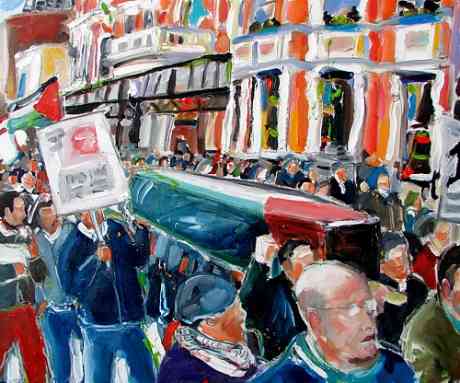
Coffin
These paintings are based on one Gaza demonstration that took place in January in Dublin. They encompass a wide range of symbols associated with the struggle of the Palestinians: the flag, speeches, symbolic coffin, the press and the Israeli Embassy.
Related Link: http://gaelart.net/gazademonstration.html
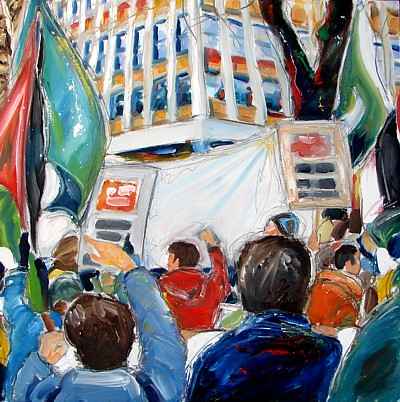
Embassy
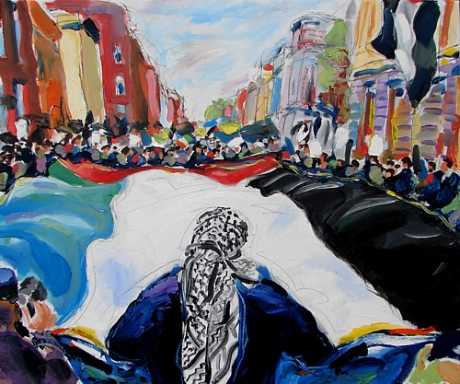
Flag
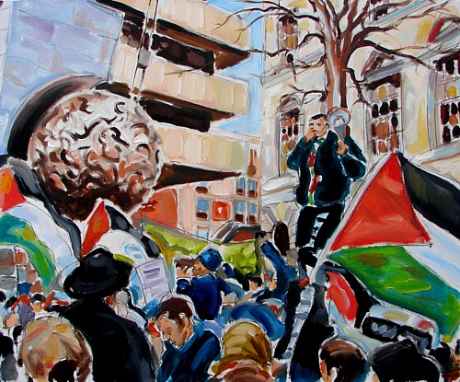
Speaker
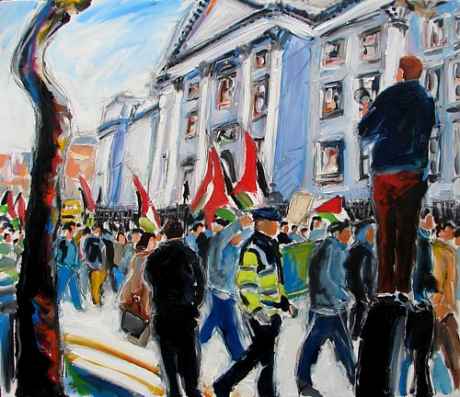
Trinity
The Democracy of Israel
The Democracy of Israel
by Rezbi on March 1, 2009
A look at (some of) the wonderfully democratic history of the state of Israel.
The Israelis regard it as a model for the World.
by Rezbi on March 1, 2009
A look at (some of) the wonderfully democratic history of the state of Israel.
The Israelis regard it as a model for the World.
Subscribe to:
Posts (Atom)