I am honoured to be in the timeless city of Cairo, and to be hosted by two remarkable institutions. For over 1,000 years, Al-Azhar has stood as a beacon of Islamic learning, and for over a century, Cairo University has been a source of Egypt's advancement. Together, you represent the harmony between tradition and progress. I am grateful for your hospitality, and the hospitality of the people of Egypt. I am also proud to carry with me the goodwill of the American people, and a greeting of peace from Muslim communities in my country: assalaamu alaykum.
"We meet at a time of tension between the United States and Muslims around the world, tension rooted in historical forces that go beyond any current policy debate.
"The relationship between Islam and the West includes centuries of co-existence and co-operation, but also conflict and religious wars. More recently, tension has been fed by colonialism that denied rights and opportunities to many Muslims, and a Cold War in which Muslim-majority countries were too often treated as proxies without regard to their own aspirations. Moreover, the sweeping change brought by modernity and globalisation led many Muslims to view the West as hostile to the traditions of Islam.
Violent extremists have exploited these tensions in a small but potent minority of Muslims. The attacks of September 11th, 2001, and the continued efforts of these extremists to engage in violence against civilians has led some in my country to view
Islam as inevitably hostile not only to America and Western countries, but also to human rights. This has bred more fear and mistrust.
So long as our relationship is defined by our differences, we will empower those who sow hatred rather than peace, and who promote conflict rather than the co-operation that can help all of our people achieve justice and prosperity. This cycle of suspicion and discord must end.
I have come here to seek a new beginning between the United States and Muslims around the world; one based upon mutual interest and mutual respect; and one based upon the truth that America and Islam are not exclusive, and need not be in competition. Instead, they overlap, and share common principles of justice and progress; tolerance and the dignity of all human beings.
I do so recognising that change cannot happen overnight. No single speech can eradicate years of mistrust, nor can I answer in the time that I have all the complex questions that brought us to this point. But I am convinced that in order to move forward, we must say openly the things we hold in our hearts, and that too often are said only behind closed doors. There must be a sustained effort to listen to each other; to learn from each other; to respect one another; and to seek common ground.
As the Holy Quran tells us: "Be conscious of God and speak always the truth." That is what I will try to do, to speak the truth as best I can, humbled by the task before us, and firm in my belief that the interests we share as human beings are far more powerful than the forces that drive us apart.
Part of this conviction is rooted in my own experience. I am a Christian, but my father came from a Kenyan family that includes generations of Muslims. As a boy, I spent several years in Indonesia and heard the call of the azaan at the break of dawn and the fall of dusk. As a young man, I worked in Chicago communities where many found dignity and peace in their Muslim faith.
As a student of history, I also know civilization's debt to Islam. It was Islam at places like Al-Azhar University that carried the light of learning through so many centuries, paving the way for Europe's Renaissance and Enlightenment. It was innovation in Muslim communities that developed the order of algebra; our magnetic compass and tools of navigation; our mastery of pens and printing; our understanding of how disease spreads and how it can be healed.
Islamic culture has given us majestic arches and soaring spires; timeless poetry and cherished music; elegant calligraphy and places of peaceful contemplation. And throughout history, Islam has demonstrated through words and deeds the possibilities of religious tolerance and racial equality.
I know, too, that Islam has always been a part of America's story. The first nation to recognise my country was Morocco. In signing the Treaty of Tripoli in 1796, our second President John Adams wrote: "The United States has in itself no character of enmity against the laws, religion or tranquility of Muslims."
And since our founding, American Muslims have enriched the United States. They have fought in our wars, served in government, stood for civil rights, started businesses, taught at our universities, excelled in our sports arenas, won Nobel Prizes, built our tallest building, and lit the Olympic Torch. And when the first Muslim-American was recently elected to Congress, he took the oath to defend our Constitution using the same Holy Quran that one of our Founding Fathers Thomas Jefferson kept in his personal library.
So I have known Islam on three continents before coming to the region where it was first revealed. That experience guides my conviction that partnership between America and Islam must be based on what Islam is, not what it isn't. And I consider it part of my responsibility as president of the United States to fight against negative stereotypes of Islam wherever they appear.
But that same principle must apply to Muslim perceptions of America. Just as Muslims do not fit a crude stereotype, America is not the crude stereotype of a self-interested empire. The United States has been one of the greatest sources of progress that the world has ever known. We were born out of revolution against an empire. We were founded upon the ideal that all are created equal, and we have shed blood and struggled for centuries to give meaning to those words within our borders, and around the world. We are shaped by every culture, drawn from every end of the Earth, and dedicated to a simple concept: Epluribus unum: "Out of many, one."
Much has been made of the fact that an African-American with the name Barack Hussein Obama could be elected president. But my personal story is not so unique. The dream of opportunity for all people has not come true for everyone in America, but its promise exists for all who come to our shores - that includes nearly seven million American Muslims in our country today who enjoy incomes and education that are higher than average.
Moreover, freedom in America is indivisible from the freedom to practice one's religion. That is why there is a mosque in every state of our union, and over 1,200 mosques within our borders. That is why the US government has gone to court to protect the right of women and girls to wear the hijab, and to punish those who would deny it.
So let there be no doubt: Islam is a part of America. And I believe that America holds within her the truth that regardless of race, religion, or station in life, all of us share common aspirations to live in peace and security; to get an education and to work with dignity; to love our families, our communities, and our God. These things we share. This is the hope of all humanity.
Of course, recognising our common humanity is only the beginning of our task. Words alone cannot meet the needs of our people. These needs will be met only if we act boldly in the years ahead; and if we understand that the challenges we face are shared, and our failure to meet them will hurt us all.
For we have learned from recent experience that when a financial system weakens in one country, prosperity is hurt everywhere. When a new flu infects one human being, all are at risk. When one nation pursues a nuclear weapon, the risk of nuclear attack rises for all nations. When violent extremists operate in one stretch of mountains, people are endangered across an ocean. And when innocents in Bosnia and Darfur are slaughtered, that is a stain on our collective conscience. That is what it means to share this world in the 21st century. That is the responsibility we have to one another as human beings.
This is a difficult responsibility to embrace. For human history has often been a record of nations and tribes subjugating one another to serve their own interests. Yet in this new age, such attitudes are self-defeating. Given our interdependence, any world order that elevates one nation or group of people over another will inevitably fail. So whatever we think of the past, we must not be prisoners of it. Our problems must be dealt with through partnership; progress must be shared.
That does not mean we should ignore sources of tension. Indeed, it suggests the opposite: we must face these tensions squarely. And so in that spirit, let me speak as clearly and plainly as I can about some specific issues that I believe we must finally confront together.
The first issue that we have to confront is violent extremism in all of its forms.
In Ankara, I made clear that America is not and never will be at war with Islam. We will, however, relentlessly confront violent extremists who pose a grave threat to our security.
Because we reject the same thing that people of all faiths reject: the killing of innocent men, women, and children. And it is my first duty as president to protect the American people.
The situation in Afghanistan demonstrates America's goals, and our need to work together. Over seven years ago, the United States pursued al-Qaeda and the Taliban with broad international support. We did not go by choice, we went because of necessity.
I am aware that some question or justify the events of 9/11. But let us be clear: al-Qaeda killed nearly 3,000 people on that day. The victims were innocent men, women and children from America and many other nations who had done nothing to harm anybody. And yet al-Qaeda chose to ruthlessly murder these people, claimed credit for the attack, and even now states their determination to kill on a massive scale. They have affiliates in many countries and are trying to expand their reach. These are not opinions to be debated; these are facts to be dealt with.
Make no mistake: We do not want to keep our troops in Afghanistan. We seek no military bases there. It is agonising for America to lose our young men and women. It is costly and politically difficult to continue this conflict. We would gladly bring every single one of our troops home if we could be confident that there were not violent extremists in Afghanistan and Pakistan determined to kill as many Americans as they possibly can. But that is not yet the case.
That's why we're partnering with a coalition of 46 countries. And despite the costs involved, America's commitment will not weaken. Indeed, none of us should tolerate these extremists. They have killed in many countries. They have killed people of different faiths more than any other, they have killed Muslims. Their actions are irreconcilable with the rights of human beings, the progress of nations, and with Islam.
The Holy Quran teaches that whoever kills an innocent, it is as if he has killed all mankind; and whoever saves a person, it is as if he has saved all mankind. The enduring faith of over a billion people is so much bigger than the narrow hatred of a few. Islam is not part of the problem in combating violent extremism it is an important part of promoting peace. We also know that military power alone is not going to solve the problems in Afghanistan and Pakistan. That is why we plan to invest $1.5 billion each year over the next five years to partner with Pakistanis to build schools and hospitals, roads and businesses, and hundreds of millions to help those who have been displaced. And that is why we are providing more than $2.8 billion to help Afghans develop their economy and deliver services that people depend upon.
Let me also address the issue of Iraq. Unlike Afghanistan, Iraq was a war of choice that provoked strong differences in my country and around the world. Although I believe that the Iraqi people are ultimately better off without the tyranny of Saddam Hussein, I also believe that events in Iraq have reminded America of the need to use diplomacy and build international consensus to resolve our problems whenever possible. Indeed, we can recall the words of Thomas Jefferson, who said: "I hope that our wisdom will grow with our power, and teach us that the less we use our power the greater it will be."
Today, America has a dual responsibility: to help Iraq forge a better future - and to leave Iraq to Iraqis. I have made it clear to the Iraqi people that we pursue no bases, and no claim on their territory or resources. Iraq's sovereignty is its own.
That is why I ordered the removal of our combat brigades by next August. That is why we will honour our agreement with Iraq's democratically elected government to remove combat troops from Iraqi cities by July, and to remove all our troops from Iraq by 2012. We will help Iraq train its security forces and develop its economy. But we will support a secure and united Iraq as a partner, and never as a patron.
And finally, just as America can never tolerate violence by extremists, we must never alter our principles. 9/11 was an enormous trauma to our country. The fear and anger that it provoked was understandable, but in some cases, it led us to act contrary to our ideals. We are taking concrete actions to change course. I have unequivocally prohibited the use of torture by the United States, and I have ordered the prison at Guantanamo Bay closed by early next year.
So America will defend itself respectful of the sovereignty of nations and the rule of law. And we will do so in partnership with Muslim communities which are also threatened. The sooner the extremists are isolated and unwelcome in Muslim communities, the sooner we will all be safer.
The second major source of tension that we need to discuss is the situation between Israelis, Palestinians and the Arab world.
America's strong bonds with Israel are well known. This bond is unbreakable. It is based upon cultural and historical ties, and the recognition that the aspiration for a Jewish homeland is rooted in a tragic history that cannot be denied.
Around the world, the Jewish people were persecuted for centuries, and anti-Semitism in Europe culminated in an unprecedented Holocaust. Tomorrow, I will visit Buchenwald, which was part of a network of camps where Jews were enslaved, tortured, shot and gassed to death by the Third Reich. Six million Jews were killed more than the entire Jewish population of Israel today. Denying that fact is baseless, ignorant, and hateful. Threatening Israel with destruction or repeating vile stereotypes about Jews is deeply wrong, and only serves to evoke in the minds of Israelis this most painful of memories while preventing the peace that the people of this region deserve.
On the other hand, it is also undeniable that the Palestinian people, Muslims and Christians, have suffered in pursuit of a homeland. For more than 60 years they have endured the pain of dislocation. Many wait in refugee camps in the West Bank, Gaza, and neighbouring lands for a life of peace and security that they have never been able to lead. They endure the daily humiliations large and small that come with occupation. So let there be no doubt: the situation for the Palestinian people is intolerable. America will not turn our backs on the legitimate Palestinian aspiration for dignity, opportunity, and a state of their own.
For decades, there has been a stalemate: two peoples with legitimate aspirations, each with a painful history that makes compromise elusive. It is easy to point fingers for Palestinians to point to the displacement brought by Israel's founding, and for Israelis to point to the constant hostility and attacks throughout its history from within its borders as well as beyond. But if we see this conflict only from one side or the other, then we will be blind to the truth: the only resolution is for the aspirations of both sides to be met through two states, where Israelis and Palestinians each live in peace and security.
That is in Israel's interest, Palestine's interest, America's interest, and the world's interest. That is why I intend to personally pursue this outcome with all the patience that the task requires. The obligations that the parties have agreed to under the road map are clear. For peace to come, it is time for them and all of us to live up to our responsibilities.
Palestinians must abandon violence. Resistance through violence and killing is wrong and does not succeed. For centuries, black people in America suffered the lash of the whip as slaves and the humiliation of segregation. But it was not violence that won full and equal rights. It was a peaceful and determined insistence upon the ideals at the centre of America's founding.
This same story can be told by people from South Africa to South Asia; from Eastern Europe to Indonesia. It's a story with a simple truth: that violence is a dead end. It is a sign of neither courage nor power to shoot rockets at sleeping children, or to blow up old women on a bus. That is not how moral authority is claimed; that is how it is surrendered. Now is the time for Palestinians to focus on what they can build. The Palestinian Authority must develop its capacity to govern, with institutions that serve the needs of its people.
Hamas does have support among some Palestinians, but they also have responsibilities. To play a role in fulfilling Palestinian aspirations, and to unify the Palestinian people, Hamas must put an end to violence, recognise past agreements, and recognise Israel's right to exist.
At the same time, Israelis must acknowledge that just as Israel's right to exist cannot be denied, neither can Palestine's. The United States does not accept the legitimacy of continued Israeli settlements. This construction violates previous agreements and undermines efforts to achieve peace. It is time for these settlements to stop.
Israel must also live up to its obligations to ensure that Palestinians can live, and work, and develop their society. And just as it devastates Palestinian families, the continuing humanitarian crisis in Gaza does not serve Israel's security; neither does the continuing lack of opportunity in the West Bank. Progress in the daily lives of the Palestinian people must be part of a road to peace, and Israel must take concrete steps to enable such progress.
Finally, the Arab states must recognise that the Arab Peace Initiative was an important beginning, but not the end of their responsibilities. The Arab-Israeli conflict should no longer be used to distract the people of Arab nations from other problems.
Instead, it must be a cause for action to help the Palestinian people develop the institutions that will sustain their state; to recognise Israel's legitimacy; and to choose progress over a self-defeating focus on the past.
America will align our policies with those who pursue peace, and say in public what we say in private to Israelis and Palestinians and Arabs. We cannot impose peace. But privately, many Muslims recognise that Israel will not go away. Likewise, many Israelis recognise the need for a Palestinian state. It is time for us to act on what everyone knows to be true.
Too many tears have flowed. Too much blood has been shed. All of us have a responsibility to work for the day when the mothers of Israelis and Palestinians can see their children grow up without fear; when the Holy Land of three great faiths is the place of peace that God intended it to be; when Jerusalem is a secure and lasting home for Jews and Christians and Muslims, and a place for all of the children of Abraham to mingle peacefully together as in the story of Isra, when Moses, Jesus, and Muhammad (peace be upon them) joined in prayer.
The third source of tension is our shared interest in the rights and responsibilities of nations on nuclear weapons. This issue has been a source of tension between the United States and the Islamic Republic of Iran. For many years, Iran has defined itself in part by its opposition to my country, and there is indeed a tumultuous history between us. In the middle of the Cold War, the United States played a role in the overthrow of a democratically elected Iranian government. Since the Islamic Revolution, Iran has played a role in acts of hostage-taking and violence against US troops and civilians.
This history is well known. Rather than remain trapped in the past, I have made it clear to Iran's leaders and people that my country is prepared to move forward. The question, now, is not what Iran is against, but rather what future it wants to build.
It will be hard to overcome decades of mistrust, but we will proceed with courage, rectitude and resolve. There will be many issues to discuss between our two countries, and we are willing to move forward without preconditions on the basis of mutual respect. But it is clear to all concerned that when it comes to nuclear weapons, we have reached a decisive point. This is not simply about America's interests. It is about preventing a nuclear arms race in the Middle East that could lead this region and the world down a hugely dangerous path.
I understand those who protest that some countries have weapons that others do not. No single nation should pick and choose which nations hold nuclear weapons. That is why I strongly reaffirmed America's commitment to seek a world in which no nations hold nuclear weapons. And any nation - including Iran - should have the right to access peaceful nuclear power if it complies with its responsibilities under the nuclear Non-Proliferation Treaty. That commitment is at the core of the treaty, and it must be kept for all who fully abide by it. And I am hopeful that all countries in the region can share in this goal.
The fourth issue that I will address is democracy. I know there has been controversy about the promotion of democracy in recent years, and much of this controversy is connected to the war in Iraq. So let me be clear: no system of government can or should be imposed upon one nation by any other.
That does not lessen my commitment, however, to governments that reflect the will of the people. Each nation gives life to this principle in its own way, grounded in the traditions of its own people. America does not presume to know what is best for everyone, just as we would not presume to pick the outcome of a peaceful election. But I do have an unyielding belief that all people yearn for certain things: the ability to speak your mind and have a say in how you are governed; confidence in the rule of law and the equal administration of justice; government that is transparent and doesn't steal from the people; the freedom to live as you choose. Those are not just American ideas, they are human rights, and that is why we will support them everywhere.
There is no straight line to realise this promise. But this much is clear: governments that protect these rights are ultimately more stable, successful and secure. Suppressing ideas never succeeds in making them go away. America respects the right of all peaceful and law-abiding voices to be heard around the world, even if we disagree with them. And we will welcome all elected, peaceful governments provided they govern with respect for all their people.
This last point is important because there are some who advocate for democracy only when they are out of power; once in power, they are ruthless in suppressing the rights of others. No matter where it takes hold, government of the people and by the people sets a single standard for all who hold power: you must maintain your power through consent, not coercion; you must respect the rights of minorities, and participate with a spirit of tolerance and compromise; you must place the interests of your people and the legitimate workings of the political process above your party. Without these ingredients, elections alone do not make true democracy.
The fifth issue that we must address together is religious freedom.
Islam has a proud tradition of tolerance. We see it in the history of Andalusia and Cordoba during the Inquisition. I saw it firsthand as a child in Indonesia, where devout Christians worshipped freely in an overwhelmingly Muslim country. That is the spirit we need today.
People in every country should be free to choose and live their faith based upon the persuasion of the mind, heart, and soul. This tolerance is essential for religion to thrive, but it is being challenged in many different ways.
Among some Muslims, there is a disturbing tendency to measure one's own faith by the rejection of another's. The richness of religious diversity must be upheld whether it is for Maronites in Lebanon or the Copts in Egypt. And faultlines must be closed among Muslims as well, as the divisions between Sunni and Shia have led to tragic violence, particularly in Iraq.
Freedom of religion is central to the ability of peoples to live together. We must always examine the ways in which we protect it. For instance, in the United States, rules on charitable giving have made it harder for Muslims to fulfil their religious obligation. That is why I am committed to working with American Muslims to ensure that they can fulfil zakat.
Likewise, it is important for Western countries to avoid impeding Muslim citizens from practicing religion as they see fit for instance, by dictating what clothes a Muslim woman should wear. We cannot disguise hostility towards any religion behind the pretence of liberalism. Indeed, faith should bring us together. That is why we are forging service projects in America that bring together Christians, Muslims, and Jews. That is why we welcome efforts like Saudi Arabian King Abdullah's interfaith dialogue and Turkey's leadership in the Alliance of Civilisations. Around the world, we can turn dialogue into interfaith service, so bridges between peoples lead to action whether it is combating malaria in Africa, or providing relief after a natural disaster.
The sixth issue that I want to address is women's rights. I know there is debate about this issue. I reject the view of some in the West that a woman who chooses to cover her hair is somehow less equal, but I do believe that a woman who is denied an education is denied equality. And it is no coincidence that countries where women are well-educated are far more likely to be prosperous.
Now let me be clear: issues of women's equality are by no means simply an issue for Islam. In Turkey, Pakistan, Bangladesh and Indonesia, we have seen Muslim-majority countries elect a woman to lead. Meanwhile, the struggle for women's equality continues in many aspects of American life, and in countries around the world.
Our daughters can contribute just as much to society as our sons, and our common prosperity will be advanced by allowing all humanity, men and women, to reach their full potential. I do not believe that women must make the same choices as men in order to be equal, and I respect those women who choose to live their lives in traditional roles. But it should be their choice. That is why the United States will partner with any Muslim-majority country to support expanded literacy for girls, and to help young women pursue employment through micro-financing that helps people live their dreams.
Finally, I want to discuss economic development and opportunity. I know that for many, the face of globalisation is contradictory. The internet and television can bring knowledge and information, but also offensive sexuality and mindless violence. Trade can bring new wealth and opportunities, but also huge disruptions and changing communities. In all nations, including my own, this change can bring fear. Fear that because of modernity we will lose control over our economic choices, our politics, and most importantly our identities - those things we most cherish about our communities, our families, our traditions, and our faith.
But I also know that human progress cannot be denied. There need not be contradiction between development and tradition. Countries like Japan and South Korea grew their economies while maintaining distinct cultures. The same is true for the astonishing progress within Muslim-majority countries from Kuala Lumpur to Dubai. In ancient times and in our times, Muslim communities have been at the forefront of innovation and education.
This is important because no development strategy can be based only upon what comes out of the ground, nor can it be sustained while young people are out of work. Many Gulf states have enjoyed great wealth as a consequence of oil, and some are beginning to focus it on broader development. But all of us must recognise that education and innovation will be the currency of the 21st century, and in too many Muslim communities there remains under-investment in these areas. I am emphasising such investments within my country. And while America in the past has focused on oil and gas in this part of the world, we now seek a broader engagement.
On education, we will expand exchange programmes, and increase scholarships, like the one that brought my father to America, while encouraging more Americans to study in Muslim communities. And we will match promising Muslim students with internships in America; invest in online learning for teachers and children around the world; and create a new online network, so a teenager in Kansas can communicate instantly with a teenager in Cairo. On economic development, we will create a new corps of business volunteers to partner with counterparts in Muslim-majority countries. And I will host a Summit on Entrepreneurship this year to identify how we can deepen ties between business leaders, foundations and social entrepreneurs in the United States and Muslim communities around the world.
On science and technology, we will launch a new fund to support technological development in Muslim-majority countries, and to help transfer ideas to the marketplace so they can create jobs. We will open centres of scientific excellence in Africa, the Middle East and Southeast Asia, and appoint new Science Envoys to collaborate on programmes that develop new sources of energy, create green jobs, digitise records, clean water, and grow new crops. And today I am announcing a new global effort with the Organisation of the Islamic Conference to eradicate polio. And we will also expand partnerships with Muslim communities to promote child and maternal health.
All these things must be done in partnership. Americans are ready to join with citizens and governments; community organisations, religious leaders, and businesses in Muslim communities around the world to help our people pursue a better life.
The issues that I have described will not be easy to address. But we have a responsibility to join together on behalf of the world we seek - a world where extremists no longer threaten our people, and American troops have come home; a world where Israelis and Palestinians are each secure in a state of their own, and nuclear energy is used for peaceful purposes; a world where governments serve their citizens, and the rights of all God's children are respected. Those are mutual interests.
That is the world we seek. But we can only achieve it together. I know there are many, Muslim and non-Muslim, who question whether we can forge this new beginning. Some are eager to stoke the flames of division, and to stand in the way of progress. Some suggest that it isn't worth the effort that we are fated to disagree, and civilisations are doomed to clash. Many more are simply sceptical that real change can occur. There is so much fear, so much mistrust. But if we choose to be bound by the past, we will never move forward. And I want to particularly say this to young people of every faith, in every country, you, more than anyone, have the ability to remake this world. All of us share this world for but a brief moment in time.
The question is whether we spend that time focused on what pushes us apart, or whether we commit ourselves to an effort, a sustained effort, to find common ground, to focus on the future we seek for our children, and to respect the dignity of all human beings.
It is easier to start wars than to end them. It is easier to blame others than to look inward; to see what is different about someone than to find the things we share. But we should choose the right path, not just the easy path. There is also one rule that lies at the heart of every religion that we do unto others as we would have them do unto us. This truth transcends nations and peoples a belief that isn't new; that isn't black or white or brown; that isn't Christian, or Muslim or Jew. It's a belief that pulsed in the cradle of civilisation, and that still beats in the heart of billions. It's a faith in other people, and it's what brought me here today.
We have the power to make the world we seek, but only if we have the courage to make a new beginning, keeping in mind what has been written.
The Holy Quran tells us, "O mankind! We have created you male and a female; and we have made you into nations and tribes so that you may know one another." The Talmud tells us: "The whole of the Torah is for the purpose of promoting peace."
The Holy Bible tells us, "Blessed are the peacemakers, for they shall be called sons of God." The people of the world can live together in peace. We know that is God's vision. Now, that must be our work here on Earth.
Thank you and may God's peace be upon you.
Boycott israHell!

Бойкот на израел и печелещите от окупацията! Boycott israHell and those who profit from occupation!
Friday, June 5, 2009


Thursday, June 4, 2009
Gaza aid still in Egypt
Report, The Electronic Intifada, 3 June 2009

Sacks of Gaza aid remain exposed in al-Arish. (Lina Atallah/IRIN)
AL-ARISH (IRIN) - The lack of proper warehousing facilities in the northeastern Egyptian cities of al-Arish and Rafah is partly to blame for bottlenecks and inefficiencies in delivering food and other aid to the Gaza Strip, a former senior Egyptian aid official has said.
The only working warehouse in al-Arish had been part-rented to the World Food Programme (WFP) with only some of its space allocated to the Egyptian Red Crescent Society (ERCS), said Ahmed Orabi, head of Egyptian Red Crescent aid operations between June 2008 and April 2009. Not all of the donated food aid arriving in al-Arish could be stored appropriately, and this had led to some wastage, he said.
The coastal city of al-Arish has been a major hub for incoming aid donations during and after the Israeli offensive (27 December 2008 - 18 January 2009). The ERCS works in close partnership with WFP to facilitate the passage of goods into Gaza for UN agencies and non-governmental organizations.
Bekim Mahmuti, head of logistics with WFP's program in the Occupied Palestinian Territories, told IRIN they had encountered no warehousing or access problems in al-Arish. "Our aid was locally purchased in Egypt and stockpiled in our warehouse in al-Arish. It successfully reached Gaza," Mahmuti said from East Jerusalem. He added that WFP had no food aid left in al-Arish by mid-May.
Other reasons for delays and difficulties in getting aid into Gaza are the frequent and unscheduled closures of the Rafah crossing, and the circuitous route that some aid has to take.
Significant quantities of aid -- mainly from Arab and Muslim countries -- have had to be trucked from al-Arish to al-Ouja (50km from Rafah on the Israeli-Egyptian border) and then to Israel's Kerem Shalom crossing into Gaza, according to the January 2009 Regional Humanitarian Update of the UN Office for the Coordination of Humanitarian Affairs (OCHA).
Kerem Shalom has become the main entry point for aid arriving from Israel, but it was not designed to handle large quantities of aid, and strict Israeli controls limit the speed with which goods can be handled.
Rafah has been used mainly for medical aid, and Kerem Shalom for food and other aid.
Incorrect documents
An insight into some of the other impediments to smooth aid delivery to Gaza can be gleaned from OCHA's January 2009 update:
"Many donations arrived in al-Arish without proper documentation or indication of a consignee. This has impaired their transfer to Gaza. As of 31 January, 3,000 tons of humanitarian supplies, which had crossed into Israel via al-Ouja was stockpiled at the Kerem Shalom terminal due to lack of clearance to enter Gaza. This situation has prompted border authorities at al-Ouja not to accept humanitarian cargo that has no proper documentation. Many truck drivers had no other options but to return to al-Arish and unload their shipments at the municipal stadium. An estimated 12,000 metric tons of humanitarian supplies have accumulated at the stadium as a result."
Earlier this month an IRIN correspondent saw sacks of food aid lying on the ground in the main sports stadium of al-Arish. They were believed to be remnants of the usable aid still waiting to be shipped to Gaza.
Dumped food aid
Orabi estimates that since the Israeli offensive on Gaza ended on 18 January 2009, 100 tons of food aid destined for Gaza has had to be dumped on rubbish tips. Most of the food had been unable to be warehoused and had gone bad with exposure to the rain and sun, he said.
"The aid was thrown away in a garbage lot and was most probably picked up by Bedouins to use as fodder for their goats," he added.
Mahmoud Abul Magd, head of the ERCS office in al-Arish, said most of the dumped aid was part of a Libyan convoy.
About 100 trucks of Libyan aid had arrived in al-Arish during the Israeli offensive but many had been over the weight limit and were thus denied access to Gaza. Some of this aid was channeled through the al-Ouja border crossing after having been repackaged to meet the correct weight standards, he said.
However, Abul Magd said the current stock of unused food and medical aid was "negligible."
A clearer picture may be difficult to discern as journalists have been denied access al-Arish sea port and the airport, places where more aid is believed to be stored.
This item comes to you via IRIN, a UN humanitarian news and information service, but may not necessarily reflect the views of the United Nations or its agencies. All IRIN material may be reposted or reprinted free-of-charge; refer to the copyright page for conditions of use. IRIN is a project of the UN Office for the Coordination of Humanitarian Affairs.

Sacks of Gaza aid remain exposed in al-Arish. (Lina Atallah/IRIN)
AL-ARISH (IRIN) - The lack of proper warehousing facilities in the northeastern Egyptian cities of al-Arish and Rafah is partly to blame for bottlenecks and inefficiencies in delivering food and other aid to the Gaza Strip, a former senior Egyptian aid official has said.
The only working warehouse in al-Arish had been part-rented to the World Food Programme (WFP) with only some of its space allocated to the Egyptian Red Crescent Society (ERCS), said Ahmed Orabi, head of Egyptian Red Crescent aid operations between June 2008 and April 2009. Not all of the donated food aid arriving in al-Arish could be stored appropriately, and this had led to some wastage, he said.
The coastal city of al-Arish has been a major hub for incoming aid donations during and after the Israeli offensive (27 December 2008 - 18 January 2009). The ERCS works in close partnership with WFP to facilitate the passage of goods into Gaza for UN agencies and non-governmental organizations.
Bekim Mahmuti, head of logistics with WFP's program in the Occupied Palestinian Territories, told IRIN they had encountered no warehousing or access problems in al-Arish. "Our aid was locally purchased in Egypt and stockpiled in our warehouse in al-Arish. It successfully reached Gaza," Mahmuti said from East Jerusalem. He added that WFP had no food aid left in al-Arish by mid-May.
Other reasons for delays and difficulties in getting aid into Gaza are the frequent and unscheduled closures of the Rafah crossing, and the circuitous route that some aid has to take.
Significant quantities of aid -- mainly from Arab and Muslim countries -- have had to be trucked from al-Arish to al-Ouja (50km from Rafah on the Israeli-Egyptian border) and then to Israel's Kerem Shalom crossing into Gaza, according to the January 2009 Regional Humanitarian Update of the UN Office for the Coordination of Humanitarian Affairs (OCHA).
Kerem Shalom has become the main entry point for aid arriving from Israel, but it was not designed to handle large quantities of aid, and strict Israeli controls limit the speed with which goods can be handled.
Rafah has been used mainly for medical aid, and Kerem Shalom for food and other aid.
Incorrect documents
An insight into some of the other impediments to smooth aid delivery to Gaza can be gleaned from OCHA's January 2009 update:
"Many donations arrived in al-Arish without proper documentation or indication of a consignee. This has impaired their transfer to Gaza. As of 31 January, 3,000 tons of humanitarian supplies, which had crossed into Israel via al-Ouja was stockpiled at the Kerem Shalom terminal due to lack of clearance to enter Gaza. This situation has prompted border authorities at al-Ouja not to accept humanitarian cargo that has no proper documentation. Many truck drivers had no other options but to return to al-Arish and unload their shipments at the municipal stadium. An estimated 12,000 metric tons of humanitarian supplies have accumulated at the stadium as a result."
Earlier this month an IRIN correspondent saw sacks of food aid lying on the ground in the main sports stadium of al-Arish. They were believed to be remnants of the usable aid still waiting to be shipped to Gaza.
Dumped food aid
Orabi estimates that since the Israeli offensive on Gaza ended on 18 January 2009, 100 tons of food aid destined for Gaza has had to be dumped on rubbish tips. Most of the food had been unable to be warehoused and had gone bad with exposure to the rain and sun, he said.
"The aid was thrown away in a garbage lot and was most probably picked up by Bedouins to use as fodder for their goats," he added.
Mahmoud Abul Magd, head of the ERCS office in al-Arish, said most of the dumped aid was part of a Libyan convoy.
About 100 trucks of Libyan aid had arrived in al-Arish during the Israeli offensive but many had been over the weight limit and were thus denied access to Gaza. Some of this aid was channeled through the al-Ouja border crossing after having been repackaged to meet the correct weight standards, he said.
However, Abul Magd said the current stock of unused food and medical aid was "negligible."
A clearer picture may be difficult to discern as journalists have been denied access al-Arish sea port and the airport, places where more aid is believed to be stored.
This item comes to you via IRIN, a UN humanitarian news and information service, but may not necessarily reflect the views of the United Nations or its agencies. All IRIN material may be reposted or reprinted free-of-charge; refer to the copyright page for conditions of use. IRIN is a project of the UN Office for the Coordination of Humanitarian Affairs.
Palestinian farmers use permaculture to challenge occupation
Sarah Irving, The Electronic Intifada, 4 June 2009

Marda village beneath the Ariel settlement in the occupied West Bank, 2008. (Amy Rawlins)
At five in the morning on 8 November 2000, Israeli troops invaded the Sustainable Development Centre in the West Bank village of Marda, tearing doors off their hinges and smashing windows. They destroyed seven years of work on the permaculture project. During the two-and-a-half hour rampage, the plant nursery, seed bank, agricultural equipment, computers and files were all wrecked.
The Centre had been established in 1993 to explore ways in which permaculture's principles of self-sufficiency could help Palestinian farmers whose lands were being confiscated and polluted by settlements like Ariel, which overshadows Marda village.
With the help of funding from Europe, the US and Australia, the Centre had managed to store and grow over 300 native plant varieties and had on its two-hectare site run courses for agricultural engineers from across the Middle East on permaculture techniques such as composting, irrigation, grey water recycling and using organic pesticides. It also offered local women training in computer and English-language skills.
The only danger that the Marda Sustainable Development Centre posed was the "threat of a good example" to Israeli military control over civil society in the West Bank. At the time of the November 2000 attack, a spokesperson for APHEDA, one of the Australian non-governmental organizations which supported the Centre, called the Israeli army's actions "a senseless attempt to destroy the morale of the community and another example of the unnecessary force being used by the Israeli military."
Green shoots
Murad al-Khufash spent four years working on that first project in Marda. When efforts to re-open the Centre foundered on a lack of funds and the threats of the on-going Israeli occupation, he decided to use his family's land to create a demonstration farm, continuing the work of trialing and adapting permaculture techniques for the West Bank's environment.
Permaculture, a movement which built on organic principles to develop a whole range of techniques for living self-sufficiently and with minimal impact on the environment, is more often associated with Westerners seeking alternative lifestyles. But, says al-Khufash, it has direct political relevance in the Israeli occupied West Bank.
"I like to help my people by teaching them the idea of growing their own food and to be independent in their markets and food" he says, "because if every farmer or Palestinian started to grow their own food we will be independent from the Israeli market."
Murad al-Khufash hopes that his new project will grow, creating jobs in the local area and allowing Palestinians from Marda and the wider area to stay at home with their families, rather than having to work overseas as he did for five years. But the savings he accumulated by working in the United States have almost run out, and he has had to make some tough choices about the project's future.
"The hardest thing is how to balance what your family needs and what the project needs, this is the hardest decision I have to make, it's a challenge and I have no guarantee of what I will have tomorrow," he explains. He was offered a visa to work abroad again this spring, and only an emergency appeal by organizations like Britain's Permaculture Association enabled him to continue working on the demonstration farm.
"What I got for the funding makes me stay and not give up, because I have hope and I prefer to live in my country and with my family rather than going to Norway and making more money. And I have to trust my friends around the world and accept the challenge, and we will see what happens next," he says.
A lack of funding isn't the only problem faced by al-Khufash's demonstration farm. Israeli army restrictions on movement mean that he has trouble finding volunteers to help on the farm, and the same travel restrictions hamper his own work. Feral pigs, allegedly released into the wild by Israeli settlers, have increased to an estimated 1,000 in number and are strong enough to break through security fences to eat crops, damage olive trees and trample seedlings. Marda is set to lose yet more land with plans to expand the Israeli settlement at Tapuah. Until he can raise the money to build a water cistern al-Khufash, like other Palestinians, is subject to the high charges imposed by the Israeli water company Mekorot -- even though they may well be buying back water stolen from their own land.
Tami Brunk, international co-ordinator for the Marda project, reports that simply carrying out the kind of farming that Murad al-Khufash does can be difficult. He is competing, she says, with farmers who "use all the synthetic fertilizers and pesticides pushed by development groups like the US Agency for International Development (USAID)." Moreover, using permaculture solutions is made all the harder by the bureaucratic impediments institutionalized within Israel's occupation. For example, "Murad's farm was hit in 2007 by a mite which destroyed his crop of cucumbers. There is a beneficial spider which preys on the mite ... but there are restrictions on importing it into Palestine."
The recent funding appeal has meant that al-Khufash's demonstration farm will keep going, at least for the moment. High-profile support from figures in the international permaculture movement has been a big boost to the project's profile and morale, and other West Bank permaculturists have tried to help out by sharing resources and trying to build up a network of like-minded people in Palestine.
The tortoise garden
An experimental permaculture community near Beit Sahour is one of those organizations trying to support Murad al-Khufasha, as well as find new ways of overcoming the Occupation.
Bustan Qaraaqa's Alice Gray emphasizes that permaculture isn't just about alternative agriculture. She hopes that the work being done at the farm she established in February 2008 with three friends from the UK -- one of whom has since been deported -- will tackle wider social and environmental issues.
"Certain native trees are very good at colonizing degraded soil and facilitating other trees that are more demanding to grow, or at soil enrichment and stabilization and altering soil conditions," she explains, pointing out the West Bank's only native tree nursery. Some tree species could help to clean up soil polluted by the chemical and sewage waste pumped out by Israeli settlements.
Bustan Qaraaqa's workers are also looking at ways that native species could help to solve the huge problem of soil erosion on the hillsides of the eastern West Bank leading to the Jordan River. According to Gray, overgrazing on land where Palestinian farmers are increasingly confined to small areas by settlements has created a situation where soil is "being just stripped away, which is totally disastrous, so we're looking at ways of using trees to stabilize the soil, to enrich it, and to provide fodder for livestock and possibly also fuel for people."
Gray adds that "Trees are much more resilient than ground vegetation to grazing and with trees it's quite easy to control -- you can cut the boughs of the tree and you can see when it's had enough and you have to find another source of fodder. But restoring that kind of habitat, if it's not done in the next decades it will be impossible to do at all because the soil's going at such a rate and once it's gone it's gone."
Permaculture's approach to reducing waste is also helping to reduce the volume of rubbish dumped in wild areas by Palestinian communities with no adequate waste management facilities. "We've supported the SOS Children's Village in Bethlehem to set up a composting scheme," Gray explains. She adds that "They're composting all their food waste now, and it can be quite powerful to do something like that, at an institutional level where there is a big volume of rubbish being generated, which might otherwise be just thrown into the desert or set on fire."
Off the grid
The Bustan Qaraaqa community -- a big stone farmhouse surrounded by 12 dunums of land -- also acts as a testing ground for ways of living "off the grid" in Palestine. Like Murad al-Khufash in Marda, Gray believes that lifestyles more associated with alternative communities in Europe and the US could offer new solutions to farmers cut off from their land by the Israeli Separation Wall.
"One of the Occupation's methods is to refuse to give people infrastructure," Gray explains. "Some farmers are saying OK, you build the Wall between me and my land. I choose my land. So the Israelis say -- you can have no infrastructure. No electricity, no running water. Now try living there."
However, she notes that "Permaculture ideas are very much about how to live 'off the grid.' You have to think, how will I get water? So if you harvest rainwater you remove a level of dependency. And how do I handle waste? If you're on a short water budget and there's no sewage collection it makes sense to have a compost toilet. And then there are sustainable ways of generating electricity. That's the next step, we haven't got there yet but we'd really like to work with getting funding to get people solar panels and things like that so they can have electricity at their sites."
As Gray emphasizes, the denial of services is one of the Israeli State's means of enforcing a political agenda aimed at removing the Arab population, from "unrecognized" Bedouin communities in the Negev as well as Palestinian villages near to the Wall. But, she believes, permaculture's reinvention of ways of living that might have been familiar generations ago can help to circumvent the occupation's methods, and farmers from villages like al-Walaja where land confiscation has been a major issue are wiling to try out some of Bustan Qaraaqa's ideas.
Sarah Irving is a freelance writer from Manchester, UK. She worked with the International Solidarity Movement in the West Bank in 2001-2 and with Olive Co-op, promoting fair trade Palestinian products and solidarity visits, in 2004-6. She now writes full-time on a range of issues, including Palestine.

Marda village beneath the Ariel settlement in the occupied West Bank, 2008. (Amy Rawlins)
At five in the morning on 8 November 2000, Israeli troops invaded the Sustainable Development Centre in the West Bank village of Marda, tearing doors off their hinges and smashing windows. They destroyed seven years of work on the permaculture project. During the two-and-a-half hour rampage, the plant nursery, seed bank, agricultural equipment, computers and files were all wrecked.
The Centre had been established in 1993 to explore ways in which permaculture's principles of self-sufficiency could help Palestinian farmers whose lands were being confiscated and polluted by settlements like Ariel, which overshadows Marda village.
With the help of funding from Europe, the US and Australia, the Centre had managed to store and grow over 300 native plant varieties and had on its two-hectare site run courses for agricultural engineers from across the Middle East on permaculture techniques such as composting, irrigation, grey water recycling and using organic pesticides. It also offered local women training in computer and English-language skills.
The only danger that the Marda Sustainable Development Centre posed was the "threat of a good example" to Israeli military control over civil society in the West Bank. At the time of the November 2000 attack, a spokesperson for APHEDA, one of the Australian non-governmental organizations which supported the Centre, called the Israeli army's actions "a senseless attempt to destroy the morale of the community and another example of the unnecessary force being used by the Israeli military."
Green shoots
Murad al-Khufash spent four years working on that first project in Marda. When efforts to re-open the Centre foundered on a lack of funds and the threats of the on-going Israeli occupation, he decided to use his family's land to create a demonstration farm, continuing the work of trialing and adapting permaculture techniques for the West Bank's environment.
Permaculture, a movement which built on organic principles to develop a whole range of techniques for living self-sufficiently and with minimal impact on the environment, is more often associated with Westerners seeking alternative lifestyles. But, says al-Khufash, it has direct political relevance in the Israeli occupied West Bank.
"I like to help my people by teaching them the idea of growing their own food and to be independent in their markets and food" he says, "because if every farmer or Palestinian started to grow their own food we will be independent from the Israeli market."
Murad al-Khufash hopes that his new project will grow, creating jobs in the local area and allowing Palestinians from Marda and the wider area to stay at home with their families, rather than having to work overseas as he did for five years. But the savings he accumulated by working in the United States have almost run out, and he has had to make some tough choices about the project's future.
"The hardest thing is how to balance what your family needs and what the project needs, this is the hardest decision I have to make, it's a challenge and I have no guarantee of what I will have tomorrow," he explains. He was offered a visa to work abroad again this spring, and only an emergency appeal by organizations like Britain's Permaculture Association enabled him to continue working on the demonstration farm.
"What I got for the funding makes me stay and not give up, because I have hope and I prefer to live in my country and with my family rather than going to Norway and making more money. And I have to trust my friends around the world and accept the challenge, and we will see what happens next," he says.
A lack of funding isn't the only problem faced by al-Khufash's demonstration farm. Israeli army restrictions on movement mean that he has trouble finding volunteers to help on the farm, and the same travel restrictions hamper his own work. Feral pigs, allegedly released into the wild by Israeli settlers, have increased to an estimated 1,000 in number and are strong enough to break through security fences to eat crops, damage olive trees and trample seedlings. Marda is set to lose yet more land with plans to expand the Israeli settlement at Tapuah. Until he can raise the money to build a water cistern al-Khufash, like other Palestinians, is subject to the high charges imposed by the Israeli water company Mekorot -- even though they may well be buying back water stolen from their own land.
Tami Brunk, international co-ordinator for the Marda project, reports that simply carrying out the kind of farming that Murad al-Khufash does can be difficult. He is competing, she says, with farmers who "use all the synthetic fertilizers and pesticides pushed by development groups like the US Agency for International Development (USAID)." Moreover, using permaculture solutions is made all the harder by the bureaucratic impediments institutionalized within Israel's occupation. For example, "Murad's farm was hit in 2007 by a mite which destroyed his crop of cucumbers. There is a beneficial spider which preys on the mite ... but there are restrictions on importing it into Palestine."
The recent funding appeal has meant that al-Khufash's demonstration farm will keep going, at least for the moment. High-profile support from figures in the international permaculture movement has been a big boost to the project's profile and morale, and other West Bank permaculturists have tried to help out by sharing resources and trying to build up a network of like-minded people in Palestine.
The tortoise garden
An experimental permaculture community near Beit Sahour is one of those organizations trying to support Murad al-Khufasha, as well as find new ways of overcoming the Occupation.
Bustan Qaraaqa's Alice Gray emphasizes that permaculture isn't just about alternative agriculture. She hopes that the work being done at the farm she established in February 2008 with three friends from the UK -- one of whom has since been deported -- will tackle wider social and environmental issues.
"Certain native trees are very good at colonizing degraded soil and facilitating other trees that are more demanding to grow, or at soil enrichment and stabilization and altering soil conditions," she explains, pointing out the West Bank's only native tree nursery. Some tree species could help to clean up soil polluted by the chemical and sewage waste pumped out by Israeli settlements.
Bustan Qaraaqa's workers are also looking at ways that native species could help to solve the huge problem of soil erosion on the hillsides of the eastern West Bank leading to the Jordan River. According to Gray, overgrazing on land where Palestinian farmers are increasingly confined to small areas by settlements has created a situation where soil is "being just stripped away, which is totally disastrous, so we're looking at ways of using trees to stabilize the soil, to enrich it, and to provide fodder for livestock and possibly also fuel for people."
Gray adds that "Trees are much more resilient than ground vegetation to grazing and with trees it's quite easy to control -- you can cut the boughs of the tree and you can see when it's had enough and you have to find another source of fodder. But restoring that kind of habitat, if it's not done in the next decades it will be impossible to do at all because the soil's going at such a rate and once it's gone it's gone."
Permaculture's approach to reducing waste is also helping to reduce the volume of rubbish dumped in wild areas by Palestinian communities with no adequate waste management facilities. "We've supported the SOS Children's Village in Bethlehem to set up a composting scheme," Gray explains. She adds that "They're composting all their food waste now, and it can be quite powerful to do something like that, at an institutional level where there is a big volume of rubbish being generated, which might otherwise be just thrown into the desert or set on fire."
Off the grid
The Bustan Qaraaqa community -- a big stone farmhouse surrounded by 12 dunums of land -- also acts as a testing ground for ways of living "off the grid" in Palestine. Like Murad al-Khufash in Marda, Gray believes that lifestyles more associated with alternative communities in Europe and the US could offer new solutions to farmers cut off from their land by the Israeli Separation Wall.
"One of the Occupation's methods is to refuse to give people infrastructure," Gray explains. "Some farmers are saying OK, you build the Wall between me and my land. I choose my land. So the Israelis say -- you can have no infrastructure. No electricity, no running water. Now try living there."
However, she notes that "Permaculture ideas are very much about how to live 'off the grid.' You have to think, how will I get water? So if you harvest rainwater you remove a level of dependency. And how do I handle waste? If you're on a short water budget and there's no sewage collection it makes sense to have a compost toilet. And then there are sustainable ways of generating electricity. That's the next step, we haven't got there yet but we'd really like to work with getting funding to get people solar panels and things like that so they can have electricity at their sites."
As Gray emphasizes, the denial of services is one of the Israeli State's means of enforcing a political agenda aimed at removing the Arab population, from "unrecognized" Bedouin communities in the Negev as well as Palestinian villages near to the Wall. But, she believes, permaculture's reinvention of ways of living that might have been familiar generations ago can help to circumvent the occupation's methods, and farmers from villages like al-Walaja where land confiscation has been a major issue are wiling to try out some of Bustan Qaraaqa's ideas.
Sarah Irving is a freelance writer from Manchester, UK. She worked with the International Solidarity Movement in the West Bank in 2001-2 and with Olive Co-op, promoting fair trade Palestinian products and solidarity visits, in 2004-6. She now writes full-time on a range of issues, including Palestine.
American Muslims, Jews rate Obama's speech
(CNN) -- American Muslims reacted enthusiastically to President Obama's much-anticipated effort to "reboot" relations with the Islamic world Thursday, while the U.S. Jewish community gave his speech mixed reviews.
President Obama urges a new chapter in ties between the U.S. and Muslims in a speech Thursday in Cairo, Egypt.

President Obama urges a new chapter in ties between the U.S. and Muslims in a speech Thursday in Cairo, Egypt.
Khadija Athman, a member of the Muslim community in Washington, said she is always impressed with Obama, but she had never been more surprised by him than she was Thursday.
"I felt he was extremely candid. He didn't mince words. He touched every aspect of Muslim world issues," said Athman, who is originally from Kenya, where Obama's father was born.
"He talked about women's rights, he talked about religious tolerance, he talked about education for women, and I feel very strongly about those issues," she said.
He also got the details right, she said, pointing out that he used the traditional Muslim phrase "peace be upon him" when referring to the Prophet Mohammed.
"It is expected of him, but the fact that he did it, people would love it," she said an Iraqi friend told her. "That will resonate extremely well and people actually will believe in Obama's sincerity."
Shahed Amanullah, editor of the Web site altmuslim.com, said he thinks Obama "accomplished exactly what he needed to accomplish" with his speech in Cairo, Egypt.
"He was really pressing for people to say in public what they say in private. Everybody knows what the solutions to a lot of these problems are and I think there is vast agreement on what they are going to be. But nobody really talks about it and puts the cards on the table," said Amanullah, of Austin, Texas.
Asma Hasan, a lawyer in Denver, Colorado, and the author of "Red, White and Muslim: My Story of Belief," agreed, but said Obama now needs to move quickly to turn words into action.
"I think Obama, better than any other recent political figure, gently asserted that effort will be expected from Muslims, too," she said. "Hearing the most powerful man in the world acknowledge their grievances in so public a manner will make Muslims very receptive to Obama for at least a few months."
Obama's understanding of Muslims will help clear the way, she said.
"When he started his speech by pointing out that Muslims had suffered under colonialism and globalization, I knew he was on the right track. So many Westerners gloss over these major historical events and ignore how hard it has been for Muslims," she said by e-mail.
Mona Eltahawy, an Egyptian-born columnist who moved to the United States nine years ago, wanted more from the speech.
"I would've liked to have heard more about civilian casualties and suffering in Pakistan and Afghanistan, because that upsets many Muslims as much as Palestinian suffering does," she said. "And I also wish he had assured Muslim women and girls in Afghanistan that their rights would not be sacrificed for the sake of a cease-fire or truce with the Taliban or other violent extremists."
She also would have liked him to press harder for democracy in the region.
"Muslims around the world are upset with the U.S. because the U.S. supports dictators in many Muslim-majority countries such as Egypt, where Obama gave his speech today, and Saudi Arabia, where he began his Middle East visit. So I was disappointed that he didn't say anything about that support that inflames Muslim sentiments as much as the Israeli-Palestinian conflict does."
James Zogby, president of the Arab American Institute in Washington, admired the way the speech was "designed to address a wide range of problems across a broad region."
"In speaking with friends in the Middle East this morning, I was impressed how many parts of the speech resonated. Everyone could take away something -- peace activists, advocates for democracy and women's rights, religious minorities, etc. In that regard, the menu worked," he said in an e-mail.
But the very breadth of the speech may make it harder for the message to get across at home, Zogby said.
"There was so much to the speech that its central thrust will be lost here in the U.S.," he said.
"Listening to some of the commentators on TV this morning was troubling," he said. He was concerned that they were "totally missing the point that this president wasn't talking 'at' Muslims, he was working to engage 'with' them. I fear that what may be lost is the fact that the president was also talking to us" in the United States "about what we need to know about Islam and our relationships with the many parts of the Muslim world. Fixing our side of this divide will take some work."
Obama did not shy away from discussing the Israeli-Palestinian conflict, a flash point for tensions in the region. American Jews responded cautiously to the speech, in which a U.S. president referred to "occupation" and "Palestine."
Malcolm Hoenlein, executive vice chairman of the Conference of Presidents of Major American Jewish Organizations, is well-placed to hear different viewpoints because his organization represents several groups.
Hoenlein cited important human rights references in the speech and thought the comments on the strong U.S.-Israeli relations and Obama's commitment to Israel were very positive.
But he said there were omissions in framing the history of the region.
Arabs, he said, weren't the only people who were displaced from their homes when Israel became a country in 1948. He cited Jewish refugees who found their way to Israel after they had been driven out by Arab countries.
Also, he said, there was no acknowledgment of the potential agreements with Israelis that were spurned by Arab leaders. He said there was no reference to Syria, Lebanon's upcoming elections or Hezbollah.
Hoenlein was pleased that there was no linkage between the Iranian issue and the Israeli and Palestinian conflict, but he didn't think Obama delivered a strong message about the dangers of a nuclear-armed Iran.
Some people Hoenlein heard from said they were angry about the speech and others praised it, he said.
At least two groups that are part of the conference of presidents weighed in.
The Anti-Defamation League, the U.S. group that monitors and fights anti-Semitism, said Obama's speech was "groundbreaking and honest," but the president "missed an opportunity" to place the Israeli-Palestinian conflict in proper historical perspective.
Glen S. Lewy, the league's national chairman, and Abraham H. Foxman, its national director, issued a statement saying the speech touched on "many important issues -- human rights, education, democracy, the need to deal with Islamic extremists -- with candor."
"He issued a clarion call for recalibrating America's relationship with the Muslim world through constructive outreach and dialogue. Speaking directly to the Muslim people, he broached issues that have never really been addressed to the Arab world before now. We share the president's genuine quest for respect, tolerance and peace," the statement said.
Lewy and Foxman also said they are willing to give Obama's "approach a chance to work and we are waiting to hear a response from the moderate Arab states. It will be interesting to see how the Muslim world reacts to the speech."
But the Anti-Defamation League said Obama should have mentioned that "six Arab nations attacked Israel from day one and the occupation of Palestinian land was a product of Israel's wars of self-defense."
"While strongly reiterating the importance of America's relationship with the state of Israel and articulating Israel's right to exist, President Obama missed the opportunity to address the misperceptions in the Arab world and to make clear that the Palestinians would have had a state had they accepted the United Nations resolution in 1948," the group said.
The group noted that Obama denounced anti-Semitism and Holocaust denial but didn't make clear "that Israel's right to statehood is not a result of anti-Semitism and the Holocaust."
It also expressed "disappointment" that Obama "found the need to balance the suffering of the Jewish people in a genocide to the suffering of the Palestinian people resulting from Arab wars."
The American Jewish Committee, a group dedicated to safeguarding Jews and Jewish life, welcomed the speech, praising the rejection of anti-Semitism and embracing Israel's legitimate right to exist.
"In the heart of a region where denial is routine -- denial of Israel's right to exist, denial of the historic link of Jews to their homeland, denial of the Holocaust -- President Obama spoke the truth with a clear, unwavering voice," said David Harris, the committee's executive director, in a news release.
Harris praised Obama for pursuing "a negotiated settlement to the Israeli-Palestinian conflict" and said the group was pleased the president denounced violence and called for Hamas to reject violence and recognize Israel.
He also welcomed "Obama's focus on Iran's confrontation with the international community over its nuclear weapons drive," but said the committee was disappointed that Obama "was not more explicit about the danger" of a nuclear-armed Iran.
President Obama urges a new chapter in ties between the U.S. and Muslims in a speech Thursday in Cairo, Egypt.
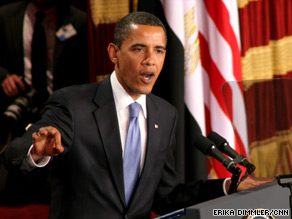
President Obama urges a new chapter in ties between the U.S. and Muslims in a speech Thursday in Cairo, Egypt.
Khadija Athman, a member of the Muslim community in Washington, said she is always impressed with Obama, but she had never been more surprised by him than she was Thursday.
"I felt he was extremely candid. He didn't mince words. He touched every aspect of Muslim world issues," said Athman, who is originally from Kenya, where Obama's father was born.
"He talked about women's rights, he talked about religious tolerance, he talked about education for women, and I feel very strongly about those issues," she said.
He also got the details right, she said, pointing out that he used the traditional Muslim phrase "peace be upon him" when referring to the Prophet Mohammed.
"It is expected of him, but the fact that he did it, people would love it," she said an Iraqi friend told her. "That will resonate extremely well and people actually will believe in Obama's sincerity."
Shahed Amanullah, editor of the Web site altmuslim.com, said he thinks Obama "accomplished exactly what he needed to accomplish" with his speech in Cairo, Egypt.
"He was really pressing for people to say in public what they say in private. Everybody knows what the solutions to a lot of these problems are and I think there is vast agreement on what they are going to be. But nobody really talks about it and puts the cards on the table," said Amanullah, of Austin, Texas.
Asma Hasan, a lawyer in Denver, Colorado, and the author of "Red, White and Muslim: My Story of Belief," agreed, but said Obama now needs to move quickly to turn words into action.
"I think Obama, better than any other recent political figure, gently asserted that effort will be expected from Muslims, too," she said. "Hearing the most powerful man in the world acknowledge their grievances in so public a manner will make Muslims very receptive to Obama for at least a few months."
Obama's understanding of Muslims will help clear the way, she said.
"When he started his speech by pointing out that Muslims had suffered under colonialism and globalization, I knew he was on the right track. So many Westerners gloss over these major historical events and ignore how hard it has been for Muslims," she said by e-mail.
Mona Eltahawy, an Egyptian-born columnist who moved to the United States nine years ago, wanted more from the speech.
"I would've liked to have heard more about civilian casualties and suffering in Pakistan and Afghanistan, because that upsets many Muslims as much as Palestinian suffering does," she said. "And I also wish he had assured Muslim women and girls in Afghanistan that their rights would not be sacrificed for the sake of a cease-fire or truce with the Taliban or other violent extremists."
She also would have liked him to press harder for democracy in the region.
"Muslims around the world are upset with the U.S. because the U.S. supports dictators in many Muslim-majority countries such as Egypt, where Obama gave his speech today, and Saudi Arabia, where he began his Middle East visit. So I was disappointed that he didn't say anything about that support that inflames Muslim sentiments as much as the Israeli-Palestinian conflict does."
James Zogby, president of the Arab American Institute in Washington, admired the way the speech was "designed to address a wide range of problems across a broad region."
"In speaking with friends in the Middle East this morning, I was impressed how many parts of the speech resonated. Everyone could take away something -- peace activists, advocates for democracy and women's rights, religious minorities, etc. In that regard, the menu worked," he said in an e-mail.
But the very breadth of the speech may make it harder for the message to get across at home, Zogby said.
"There was so much to the speech that its central thrust will be lost here in the U.S.," he said.
"Listening to some of the commentators on TV this morning was troubling," he said. He was concerned that they were "totally missing the point that this president wasn't talking 'at' Muslims, he was working to engage 'with' them. I fear that what may be lost is the fact that the president was also talking to us" in the United States "about what we need to know about Islam and our relationships with the many parts of the Muslim world. Fixing our side of this divide will take some work."
Obama did not shy away from discussing the Israeli-Palestinian conflict, a flash point for tensions in the region. American Jews responded cautiously to the speech, in which a U.S. president referred to "occupation" and "Palestine."
Malcolm Hoenlein, executive vice chairman of the Conference of Presidents of Major American Jewish Organizations, is well-placed to hear different viewpoints because his organization represents several groups.
Hoenlein cited important human rights references in the speech and thought the comments on the strong U.S.-Israeli relations and Obama's commitment to Israel were very positive.
But he said there were omissions in framing the history of the region.
Arabs, he said, weren't the only people who were displaced from their homes when Israel became a country in 1948. He cited Jewish refugees who found their way to Israel after they had been driven out by Arab countries.
Also, he said, there was no acknowledgment of the potential agreements with Israelis that were spurned by Arab leaders. He said there was no reference to Syria, Lebanon's upcoming elections or Hezbollah.
Hoenlein was pleased that there was no linkage between the Iranian issue and the Israeli and Palestinian conflict, but he didn't think Obama delivered a strong message about the dangers of a nuclear-armed Iran.
Some people Hoenlein heard from said they were angry about the speech and others praised it, he said.
At least two groups that are part of the conference of presidents weighed in.
The Anti-Defamation League, the U.S. group that monitors and fights anti-Semitism, said Obama's speech was "groundbreaking and honest," but the president "missed an opportunity" to place the Israeli-Palestinian conflict in proper historical perspective.
Glen S. Lewy, the league's national chairman, and Abraham H. Foxman, its national director, issued a statement saying the speech touched on "many important issues -- human rights, education, democracy, the need to deal with Islamic extremists -- with candor."
"He issued a clarion call for recalibrating America's relationship with the Muslim world through constructive outreach and dialogue. Speaking directly to the Muslim people, he broached issues that have never really been addressed to the Arab world before now. We share the president's genuine quest for respect, tolerance and peace," the statement said.
Lewy and Foxman also said they are willing to give Obama's "approach a chance to work and we are waiting to hear a response from the moderate Arab states. It will be interesting to see how the Muslim world reacts to the speech."
But the Anti-Defamation League said Obama should have mentioned that "six Arab nations attacked Israel from day one and the occupation of Palestinian land was a product of Israel's wars of self-defense."
"While strongly reiterating the importance of America's relationship with the state of Israel and articulating Israel's right to exist, President Obama missed the opportunity to address the misperceptions in the Arab world and to make clear that the Palestinians would have had a state had they accepted the United Nations resolution in 1948," the group said.
The group noted that Obama denounced anti-Semitism and Holocaust denial but didn't make clear "that Israel's right to statehood is not a result of anti-Semitism and the Holocaust."
It also expressed "disappointment" that Obama "found the need to balance the suffering of the Jewish people in a genocide to the suffering of the Palestinian people resulting from Arab wars."
The American Jewish Committee, a group dedicated to safeguarding Jews and Jewish life, welcomed the speech, praising the rejection of anti-Semitism and embracing Israel's legitimate right to exist.
"In the heart of a region where denial is routine -- denial of Israel's right to exist, denial of the historic link of Jews to their homeland, denial of the Holocaust -- President Obama spoke the truth with a clear, unwavering voice," said David Harris, the committee's executive director, in a news release.
Harris praised Obama for pursuing "a negotiated settlement to the Israeli-Palestinian conflict" and said the group was pleased the president denounced violence and called for Hamas to reject violence and recognize Israel.
He also welcomed "Obama's focus on Iran's confrontation with the international community over its nuclear weapons drive," but said the committee was disappointed that Obama "was not more explicit about the danger" of a nuclear-armed Iran.
Obama should visit Gaza
Medea Benjamin, The Electronic Intifada, 3 June 2009
US President Barack Obama will give a major policy talk at Cairo University on 4 June, intended to start mending the rift between the United States and the Arab world. During the Bush years, many Arabs turned against the United States because of the invasions of Afghanistan and Iraq, as well as the abuses at Guantanamo and Abu Ghraib. But the issue that is really at the crux of the tensions with the United States is the intractable conflict between Israel and Palestine, and what many perceive as a one-sided US policy in support of Israel.
The Obama administration has taken a positive stand on the Israeli settlements, calling for a complete freeze. "[Obama] wants to see a stop to settlements -- not some settlements, not outposts, not 'natural growth' exceptions," Secretary of State Hillary Clinton recently told reporters.
But the administration has said almost nothing about the devastating Israeli invasion of Gaza that left more than 1,400 dead, including some 400 children. To many in the Middle East, this is an unfortunate continuation of past policies that condemn the loss of innocent Israeli lives, but refuse to speak out against the disproportionately greater loss of Palestinian lives at the hands of the Israeli military.
The Israeli invasion of Gaza began on 27 December 2008, when Obama had just won the election but had not yet taken office. While he spoke out against the 26 November Mumbai terrorism attack, he refused to even call for a ceasefire in Gaza, saying coldly, "When it comes to foreign affairs it is particularly important to adhere to the principle of one president at a time."
Once inaugurated, Obama appointed former Senator George Mitchell as a special peace envoy and immediately sent him on a "listening tour" to key places in the Middle East -- except Gaza. Mitchell returned for a second trip to the region in late February, visiting Turkey, the United Arab Emirates, Egypt, Israel and the West Bank but once again bypassing Gaza. The same thing happened on his third trip in April.
Hillary Clinton has never visited war-torn Gaza. She promised $300 million for rebuilding, but the aid won't get to Gaza as long as the administration insists on dealing only with Mahmoud Abbas and his Palestinian Authority in the West Bank while shunning Hamas, which controls Gaza and was democratically elected.
Obama won great support from the American people during the presidential campaign when he said that America must talk to its adversaries, without preconditions. But his administration now puts ridiculous conditions on talking to Hamas: It must recognize Israel, renounce violence and accept previous international agreements. Israel, on the other hand, does not have to recognize Palestine, renounce violence or abide by past agreements. Putting preconditions on just one side of the conflict makes it impossible to move a peace process forward.
While Obama prepares for his trip to the Middle East, more than 150 people -- mostly Americans -- are trying to enter war-torn Gaza through both the Egyptian and Israeli borders. Organized under the umbrella of the peace group CODEPINK, this is the largest group of Americans to travel to Gaza since the siege began.
The delegations, invited by the UN agency for Palestine refugees (UNRWA), are bringing medicines, toys, school supplies and playground building materials. An estimated 1,346 Gazan children were left without one or more of their parents as a result of the Israeli assault and the majority were left traumatized and depressed.
That's why the peace group CODEPINK has launched an international petition calling on Obama to visit Gaza and see for himself the devastation and deprivation that continues to plague the region's 1.5 million people almost six months after the invasion. Just this week, Obama tacked a new stop to his upcoming Middle Eastern visit: Saudi Arabia. If he can make room for a private dinner with the King, then surely he can find the time to go to Gaza. Isn't it more important for Obama to visit a region where 1,400 people have recently been killed and thousands of homes, schools and mosques destroyed? Isn't it more important for him to see how the Israelis are using the yearly $3 billion in military aid from US taxpayers?
Obama should take the opportunity, during this visit to Egypt next week, to visit Gaza. He should express his condolences for the loss of so many innocent lives, call for a lifting of the inhumane siege that continues to imprison an entire population, and support an investigation of how US military funds to Israel are being spent.
Those actions, more than any fine words he may speak during his talk at Cairo University, will do wonders to repairs our relations with the Arab world that were so tattered during the Bush years.
Medea Benjamin (medea@globalexchange.org) is cofounder of Global Exchange and CODEPINK: Women for Peace.
US President Barack Obama will give a major policy talk at Cairo University on 4 June, intended to start mending the rift between the United States and the Arab world. During the Bush years, many Arabs turned against the United States because of the invasions of Afghanistan and Iraq, as well as the abuses at Guantanamo and Abu Ghraib. But the issue that is really at the crux of the tensions with the United States is the intractable conflict between Israel and Palestine, and what many perceive as a one-sided US policy in support of Israel.
The Obama administration has taken a positive stand on the Israeli settlements, calling for a complete freeze. "[Obama] wants to see a stop to settlements -- not some settlements, not outposts, not 'natural growth' exceptions," Secretary of State Hillary Clinton recently told reporters.
But the administration has said almost nothing about the devastating Israeli invasion of Gaza that left more than 1,400 dead, including some 400 children. To many in the Middle East, this is an unfortunate continuation of past policies that condemn the loss of innocent Israeli lives, but refuse to speak out against the disproportionately greater loss of Palestinian lives at the hands of the Israeli military.
The Israeli invasion of Gaza began on 27 December 2008, when Obama had just won the election but had not yet taken office. While he spoke out against the 26 November Mumbai terrorism attack, he refused to even call for a ceasefire in Gaza, saying coldly, "When it comes to foreign affairs it is particularly important to adhere to the principle of one president at a time."
Once inaugurated, Obama appointed former Senator George Mitchell as a special peace envoy and immediately sent him on a "listening tour" to key places in the Middle East -- except Gaza. Mitchell returned for a second trip to the region in late February, visiting Turkey, the United Arab Emirates, Egypt, Israel and the West Bank but once again bypassing Gaza. The same thing happened on his third trip in April.
Hillary Clinton has never visited war-torn Gaza. She promised $300 million for rebuilding, but the aid won't get to Gaza as long as the administration insists on dealing only with Mahmoud Abbas and his Palestinian Authority in the West Bank while shunning Hamas, which controls Gaza and was democratically elected.
Obama won great support from the American people during the presidential campaign when he said that America must talk to its adversaries, without preconditions. But his administration now puts ridiculous conditions on talking to Hamas: It must recognize Israel, renounce violence and accept previous international agreements. Israel, on the other hand, does not have to recognize Palestine, renounce violence or abide by past agreements. Putting preconditions on just one side of the conflict makes it impossible to move a peace process forward.
While Obama prepares for his trip to the Middle East, more than 150 people -- mostly Americans -- are trying to enter war-torn Gaza through both the Egyptian and Israeli borders. Organized under the umbrella of the peace group CODEPINK, this is the largest group of Americans to travel to Gaza since the siege began.
The delegations, invited by the UN agency for Palestine refugees (UNRWA), are bringing medicines, toys, school supplies and playground building materials. An estimated 1,346 Gazan children were left without one or more of their parents as a result of the Israeli assault and the majority were left traumatized and depressed.
That's why the peace group CODEPINK has launched an international petition calling on Obama to visit Gaza and see for himself the devastation and deprivation that continues to plague the region's 1.5 million people almost six months after the invasion. Just this week, Obama tacked a new stop to his upcoming Middle Eastern visit: Saudi Arabia. If he can make room for a private dinner with the King, then surely he can find the time to go to Gaza. Isn't it more important for Obama to visit a region where 1,400 people have recently been killed and thousands of homes, schools and mosques destroyed? Isn't it more important for him to see how the Israelis are using the yearly $3 billion in military aid from US taxpayers?
Obama should take the opportunity, during this visit to Egypt next week, to visit Gaza. He should express his condolences for the loss of so many innocent lives, call for a lifting of the inhumane siege that continues to imprison an entire population, and support an investigation of how US military funds to Israel are being spent.
Those actions, more than any fine words he may speak during his talk at Cairo University, will do wonders to repairs our relations with the Arab world that were so tattered during the Bush years.
Medea Benjamin (medea@globalexchange.org) is cofounder of Global Exchange and CODEPINK: Women for Peace.
Deaths in Fatah-Hamas standoff

Police encircled a house where three Hamas fighters were hiding in the basement [AFP]
One Palestinian policeman and two Hamas fighters have been killed in the town of Qalqilya in the West Bank, officials have said.
Shooting erupted when police loyal to Mahmoud Abbas, the Palestinian president and leader of Fatah, surrounded a house on Thursday to arrest suspected Hamas fighters.
Al Jazeera's Nour Odeh, reporting from Qalqilya, said security forces first thought three Hamas fighters had been killed but sources later told her one of them had survived and surrendered.
Odeh said security forces had discovered three Hamas members in the basement of a house belonging to a man already in police custody.
"As soon as that basement was discovered, the policeman was shot.
"There were several attempts to negotiate their peaceful surrender. The mother of one of the Hamas gunmen came along with her son and nephew to try to convince the three to surrender their weapons but they refused.
"According to witnesses they shot back at the police."
Water canons
Odeh said the police had used teargas and water canons, trying to get the fighters to come out, and then tried to dig through a tunnel which was part of the hideout.
"Apparently the sewage system flooded the basement, probably leading to these men's tragic death."
The fighting was the latest in a series of incidents that have further stoked tensions between Abbas' Fatah movement and Hamas, which controls the Gaza Strip.
Earlier this week, three police officers, two Hamas fighters and a bystander were killed in fighting in Qalqilya, following a dawn raid on suspected Hamas members.
The raid sparked angry demonstrations by Hamas supporters in the Gaza Strip.
Hamas says that Fatah-dominated security forces are pursuing a politically motivated crackdown against Hamas activists, a claim which Fatah has also made about Hamas in Gaza.
West Bank raid sparks deadly clash

Raids on suspected Hamas fighters have sparked angry protests by Hamas supporters in Gaza [AFP]
A Palestinian policeman has been killed in an ongoing standoff between Hamas fighters and security forces loyal to Mahmoud Abbas, the Palestinian president, in the occupied West Bank, officials have said.
The clash erupted after police from the Palestinian Authority (PA) surrounded a house in the West Bank town of Qalqilya on Thursday to arrest suspected Hamas gunmen, Adnan Damiri, a PA spokesman said.
Several people were also injured in the exchange of gunfire, he said.
Al Jazeera's Nour Odeh, reporting from Qalqilya, said the police had uncovered a hideout for Hamas fighters using a warrant from the district attorney's office.
Negotiations
"At the moment there are negotiations with the three Hamas fighters to surrender, to give themselves up," she said.
"We know that one of the mothers of these fighters came to try and mediate her son's surrender, [but] the Hamas fighters have so far refused.
"Other efforts are undergoing as well to surrender the body of the Palestinian officer who was killed, but so far all of these efforts have not yielded any positive results and the clash is continuing."
The fighting was the latest in a series of incidents that have further stoked tensions between Abbas' Fatah movement and Hamas, which controls the Gaza Strip.
Earlier this week, three police officers, two Hamas fighters and a bystander were killed in fighting in Qalqilya, following a dawn raid on suspected Hamas members.
The raid sparked angry demonstrations by Hamas supporters in the Gaza Strip.
Hamas says that Fatah-dominated security forces are pursuing a politically motivated crackdown against Hamas activists, a claim which Fatah has also made about Hamas in Gaza.
Obama seeks new start with Muslims

Obama, left, held talks with Mubarak prior to his speech in Cairo [EPA]
Barack Obama, the US president, has called for a "new beginning" with the world's 1.5 billion Muslims.
Laying out his vision on Thursday for a new US partnership with the Muslim world during a visit to the Egyptian capital, Cairo, Obama said the "cycle of suspicion and discord" must end.
"I've come here to Cairo to seek a new beginning, one based on mutual interest and mutual respect and based on the truth that America and Islam are not exclusive and need not be in competittion," Obama told a crowd of invited guests at the Cairo University.
"Instead, they overlap, and share common principles, principles of justice and progress, tolerance and the dignity of all human beings."
But Obama, who is on a visit to the Middle East and reached Cairo from Saudi Arabia, cautioned against expecting immediate change.
"No single speech can eradicate years of mistrust, nor can I answer in the time that I have all the complex questions that brought us to this point," he said.
"But I am convinced that in order to move forward, we must say openly the things we hold in our hearts, and that too often are said only behind closed doors."
'Palestinian suffering'
"The first issue that we have to confront is violent extremism in all of its forms," Obama said, repeating his declaration in Ankara in April that "America is not - and never will be - at war with Islam."
"We will, however, relentlessly confront violent extremists who pose a grave threat to our security.
"Because we reject the same thing that people of all faiths reject: the killing of innocent men, women, and children. And it is my first duty as president to protect the American people."
Obama also acknowledged that one major issue of tension remains the Israeli-Palestinian conflict.
He said US-Israeli relations are strong and "unbreakable" and are based on the recognition that the aspiration for a Jewish homeland is rooted in a tragic history that cannot be denied.
But he said it is also undeniable that the Palestinian people have "suffered" in pursuit of their own homeland.
"The only resolution is for the aspirations of both sides to be met through two states, where Israelis and Palestinians each live in peace and security.
"That is in Israel's interest, Palestine's interest, America's interest, and the world's interest."
He said Palestinians must renounce violence, while Israelis must halt settlement construction and ensure that Palestinians can live, work and develop their society.
Positive reaction
Immediately after the wide-ranging speech, Marwan Bishara, Al Jazeera's senior political analyst, said that we must not be dazzled by the speech if we needed a sobering analysis.
He said we must remember that the US remained the world's single largest military power.

The US president spoke before a crowd of invited guests at Cairo University [Reuters]
"However, it contrasts with the earlier harsh power empire. Obama's is a benevolent empire, but empire nonetheless. He preached about democracy, human rights and women's rights. …. He engaged with world affairs at large, especially with the Islamic world."
A spokesman for Mahmoud Abbas, the Palestinian president, described Obama's speech as a "good start".
"His call for stopping settlement and for the establishment of a Palestinian state, and his reference to the suffering of Palestinians ... is a clear message to Israel that a just peace is built on the foundations of a Palestinian state with Jerusalem as its capital," Nabil Abu Rdainah said.
"President Obama's speech is a good start and an important step towards a new American policy," he said.
Ahmad Yousuf, a senior Hamas official, told Al Jazeera that Obama's speech reminded him of Martin Luther King's "I have a dream speech".
About Obama stressing on the legitimacy of Israel, he said the Palestinians must have a state of their own before being asked to recognise another.
But the message that America is not a threat to the Muslim world is a good signal, he said.
Afghanistan
Obama also addressed the war in Afghanistan in his speech.
He said the United States does not want to keep its troops in Afghanistan, and is not seeking military bases there.
But he said the US is in the South Asian nation out of necessity, following the attacks of September 11, 2001.
"Let us be clear: al-Qaeda killed nearly 3,000 people on that day. The victims were innocent men, women and children from America and many other nations who had done nothing to harm anybody.
"They [al-Qaeda] have affiliates in many countries and are trying to expand their reach. These are not opinions to be debated; these are facts to be dealt with."
The US leader also broached the subject of Iran's controversial nuclear programme, reaffirming America's "commitment" to seeking a nuclear weapons-free world.
"No single nation should pick and choose which nations hold nuclear weapons. ... And any nation, including Iran, should have the right to access peaceful nuclear power."
Obama's trip to the Middle East is part of efforts to build a coalition of moderate Muslim governments to support his efforts to revive stalled Israeli-Palestinian peace talks and help the US curb Iran's nuclear programme.
Source: Al Jazeera and agencies
Wednesday, June 3, 2009
An Open Letter to President Obama From the Free Gaza Movement
3 June 2009
Dear President Obama,
Tomorrow you travel to Egypt to give one of the most important speeches of your presidency. With the words you deliver you have said that you want to “reset” U.S. relations with the Muslim world and create a fundamental change for the better. We sincerely wish you well. But you have also said that “part of being a good friend is being honest.” Let’s be honest.
Israel’s ongoing occupation and colonization of Palestinian land and the United States’ unquestioned financial, military and political support for Israel is at the heart of the negative perceptions and bitter anger that many Arabs and Muslims have of the United States. Tomorrow, we hope to hear from you a commitment to aligning U.S. policy in the Middle East with U.N. Resolutions and international law.
The Universal Declaration of Human Rights gives everyone the right to freely enter and exit one’s own country. You will exercise this right when you arrive in Egypt tomorrow and then return to the United States. This is a right that Palestinians--particularly those trapped in Gaza--are routinely denied.
* Over 200 Palestinian medical patients in Gaza, many critically ill, are unable to seek adequate treatment because Israeli authorities regularly deny Palestinian patients the right to travel abroad to receive the medical treatment that is not available in Gaza; at the same time import of many medicines and medical equipment into Gaza is prevented by Israel.
* Over 700 Palestinian students in Gaza, many with scholarships, are unable to attend their universities abroad because Israel regularly denies them this right.
* Thousands of Palestinians abroad are unable to visit their families because Israel will not allow them to re-enter their own country.
When you arrive in Egypt you will travel to your accommodations in a car maintained with spare parts banned to Palestinians, powered by gasoline denied to the people of Gaza. You will use electric lights that do not often work in Gaza, because Israel blocks the fuel needed to run Gaza’s electrical grid. You may enjoy a cup of coffee or tea during your visit - commodities Israel will not allow into Gaza.
The truth is that Israel lets in less than 20% of the ordinary supplies needed in Gaza, and allows no reconstruction materials whatsoever to enter. As a consequence over 95% of all industries have collapsed, creating massive unemployment and poverty. The purpose of the Israeli blockade is to punish and break an entire people. Collective punishment is strictly prohibited under international law, yet it remains Israel’s primary policy in regards to the Palestinian people.
On June 25th, the Free Gaza Movement sets sail on our eighth voyage to challenge the brutal Israeli blockade of Gaza. Though we have been threatened and our ships rammed by the Israeli navy, we will not be deterred. We sail in the spirit of the Freedom Riders who, in the year you were born, risked their lives so that African-Americans could travel freely in the United States. We sail in the spirit of international cooperation that helped create the United Nations, in the spirit of the international civil resistance that overcame Apartheid.
President Obama, you have based your political career on what you call the “audacity of hope” - the faith that each of us, individually and collectively, can change things for the better. But faith without action is dead. We too believe in hope, but from our experience we know that hope alone will not change the world. Like you, we know that the price and promise of our mutual humanity demands that each of us treat one another with dignity and respect, and that all of us strive to insure that our sisters and brothers around the world are free to make of their lives what they will, and pursue their full measure of happiness.
Mister President, you led the fight in the U.S. Senate to insure that aid was actually delivered to people after Hurricane Katrina devastated New Orleans. A man-made disaster continues to devastate the people of Gaza; due to Israel’s ongoing hermetic closure of the Gaza Strip over 80% of the population there require food assistance just in order to survive. We hope your speech tomorrow in Egypt is successful but, at a minimum, you must use your privilege to demand and secure open access to Gaza for all international humanitarian, reconstruction, and developmental supplies. Words matter, but words are not enough.
We in the Free Gaza Movement will sail to Gaza again and again and again, in vigorous unarmed resistance, until the Israeli blockade is forever shattered and the Palestinian people have free access to the rest of the world.
Please recognize that the fact that we even have to ask (let alone risk our lives) to be allowed to provide food to the hungry, medicine to the sick, and shelter to the homeless is in itself an obscenity. We look forward to hearing from you an uncompromising commitment for the immediate end of the criminal siege of Gaza, as well as an assurance that respect for the human rights, dignity and equality of the Palestinian people will be at the core of your administration’s policy toward the Israeli-Arab conflict.
Sincerely Yours,
The Free Gaza Movement Board of Directors
Huwaida Arraf, JD
Greta Berlin
Eliza Ernshire
Derek Graham
Fathi Jaouadi
Ramzi Kysia
###
www.FreeGaza.org
Dear President Obama,
Tomorrow you travel to Egypt to give one of the most important speeches of your presidency. With the words you deliver you have said that you want to “reset” U.S. relations with the Muslim world and create a fundamental change for the better. We sincerely wish you well. But you have also said that “part of being a good friend is being honest.” Let’s be honest.
Israel’s ongoing occupation and colonization of Palestinian land and the United States’ unquestioned financial, military and political support for Israel is at the heart of the negative perceptions and bitter anger that many Arabs and Muslims have of the United States. Tomorrow, we hope to hear from you a commitment to aligning U.S. policy in the Middle East with U.N. Resolutions and international law.
The Universal Declaration of Human Rights gives everyone the right to freely enter and exit one’s own country. You will exercise this right when you arrive in Egypt tomorrow and then return to the United States. This is a right that Palestinians--particularly those trapped in Gaza--are routinely denied.
* Over 200 Palestinian medical patients in Gaza, many critically ill, are unable to seek adequate treatment because Israeli authorities regularly deny Palestinian patients the right to travel abroad to receive the medical treatment that is not available in Gaza; at the same time import of many medicines and medical equipment into Gaza is prevented by Israel.
* Over 700 Palestinian students in Gaza, many with scholarships, are unable to attend their universities abroad because Israel regularly denies them this right.
* Thousands of Palestinians abroad are unable to visit their families because Israel will not allow them to re-enter their own country.
When you arrive in Egypt you will travel to your accommodations in a car maintained with spare parts banned to Palestinians, powered by gasoline denied to the people of Gaza. You will use electric lights that do not often work in Gaza, because Israel blocks the fuel needed to run Gaza’s electrical grid. You may enjoy a cup of coffee or tea during your visit - commodities Israel will not allow into Gaza.
The truth is that Israel lets in less than 20% of the ordinary supplies needed in Gaza, and allows no reconstruction materials whatsoever to enter. As a consequence over 95% of all industries have collapsed, creating massive unemployment and poverty. The purpose of the Israeli blockade is to punish and break an entire people. Collective punishment is strictly prohibited under international law, yet it remains Israel’s primary policy in regards to the Palestinian people.
On June 25th, the Free Gaza Movement sets sail on our eighth voyage to challenge the brutal Israeli blockade of Gaza. Though we have been threatened and our ships rammed by the Israeli navy, we will not be deterred. We sail in the spirit of the Freedom Riders who, in the year you were born, risked their lives so that African-Americans could travel freely in the United States. We sail in the spirit of international cooperation that helped create the United Nations, in the spirit of the international civil resistance that overcame Apartheid.
President Obama, you have based your political career on what you call the “audacity of hope” - the faith that each of us, individually and collectively, can change things for the better. But faith without action is dead. We too believe in hope, but from our experience we know that hope alone will not change the world. Like you, we know that the price and promise of our mutual humanity demands that each of us treat one another with dignity and respect, and that all of us strive to insure that our sisters and brothers around the world are free to make of their lives what they will, and pursue their full measure of happiness.
Mister President, you led the fight in the U.S. Senate to insure that aid was actually delivered to people after Hurricane Katrina devastated New Orleans. A man-made disaster continues to devastate the people of Gaza; due to Israel’s ongoing hermetic closure of the Gaza Strip over 80% of the population there require food assistance just in order to survive. We hope your speech tomorrow in Egypt is successful but, at a minimum, you must use your privilege to demand and secure open access to Gaza for all international humanitarian, reconstruction, and developmental supplies. Words matter, but words are not enough.
We in the Free Gaza Movement will sail to Gaza again and again and again, in vigorous unarmed resistance, until the Israeli blockade is forever shattered and the Palestinian people have free access to the rest of the world.
Please recognize that the fact that we even have to ask (let alone risk our lives) to be allowed to provide food to the hungry, medicine to the sick, and shelter to the homeless is in itself an obscenity. We look forward to hearing from you an uncompromising commitment for the immediate end of the criminal siege of Gaza, as well as an assurance that respect for the human rights, dignity and equality of the Palestinian people will be at the core of your administration’s policy toward the Israeli-Arab conflict.
Sincerely Yours,
The Free Gaza Movement Board of Directors
Huwaida Arraf, JD
Greta Berlin
Eliza Ernshire
Derek Graham
Fathi Jaouadi
Ramzi Kysia
###
www.FreeGaza.org
Tuesday, June 2, 2009
Harvest challenges
1 June 2009
Just after 7 am on May 30th, Palestinian farmers in Khoza’a, east of Khan Younis, returned to the land they’d been menaced off of 5 days earlier. “The same day the Israelis dropped papers saying they would shoot at us for being on our land they did shoot at us,” Ahmed, a 22 year old farmer explained. It was around 10:30, he said. “They were shooting so much that the dirt rose in clouds of dust.”
When we arrive on May 30th, the bales of wheat are ready, all neatly and compactly hand-bundled, covering 30 dunums (1 dunum=1000 square metres) of land belonging to Radi Abu Rayder. He has another 140 dunums which he can no longer access because it lies too close to the border, within the Israel-imposed “buffer zone”.
The farmers will take 2 days to clear the bundles from the field.
The farmers today are two 18 year olds, two 22 year olds, and two men in their late 30s/early 40s.
They work steadily, carrying bales of wheat to the waiting tractor trailer. It is piled as high and full as manageable, then trundles off to a storage field hundreds of metres away, further from the Green Line and the potential danger from Israeli soldiers.
While most of the 30 dunums has been harvested, a small section remains. As some of the farmers off-load the trailer, the others resume hand-picking the wheat, ripping in bunches and laying for bundling.
As they work, they tell us of how the land used to be. “This area used to be so filled with trees you couldn’t see the fence,” Ahmed recalled, gesturing at the naked fields around us. He spoke of how they adapted to the razing of trees and grew, instead, many types of vegetables. “We grew tomatoes, peppers, eggplants, and beans, among other things. We used to fill 17-20 trucks (4 tons each) of produce each day,” he said.
Amazingly, as he recounts their losses, he speaks without audibe bitterness or anger. This is something I’ve come across countless times, whether speaking of razed farmland or a bombed house. The tone, when emotion is evident, is fatigue and confusion: why do they attack us? how are we supposed to live? how can I feed my children?
But Ahmed recounts with a soft smile, just telling how it used to be.
Some time later, we notice thick smoke rising from the direction of the tractor. Moving to see what’s happened, we arrive to find blackened, burnt wheat spread along the dirt track, laid there as the panicked farmers put out the fire. Upon inspection, they see that the tractor crossed under a low-hanging electrical wire which immediately set the dry wheat alight. It’s not hard to imagine how the wheat and barley in Johr ad Dik blazed just weeks ago, after Israeli soldiers shot incendiary bombs into farmers’ fields.
After two days, the group has successfully brought all of the bales to safety. We are pleased their harvest hasn’t been lost, but not disillusioned to think that this is a victory. Their situation remains the same: each time they go onto their land near the Green Line border fence they face the danger of being targeted by Israeli soldiers from jeeps or from their watchtowers.
A heavy price to pay for working on your land.
Six days earlier, on May 24th, we joined 7 farmers, including women and 1 youth, in a different area of Khoza’a, on land of Nasser abu Rjla a few hundred metres from the border fence. They, too, were harvesting the wheat they had already bundled, though they were forced to bring it in without the luxury of a tractor.
At around 7:45 am the shooting began, coming from one of the mechanical watchtowers this time. These towers are a recent addition to the military landscape: remotely-operated by soldiers, the towers guns can shoot as dangerously close as the guns of Israeli soldiers at the jeeps.
Just after 7 am on May 30th, Palestinian farmers in Khoza’a, east of Khan Younis, returned to the land they’d been menaced off of 5 days earlier. “The same day the Israelis dropped papers saying they would shoot at us for being on our land they did shoot at us,” Ahmed, a 22 year old farmer explained. It was around 10:30, he said. “They were shooting so much that the dirt rose in clouds of dust.”
When we arrive on May 30th, the bales of wheat are ready, all neatly and compactly hand-bundled, covering 30 dunums (1 dunum=1000 square metres) of land belonging to Radi Abu Rayder. He has another 140 dunums which he can no longer access because it lies too close to the border, within the Israel-imposed “buffer zone”.
The farmers will take 2 days to clear the bundles from the field.
The farmers today are two 18 year olds, two 22 year olds, and two men in their late 30s/early 40s.
They work steadily, carrying bales of wheat to the waiting tractor trailer. It is piled as high and full as manageable, then trundles off to a storage field hundreds of metres away, further from the Green Line and the potential danger from Israeli soldiers.
While most of the 30 dunums has been harvested, a small section remains. As some of the farmers off-load the trailer, the others resume hand-picking the wheat, ripping in bunches and laying for bundling.
As they work, they tell us of how the land used to be. “This area used to be so filled with trees you couldn’t see the fence,” Ahmed recalled, gesturing at the naked fields around us. He spoke of how they adapted to the razing of trees and grew, instead, many types of vegetables. “We grew tomatoes, peppers, eggplants, and beans, among other things. We used to fill 17-20 trucks (4 tons each) of produce each day,” he said.
Amazingly, as he recounts their losses, he speaks without audibe bitterness or anger. This is something I’ve come across countless times, whether speaking of razed farmland or a bombed house. The tone, when emotion is evident, is fatigue and confusion: why do they attack us? how are we supposed to live? how can I feed my children?
But Ahmed recounts with a soft smile, just telling how it used to be.
Some time later, we notice thick smoke rising from the direction of the tractor. Moving to see what’s happened, we arrive to find blackened, burnt wheat spread along the dirt track, laid there as the panicked farmers put out the fire. Upon inspection, they see that the tractor crossed under a low-hanging electrical wire which immediately set the dry wheat alight. It’s not hard to imagine how the wheat and barley in Johr ad Dik blazed just weeks ago, after Israeli soldiers shot incendiary bombs into farmers’ fields.
After two days, the group has successfully brought all of the bales to safety. We are pleased their harvest hasn’t been lost, but not disillusioned to think that this is a victory. Their situation remains the same: each time they go onto their land near the Green Line border fence they face the danger of being targeted by Israeli soldiers from jeeps or from their watchtowers.
A heavy price to pay for working on your land.
Six days earlier, on May 24th, we joined 7 farmers, including women and 1 youth, in a different area of Khoza’a, on land of Nasser abu Rjla a few hundred metres from the border fence. They, too, were harvesting the wheat they had already bundled, though they were forced to bring it in without the luxury of a tractor.
At around 7:45 am the shooting began, coming from one of the mechanical watchtowers this time. These towers are a recent addition to the military landscape: remotely-operated by soldiers, the towers guns can shoot as dangerously close as the guns of Israeli soldiers at the jeeps.
At a breaking point: "Young Freud in Gaza"
Maymanah Farhat, The Electronic Intifada, 29 May 2009

A scene from Young Freud in Gaza
In addition to a long list of films exploring themes of social injustice and conflict, Swedish filmmaker PeÅ Holmquist has directed several on Palestine. Young Freud in Gaza (2008), his most recent documentary on the subject, enters the recesses of Palestinian society as it copes with life under Israeli occupation. Directed with Holmquist's longtime partner, Beirut-born Armenian filmmaker and journalist Suzanne Khardalian, the 60-minute film follows Ayed, a 27-year-old psychologist working for the Palestinian Authority's Clinic for Mental Health in northern Gaza. The only field psychologist in the area, Ayed frequently makes home visits, treating patients of all ages, from diverse backgrounds.
The film chronicles his consultations from 2006 to 2008, as the psychologist and his community are surrounded by crippling economic sanctions, violent clashes between the Hamas and Fatah factions and frequent Israeli missile attacks. The film not only accompanies Ayed as he administers counseling sessions but also when he is at home with family and friends. A looming element that is often present is the outcome of Hamas' win of the 2006 Palestinian parliamentary elections and the subsequent changes Gaza is made to endure. This has a profound affect on Ayed and his patients as they experience significant backlash from Israel and witness growing internal political divisions. In the span of time covered in the film, Gaza's state plummets, as its civil infrastructure is debilitated and violence increases.
Despite this grim reality, Ayed remains dedicated to treating his patients and works to gain their trust from the onset. Even the most guarded and skeptical individuals, such as maimed Hamas fighters, put their faith in him once their treatment begins. From chronic depression to eating disorders, Ayed's patients experience a range of mental health issues. A common variable in their stories, however, is the Israeli occupation and the significant physical and psychological damage it has caused to Gaza's residents.
Abed is a young man who was severely injured in a failed suicide mission in Israel. Suffering from partial memory loss, Ayed attempts to help him remember the events of that day as a way of relieving stress and alleviating physical pain. As his story unfolds, we learn that he barely escaped death after being chased by Israeli authorities. The details of Abed's situation are later revealed when he describes having been paid to execute the foiled attack. Out of desperation and the prospect of providing momentary financial stability for his impoverished family, Abed decided to work with militants and pursued the assignment. This speaks volumes about the dire circumstances experienced in Gaza and the wide-scale violence instigated by the occupation.
Another case involves Inas, a teenage girl who is severely traumatized by a childhood experience. Having come upon the body of a classmate killed by Israeli fire near her school, Inas has suffered from depression and anxiety throughout her adolescence. Ayed attempts to counsel Inas on dealing with her mental state, while struggling to involve her parents who have grown impatient with the lengthy road to recovery. Some of the most telling scenes of the film occur when he lectures Inas' parents on the importance of visiting the clinic for further treatment. Stern and unyielding, he admonishes them for their lack of commitment and the effects it has on Inas. It is here that we witness one of the many challenges facing a psychologist working with few resources and little community support. As Ayed confirms, Gaza is badly in need of "a million psychologists."
Often frustrated and let down, he eventually finds himself torn between continuing his practice and enduring its psychological toll or resigning from his position in search of peace of mind.
Young Freud in Gaza provides a much-needed look into a community struggling to survive amidst abject poverty and brutal assaults as it resides under the shadows of collective trauma. With the international blockade leaving the territory virtually cut off from the outside world, the documentary not only offers a glimpse into the private lives of Palestinians in Gaza, it serves as an important historical record.
Grounded in the conversations that occur during Ayed's counseling sessions, the film works to draw the viewer in as though they are witnessing these exchanges firsthand. The directors are physically absent as Ayed narrates scenes, conducts interviews or goes about his day. During some of his most vulnerable moments, namely when he begins to doubt the effectiveness of his work amidst deadly factional violence, the camera serves as a confessional of sorts.
This intimate setting is also created by the camera's close proximity to its subjects and the capturing of the interior spaces of daily life. From Ayed's medical office to modest dwellings in refugee camps, the viewer is brought into Gaza's internal realms. Yet at all times the film evokes the external forces that deeply impact residents. Shots of a hovering Israeli surveillance blimp, news footage and scenes showing outbreaks of fighting among Hamas and Fatah forces serve as constant reminders of the grave environment that lies just beyond the safe haven Ayed creates for his patients.
Although informative and engaging, Young Freud in Gaza is perhaps best understood by viewers familiar with the contemporary history of Palestine and the Israeli occupation. Lacking an overall historical context, the film assumes the viewer possess some knowledge of recent events in the occupied territories, labeling certain scenes with simple titles and little explanation. Clues to the details of these events can be found mainly when Ayed references them in passing, such as when he explains to a patient that the clinic's shortage of antidepressants is a result of the Israeli-led blockade. More details on the cause of the confrontations between factions, which dominate the film, would provide a more comprehensive approach to representing the situation in Gaza during that time.
Lengthier accounts of each patient's treatment and their progress would have also enhanced the film, as their stories are seemingly incomplete. In the end one is left wishing that the filmmakers would have incorporated more footage so as to expand their narrative. Given Israel's vicious attack on Gaza earlier this year, however, Young Freud in Gaza nevertheless speaks with a profound urgency.
Maymanah Farhat specializes in modern and contemporary Arab art. Her collected writings can be viewed online at http://maymanahfarhat.wordpress.com.

A scene from Young Freud in Gaza
In addition to a long list of films exploring themes of social injustice and conflict, Swedish filmmaker PeÅ Holmquist has directed several on Palestine. Young Freud in Gaza (2008), his most recent documentary on the subject, enters the recesses of Palestinian society as it copes with life under Israeli occupation. Directed with Holmquist's longtime partner, Beirut-born Armenian filmmaker and journalist Suzanne Khardalian, the 60-minute film follows Ayed, a 27-year-old psychologist working for the Palestinian Authority's Clinic for Mental Health in northern Gaza. The only field psychologist in the area, Ayed frequently makes home visits, treating patients of all ages, from diverse backgrounds.
The film chronicles his consultations from 2006 to 2008, as the psychologist and his community are surrounded by crippling economic sanctions, violent clashes between the Hamas and Fatah factions and frequent Israeli missile attacks. The film not only accompanies Ayed as he administers counseling sessions but also when he is at home with family and friends. A looming element that is often present is the outcome of Hamas' win of the 2006 Palestinian parliamentary elections and the subsequent changes Gaza is made to endure. This has a profound affect on Ayed and his patients as they experience significant backlash from Israel and witness growing internal political divisions. In the span of time covered in the film, Gaza's state plummets, as its civil infrastructure is debilitated and violence increases.
Despite this grim reality, Ayed remains dedicated to treating his patients and works to gain their trust from the onset. Even the most guarded and skeptical individuals, such as maimed Hamas fighters, put their faith in him once their treatment begins. From chronic depression to eating disorders, Ayed's patients experience a range of mental health issues. A common variable in their stories, however, is the Israeli occupation and the significant physical and psychological damage it has caused to Gaza's residents.
Abed is a young man who was severely injured in a failed suicide mission in Israel. Suffering from partial memory loss, Ayed attempts to help him remember the events of that day as a way of relieving stress and alleviating physical pain. As his story unfolds, we learn that he barely escaped death after being chased by Israeli authorities. The details of Abed's situation are later revealed when he describes having been paid to execute the foiled attack. Out of desperation and the prospect of providing momentary financial stability for his impoverished family, Abed decided to work with militants and pursued the assignment. This speaks volumes about the dire circumstances experienced in Gaza and the wide-scale violence instigated by the occupation.
Another case involves Inas, a teenage girl who is severely traumatized by a childhood experience. Having come upon the body of a classmate killed by Israeli fire near her school, Inas has suffered from depression and anxiety throughout her adolescence. Ayed attempts to counsel Inas on dealing with her mental state, while struggling to involve her parents who have grown impatient with the lengthy road to recovery. Some of the most telling scenes of the film occur when he lectures Inas' parents on the importance of visiting the clinic for further treatment. Stern and unyielding, he admonishes them for their lack of commitment and the effects it has on Inas. It is here that we witness one of the many challenges facing a psychologist working with few resources and little community support. As Ayed confirms, Gaza is badly in need of "a million psychologists."
Often frustrated and let down, he eventually finds himself torn between continuing his practice and enduring its psychological toll or resigning from his position in search of peace of mind.
Young Freud in Gaza provides a much-needed look into a community struggling to survive amidst abject poverty and brutal assaults as it resides under the shadows of collective trauma. With the international blockade leaving the territory virtually cut off from the outside world, the documentary not only offers a glimpse into the private lives of Palestinians in Gaza, it serves as an important historical record.
Grounded in the conversations that occur during Ayed's counseling sessions, the film works to draw the viewer in as though they are witnessing these exchanges firsthand. The directors are physically absent as Ayed narrates scenes, conducts interviews or goes about his day. During some of his most vulnerable moments, namely when he begins to doubt the effectiveness of his work amidst deadly factional violence, the camera serves as a confessional of sorts.
This intimate setting is also created by the camera's close proximity to its subjects and the capturing of the interior spaces of daily life. From Ayed's medical office to modest dwellings in refugee camps, the viewer is brought into Gaza's internal realms. Yet at all times the film evokes the external forces that deeply impact residents. Shots of a hovering Israeli surveillance blimp, news footage and scenes showing outbreaks of fighting among Hamas and Fatah forces serve as constant reminders of the grave environment that lies just beyond the safe haven Ayed creates for his patients.
Although informative and engaging, Young Freud in Gaza is perhaps best understood by viewers familiar with the contemporary history of Palestine and the Israeli occupation. Lacking an overall historical context, the film assumes the viewer possess some knowledge of recent events in the occupied territories, labeling certain scenes with simple titles and little explanation. Clues to the details of these events can be found mainly when Ayed references them in passing, such as when he explains to a patient that the clinic's shortage of antidepressants is a result of the Israeli-led blockade. More details on the cause of the confrontations between factions, which dominate the film, would provide a more comprehensive approach to representing the situation in Gaza during that time.
Lengthier accounts of each patient's treatment and their progress would have also enhanced the film, as their stories are seemingly incomplete. In the end one is left wishing that the filmmakers would have incorporated more footage so as to expand their narrative. Given Israel's vicious attack on Gaza earlier this year, however, Young Freud in Gaza nevertheless speaks with a profound urgency.
Maymanah Farhat specializes in modern and contemporary Arab art. Her collected writings can be viewed online at http://maymanahfarhat.wordpress.com.
"Boycotts work": An interview with Omar Barghouti
Ali Mustafa, The Electronic Intifada, 1 June 2009
Omar Barghouti is an independent Palestinian researcher, commentator and human rights activist and a leader of the Palestinian campaign of boycott, divestment and sanctions to force Israel to uphold international law and universal human rights. Barghouti discussed the growing worldwide campaign with The Electronic Intifada contributor Ali Mustafa.
Ali Mustafa: Why do you characterize Israel as an apartheid state and how is it similar or different than apartheid South Africa?
Omar Barghouti: We don't have to prove that Israel is identical to apartheid South Africa in order to [justify] the label "apartheid." Apartheid is a generalized crime according to United Nations conventions and there are certain criteria that may or may not apply to any specific situation -- so we judge a situation on its own merits and whether or not it fulfills those conditions of being called an apartheid state. According to the basic conventions of the UN defining the crime of apartheid, Israel satisfies almost all the conditions to be granted the label of apartheid. Other than the clear racial separation in the occupied West Bank between Jews and non-Jews (indigenous Palestinians) -- separate roads, separate housing, separate everything -- apartheid is also alive and well inside Israel despite appearances [to the contrary]. Unlike South Africa, Israel is more sophisticated; it's an evolved form of apartheid. South African apartheid was rudimentary, primitive, so to speak -- black, white, clear separation, no rights ... The Palestinian citizens of Israel (the indigenous population) have the right to vote, which is a huge difference from South Africa. However, in every other vital domain, they are discriminated against by law, not only by policy. Therefore, it is legalized and institutionalized racism and that's what makes it apartheid -- there is racism in Canada and other western democracies as well, but the difference is that it's not legalized and institutionalized, at least not any longer ...
In Israel there are basic laws, meaning the equivalent of the constitution, as Israel does not have a constitution, where there is clear-cut discrimination between Jews and non-Jews. The most important rights that are given to Jewish citizens and not given to non-Jewish citizens are the right to automatic citizenship and nationality for any Jewish immigrant who comes from abroad to Israel. There is no "Israeli" nationality, but there is "Jewish" nationality -- Palestinians as citizens can never get nationality in Israel ... because there is no such thing as an Israeli nationality, whereas Palestinian refugees who were ethnically cleansed by Israel in 1948 and since then are not entitled to go back to their homes of origin as stipulated by international law simply because they are not Jewish -- so this is the kind of apartheid we have.
Another very important point is that 93 percent land ownership in Israel by law is off limits to its so-called non-Jewish citizens -- 93 percent is only for the benefit of Jewish citizens of the State of Israel -- if this is not apartheid, I don't know what is. Even in South Africa, the percentage of land that was off-limits to blacks was 86 percent, even lower than in Israel. But of course, many analysts would say that the Israeli occupation and denial of refugee rights is even much worse than anything South Africa had, which is true; South Africa never bombed bantustans with F-16s, they never had this level of outright violence and massacres. Of course, there was Sharpeville, so many massacres in Soweto, and so on, but it all pales in comparison to what Israel has been doing to the Palestinians and this is according to testimonies from Desmond Tutu, Ronnie Kasrils, and many South African leaders who should know.
AM: One of the most contentious aspects of the boycott, divestment and sanctions campaign is the academic boycott. Can you clarify exactly what this means and why Israeli academic institutions are, as you argue, such a fundamental extension of the Israeli state and state policy?
OB: The academic boycott, which was called for by the Palestinian Campaign for the Academic and Cultural Boycott of Israel in 2004, is an institutional boycott -- so it's a call to every conscientious academic and academic institution to boycott every Israeli academic institution because of their complicity in perpetuating Israel's occupation and other forms of oppression ... Complicity in the case of Israel is different than academic complicity elsewhere. In Canada, for example, your biggest universities are certainly complicit in Canadian policy, especially since they're all state-funded universities exactly like in Israel ... But what's different is that in Israel, they are in full organic partnership with the security/military establishment -- so that most of the weapons developed by the Israeli army are done through the universities, most of the research justifying the repression of the Palestinians and denial of Palestinian rights is done by academics in the universities in academic programs; many of the colonization projects that are considered by international law to be war crimes have been produced by universities. The wall [in the West Bank] for example was produced in an academic environment; an academic at Haifa University claims that this is his brainchild and there is no reason not to believe him because he has produced other projects that were terribly involved in the ethnic cleansing of Palestinians even inside Israel. At every level there is a very deep, entrenched complicity between the Israeli academia and the security/military establishment.
Also, all Israeli academics, like all Israelis within a certain age group, with some exceptions, serve in the occupation reserve army. They serve as occupying soldiers part-time every year, three months every year ... Â You go and leave academia, your research, you leave everything, and you serve at a checkpoint or worse -- so you're either participating in committing human rights violations or war crimes, or at least you watch them with total apathy -- in both cases you're very complicit even at an individual level; the universities not only tolerate that, they promote that -- this is part of the system. Despite this, we are not calling for boycotting individual academics but institutions. The only reason why our boycott is not individual is because otherwise it would be McCarthyist -- it would involve some form of McCarthyism or political test: who is a good academic, who is bad, and who decides? And we don't want to get into that because it's a very troubling prospect to have political tests and in principle, we are against political tests, so that's why we have an institutional boycott.
AM: One common argument against the boycott, divestment and sanctions campaign is that dialogue is more constructive than boycotts. How would you respond?
OB: That's wrong factually and wrong logically. Factually, there have been so many attempts at dialogue since 1993 when the so-called peace process was announced at Oslo. There were many dialogue organizations and initiatives established; it became an industry -- we call it the peace industry. You could get rich very fast by getting involved in one of those dialogue groups and you get to travel to Europe and stay in fancy hotels and get a lot of money in return, but otherwise it produces absolutely nothing on the ground. The main reason is because it's morally flawed and based on the false premise that this so-called conflict is mainly due to mutual hatred and, therefore, you need some kind of therapy or dialogue between those two equivalent, symmetric, warring parties. Put them in a room, force them to talk to one another, then they will fall in love, the hatred will go away and you will have your Romeo and Juliet story. Of course, this is deceitful and morally very corrupt because the conflict is a colonial conflict -- it's not a domestic dispute between a husband and wife -- it's a colonial conflict based on ethnic cleansing, racism, colonialism and apartheid. Without taking away the roots of the conflict you cannot have any coexistence, at least not ethical coexistence.
There are many other issues related to this dialogue industry in that you don't have dialogue between asymmetric parties, you have negotiations. To have a dialogue you have to have a certain minimal level of a common denominator based on a common vision for the ultimate solution based on equality and ending injustice. If you don't have that common denominator than it's negotiation between the stronger and weaker party and, as I've written elsewhere, you can't have a bridge between them but only a ladder where you go up or down not across ... I call this the master/slave type of coexistence ... A master and a slave can also reach an agreement where this is reality and you cannot challenge it and you make the best out of it. There is no war, no conflict, nobody is killing anybody, but a master remains a master and the slave remains a slave -- so this is not the kind of peace that we the oppressed are seeking -- the minimum is to have a just peace. Only with justice can we have a sustainable peace. So dialogue does not work -- it has not worked in reality and cannot work in principle. Boycotts have worked in reality and in principle so there is absolutely no reason why they cannot work, because Israel has total impunity given the official support it gets from the west in all fields (economic, cultural, academic and so on). Without raising the price of its oppression, it will never give up; it will never concede on any of our rights.
AM: There is the historical example of South African apartheid, but are there any other types of historical forms of nonviolent resistance -- not necessarily boycotts -- that the Palestinian Campaign for the Academic and Cultural Boycott of Israel (PACBI) draws its inspiration from?
OB: Yes, from Palestinian nonviolence. For a hundred years, well before the South African inspiration, we have been mainly inspired by our own history and roots of civil resistance. In a hundred years of conflict with the settler-colonial conquest of Zionism, we have resisted Zionism mostly by civil resistance and not violent or armed resistance, unlike the common myth that Palestinian resistance is only armed. This is not true. For more than a hundred years Palestinians have resisted with cultural and artistic resistance, strikes, demonstrations, women's and trade union organizing, and so on. The majority of people were involved in nonviolent resistance before the inspiration of Gandhi and that of South Africa.
AM: Many academics, even those generally sympathetic to the Palestinian cause, argue that any proposed academic boycott jeopardizes the principle of academic freedom. Is there any truth to that claim?
OB: The claim is very biased in that it privileges Israeli academic freedom over any other, so they completely ignore that by denying Palestinians their basic rights -- all of our freedoms, including academic freedom -- Israel is also infringing deeply on our academic freedom. That doesn't count, it seems. We never heard those liberal voices when Israel shut down Palestinian universities during the first intifada [uprising] -- Birzeit University was shut down for four [consecutive] years, for example. We haven't heard much of an outcry among those liberals who are now shouting academic freedom. Is academic freedom a privilege to whites only? Do we global southerners deserve academic freedom? Are we equally human or not? So those people who are shouting academic freedom are either hypocrites or racists, I'm sorry to say it. They are either hypocritical in that they only care about academic freedom for Israelis and they consider them white, European, Jewish, civilized and not for us Palestinians who are southerners and brown -- this is at a theoretical level. In principle the academic boycott that PACBI is calling for and all our partners are adopting is institutional; therefore, it does not infringe on the rights and privileges of Israeli academics to go out and participate in conferences and so on so long as this is not the product of an institutional link -- we are calling for cutting all institutional links, not to cut off visits by individual academics, or artists, or cultural figures to participate in events and so on -- they can and they do and that will not stop -- so it's really very hypocritical and deceptive to call the academic boycott a form of infringement on academic freedom.
AM: Some have even claimed that such an academic boycott would actually enhance academic freedom of Israeli academics. Could you elaborate on that a little bit?
OB: Professor Oren Ben-Dor, who is an Israeli-British philosopher who supports the boycott, argued this in an article early on a few years ago. He said that in Israel, there's actually no academic freedom when it comes to the taboo issues such as the history of the conflict: the ethnic cleansing, the Nakba [catastrophe], the different sets of laws for Arabs and Jews inside the State of Israel. There are certain taboos that are untouchable in Israeli academia. Oren Ben-Dor's argument was that the academic boycott would force Israeli academics and institutions to discuss those taboo issues -- and finally they are discussing them. So in a way the boycott actually promoted a certain level of academic freedom in Israel that was missing.
AM: Another common argument made by critics of the boycott, divestment and sanctions campaign is that only once Hamas ceases launching rockets into Israel will peace be possible. How would you respond to this claim?
OB: In the West Bank you have a largely quisling government that is completely supporting Israel in anything it wants to do. They get immediate support from the Palestinian Authority (PA) in Ramallah, which is an unelected authority imposed by an American general -- despite that it has not stopped the construction of the wall (which is illegal according to the International Court of Justice at the Hague), or the construction of settlements (which are also illegal; they are considered war crimes under international law), or the checkpoints (there are close to 700 roadblocks and checkpoints preventing the freedom of movement of Palestinians), or the confiscation of land, or the indiscriminate killings (including of children), or the imprisonment of political prisoners, or all the other repressive measures of the occupation that are designed to ethnically cleanse the indigenous Palestinians in a very slow and gradual, but persistent, manner. So we have not seen any difference in the repression between the West Bank and Gaza, prior to the war of course, that can be related to Hamas or not to Hamas. In the West Bank, the PA is ruling, not Hamas, so clearly this is a policy of the State of Israel. It's irrelevant if Hamas accepts Israel's right to exist as a Jewish state or accepts the 1967 borders ... Israel will never accept our rights unless it is forced to. Our 60 years of experience with Zionist colonial oppression and apartheid has shown us that unless we resist by all means -- particularly through civil resistance -- to force Israel into a pariah status in the world, like South Africa was turned in the 1980s, there is no chance of advancing the prospects for a just peace.
AM: Finally, you have argued numerous times in your published works that ultimately you would like to see in historic Palestine a binational, secular, democratic state.
OB: Not a binational state -- I am completely against binationalism. A secular, democratic state, yes, but not binational. There is a big difference.
AM: What exactly is the sentiment on the ground in Palestine on this question?
OB: I must clarify that the boycott, divestment and sanctions movement takes no position on the shape of the political solution. It adopts a rights-based, not solutions-based, approach. I am completely and categorically against binationalism because it assumes that there are two nations with equal moral claims to the land and therefore, we have to accommodate both national rights. I am completely opposed to that, but it would take me too long to explain why, so I will stick to the model I support, which is a secular, democratic state: one person, one vote -- regardless of ethnicity, religion, nationality, gender, and so on and so forth ... Full equality under the law with the inclusion of the refugees -- this must be based on the right of return for Palestinian refugees. In other words, a secular, democratic state that accommodates our inalienable rights as Palestinians with the acquired rights of Israeli Jews as settlers. Why do I see this as the main solution? Morally, it's obviously the most moral solution because it treats people as equals, the two-state solution is not only impossible now -- Israel has made it an absolute pipe dream that cannot happen -- it is an immoral solution. At best, it would address some of the rights of Palestinians in the occupied West Bank and Gaza, while ignoring the majority of Palestinians -- those in exile, the refugees, as well as the Palestinian citizens of Israel. There are three segments of the Palestinian people -- unless you address the basic requirements of justice for all three segments than we will not have exercised our right to self-determination. The only way that we can exercise our right to self-determination, without imposing unnecessary injustice on our oppressors, is to have a secular, democratic state where nobody is thrown into the sea, nobody is sent back to Poland, and nobody is left in refugee camps. We can coexist ethically with our rights given back to us.
Now on the ground, back to your question, there is no political party in Palestine now or among Palestinians outside either calling for a secular, democratic one-state solution. Despite this, polls in the West Bank and Gaza have consistently in the last few years shown 25-30 percent support for a secular, democratic state. Two polls in 2007 showed two-thirds majority support for a single state solution in all flavors -- some of them think of a purely Palestinian state without Israelis and so on -- in exile it's even much higher because the main issue is that refugees in particular, and people fighting for refugee rights like I am, know that you cannot reconcile the right of return for refugees with a two state solution. That is the big white elephant in the room and people are ignoring it -- a return for refugees would end Israel's existence as a Jewish state. The right of return is a basic right that cannot be given away; it's inalienable. Â A two-state solution was never moral and it's no longer working -- it's impossible with all the Israeli settlements and so on. We need to move on to the more moral solution that treats everyone as equal under the law, whether they are Jewish-Israeli or Palestinian.
AM: You hear a lot of academics and public intellectuals like Noam Chomsky and Norman Finkelstein saying that the two-state solution represents the international consensus, and that the one-state solution of the kind that you speak of is unrealistic.
OB: The siege against Gaza is also an expression of international consensus -- that doesn't make it right. It's an international conspiracy that is a war crime -- it's a crime against humanity, despite support from the UN and all the powers that be around the world ... It's amazing for activists, and public intellectuals who are counted as activists, to support the international consensus when they like to, and they oppose it on every other account. When Professor Chomsky opposed the Indonesian occupation of East Timor there was an international consensus supporting Indonesia. No one raised, before Chomsky, the issue of freedom for East Timor -- it was Chomsky first and foremost, and he single-handedly pushed this on the agenda until now we have the autonomy of East Timor and semi-independence. So international consensus often means that the main powers agree on an injustice because it fits their interests -- that doesn't mean that we have to accept that; we have to struggle to change that and the way we do that is on the ground. By proposing the more moral solution we are saying that this can mobilize universal support from around the world -- except from those who are keen to maintain Israel as a racist, ethnocentric state.
Ali Mustafa is a freelance journalist, writer and media activist. He is a member of the Coalition Against Israeli Apartheid (CAIA) and currently resides in Toronto, Canada.
Omar Barghouti is an independent Palestinian researcher, commentator and human rights activist and a leader of the Palestinian campaign of boycott, divestment and sanctions to force Israel to uphold international law and universal human rights. Barghouti discussed the growing worldwide campaign with The Electronic Intifada contributor Ali Mustafa.
Ali Mustafa: Why do you characterize Israel as an apartheid state and how is it similar or different than apartheid South Africa?
Omar Barghouti: We don't have to prove that Israel is identical to apartheid South Africa in order to [justify] the label "apartheid." Apartheid is a generalized crime according to United Nations conventions and there are certain criteria that may or may not apply to any specific situation -- so we judge a situation on its own merits and whether or not it fulfills those conditions of being called an apartheid state. According to the basic conventions of the UN defining the crime of apartheid, Israel satisfies almost all the conditions to be granted the label of apartheid. Other than the clear racial separation in the occupied West Bank between Jews and non-Jews (indigenous Palestinians) -- separate roads, separate housing, separate everything -- apartheid is also alive and well inside Israel despite appearances [to the contrary]. Unlike South Africa, Israel is more sophisticated; it's an evolved form of apartheid. South African apartheid was rudimentary, primitive, so to speak -- black, white, clear separation, no rights ... The Palestinian citizens of Israel (the indigenous population) have the right to vote, which is a huge difference from South Africa. However, in every other vital domain, they are discriminated against by law, not only by policy. Therefore, it is legalized and institutionalized racism and that's what makes it apartheid -- there is racism in Canada and other western democracies as well, but the difference is that it's not legalized and institutionalized, at least not any longer ...
In Israel there are basic laws, meaning the equivalent of the constitution, as Israel does not have a constitution, where there is clear-cut discrimination between Jews and non-Jews. The most important rights that are given to Jewish citizens and not given to non-Jewish citizens are the right to automatic citizenship and nationality for any Jewish immigrant who comes from abroad to Israel. There is no "Israeli" nationality, but there is "Jewish" nationality -- Palestinians as citizens can never get nationality in Israel ... because there is no such thing as an Israeli nationality, whereas Palestinian refugees who were ethnically cleansed by Israel in 1948 and since then are not entitled to go back to their homes of origin as stipulated by international law simply because they are not Jewish -- so this is the kind of apartheid we have.
Another very important point is that 93 percent land ownership in Israel by law is off limits to its so-called non-Jewish citizens -- 93 percent is only for the benefit of Jewish citizens of the State of Israel -- if this is not apartheid, I don't know what is. Even in South Africa, the percentage of land that was off-limits to blacks was 86 percent, even lower than in Israel. But of course, many analysts would say that the Israeli occupation and denial of refugee rights is even much worse than anything South Africa had, which is true; South Africa never bombed bantustans with F-16s, they never had this level of outright violence and massacres. Of course, there was Sharpeville, so many massacres in Soweto, and so on, but it all pales in comparison to what Israel has been doing to the Palestinians and this is according to testimonies from Desmond Tutu, Ronnie Kasrils, and many South African leaders who should know.
AM: One of the most contentious aspects of the boycott, divestment and sanctions campaign is the academic boycott. Can you clarify exactly what this means and why Israeli academic institutions are, as you argue, such a fundamental extension of the Israeli state and state policy?
OB: The academic boycott, which was called for by the Palestinian Campaign for the Academic and Cultural Boycott of Israel in 2004, is an institutional boycott -- so it's a call to every conscientious academic and academic institution to boycott every Israeli academic institution because of their complicity in perpetuating Israel's occupation and other forms of oppression ... Complicity in the case of Israel is different than academic complicity elsewhere. In Canada, for example, your biggest universities are certainly complicit in Canadian policy, especially since they're all state-funded universities exactly like in Israel ... But what's different is that in Israel, they are in full organic partnership with the security/military establishment -- so that most of the weapons developed by the Israeli army are done through the universities, most of the research justifying the repression of the Palestinians and denial of Palestinian rights is done by academics in the universities in academic programs; many of the colonization projects that are considered by international law to be war crimes have been produced by universities. The wall [in the West Bank] for example was produced in an academic environment; an academic at Haifa University claims that this is his brainchild and there is no reason not to believe him because he has produced other projects that were terribly involved in the ethnic cleansing of Palestinians even inside Israel. At every level there is a very deep, entrenched complicity between the Israeli academia and the security/military establishment.
Also, all Israeli academics, like all Israelis within a certain age group, with some exceptions, serve in the occupation reserve army. They serve as occupying soldiers part-time every year, three months every year ... Â You go and leave academia, your research, you leave everything, and you serve at a checkpoint or worse -- so you're either participating in committing human rights violations or war crimes, or at least you watch them with total apathy -- in both cases you're very complicit even at an individual level; the universities not only tolerate that, they promote that -- this is part of the system. Despite this, we are not calling for boycotting individual academics but institutions. The only reason why our boycott is not individual is because otherwise it would be McCarthyist -- it would involve some form of McCarthyism or political test: who is a good academic, who is bad, and who decides? And we don't want to get into that because it's a very troubling prospect to have political tests and in principle, we are against political tests, so that's why we have an institutional boycott.
AM: One common argument against the boycott, divestment and sanctions campaign is that dialogue is more constructive than boycotts. How would you respond?
OB: That's wrong factually and wrong logically. Factually, there have been so many attempts at dialogue since 1993 when the so-called peace process was announced at Oslo. There were many dialogue organizations and initiatives established; it became an industry -- we call it the peace industry. You could get rich very fast by getting involved in one of those dialogue groups and you get to travel to Europe and stay in fancy hotels and get a lot of money in return, but otherwise it produces absolutely nothing on the ground. The main reason is because it's morally flawed and based on the false premise that this so-called conflict is mainly due to mutual hatred and, therefore, you need some kind of therapy or dialogue between those two equivalent, symmetric, warring parties. Put them in a room, force them to talk to one another, then they will fall in love, the hatred will go away and you will have your Romeo and Juliet story. Of course, this is deceitful and morally very corrupt because the conflict is a colonial conflict -- it's not a domestic dispute between a husband and wife -- it's a colonial conflict based on ethnic cleansing, racism, colonialism and apartheid. Without taking away the roots of the conflict you cannot have any coexistence, at least not ethical coexistence.
There are many other issues related to this dialogue industry in that you don't have dialogue between asymmetric parties, you have negotiations. To have a dialogue you have to have a certain minimal level of a common denominator based on a common vision for the ultimate solution based on equality and ending injustice. If you don't have that common denominator than it's negotiation between the stronger and weaker party and, as I've written elsewhere, you can't have a bridge between them but only a ladder where you go up or down not across ... I call this the master/slave type of coexistence ... A master and a slave can also reach an agreement where this is reality and you cannot challenge it and you make the best out of it. There is no war, no conflict, nobody is killing anybody, but a master remains a master and the slave remains a slave -- so this is not the kind of peace that we the oppressed are seeking -- the minimum is to have a just peace. Only with justice can we have a sustainable peace. So dialogue does not work -- it has not worked in reality and cannot work in principle. Boycotts have worked in reality and in principle so there is absolutely no reason why they cannot work, because Israel has total impunity given the official support it gets from the west in all fields (economic, cultural, academic and so on). Without raising the price of its oppression, it will never give up; it will never concede on any of our rights.
AM: There is the historical example of South African apartheid, but are there any other types of historical forms of nonviolent resistance -- not necessarily boycotts -- that the Palestinian Campaign for the Academic and Cultural Boycott of Israel (PACBI) draws its inspiration from?
OB: Yes, from Palestinian nonviolence. For a hundred years, well before the South African inspiration, we have been mainly inspired by our own history and roots of civil resistance. In a hundred years of conflict with the settler-colonial conquest of Zionism, we have resisted Zionism mostly by civil resistance and not violent or armed resistance, unlike the common myth that Palestinian resistance is only armed. This is not true. For more than a hundred years Palestinians have resisted with cultural and artistic resistance, strikes, demonstrations, women's and trade union organizing, and so on. The majority of people were involved in nonviolent resistance before the inspiration of Gandhi and that of South Africa.
AM: Many academics, even those generally sympathetic to the Palestinian cause, argue that any proposed academic boycott jeopardizes the principle of academic freedom. Is there any truth to that claim?
OB: The claim is very biased in that it privileges Israeli academic freedom over any other, so they completely ignore that by denying Palestinians their basic rights -- all of our freedoms, including academic freedom -- Israel is also infringing deeply on our academic freedom. That doesn't count, it seems. We never heard those liberal voices when Israel shut down Palestinian universities during the first intifada [uprising] -- Birzeit University was shut down for four [consecutive] years, for example. We haven't heard much of an outcry among those liberals who are now shouting academic freedom. Is academic freedom a privilege to whites only? Do we global southerners deserve academic freedom? Are we equally human or not? So those people who are shouting academic freedom are either hypocrites or racists, I'm sorry to say it. They are either hypocritical in that they only care about academic freedom for Israelis and they consider them white, European, Jewish, civilized and not for us Palestinians who are southerners and brown -- this is at a theoretical level. In principle the academic boycott that PACBI is calling for and all our partners are adopting is institutional; therefore, it does not infringe on the rights and privileges of Israeli academics to go out and participate in conferences and so on so long as this is not the product of an institutional link -- we are calling for cutting all institutional links, not to cut off visits by individual academics, or artists, or cultural figures to participate in events and so on -- they can and they do and that will not stop -- so it's really very hypocritical and deceptive to call the academic boycott a form of infringement on academic freedom.
AM: Some have even claimed that such an academic boycott would actually enhance academic freedom of Israeli academics. Could you elaborate on that a little bit?
OB: Professor Oren Ben-Dor, who is an Israeli-British philosopher who supports the boycott, argued this in an article early on a few years ago. He said that in Israel, there's actually no academic freedom when it comes to the taboo issues such as the history of the conflict: the ethnic cleansing, the Nakba [catastrophe], the different sets of laws for Arabs and Jews inside the State of Israel. There are certain taboos that are untouchable in Israeli academia. Oren Ben-Dor's argument was that the academic boycott would force Israeli academics and institutions to discuss those taboo issues -- and finally they are discussing them. So in a way the boycott actually promoted a certain level of academic freedom in Israel that was missing.
AM: Another common argument made by critics of the boycott, divestment and sanctions campaign is that only once Hamas ceases launching rockets into Israel will peace be possible. How would you respond to this claim?
OB: In the West Bank you have a largely quisling government that is completely supporting Israel in anything it wants to do. They get immediate support from the Palestinian Authority (PA) in Ramallah, which is an unelected authority imposed by an American general -- despite that it has not stopped the construction of the wall (which is illegal according to the International Court of Justice at the Hague), or the construction of settlements (which are also illegal; they are considered war crimes under international law), or the checkpoints (there are close to 700 roadblocks and checkpoints preventing the freedom of movement of Palestinians), or the confiscation of land, or the indiscriminate killings (including of children), or the imprisonment of political prisoners, or all the other repressive measures of the occupation that are designed to ethnically cleanse the indigenous Palestinians in a very slow and gradual, but persistent, manner. So we have not seen any difference in the repression between the West Bank and Gaza, prior to the war of course, that can be related to Hamas or not to Hamas. In the West Bank, the PA is ruling, not Hamas, so clearly this is a policy of the State of Israel. It's irrelevant if Hamas accepts Israel's right to exist as a Jewish state or accepts the 1967 borders ... Israel will never accept our rights unless it is forced to. Our 60 years of experience with Zionist colonial oppression and apartheid has shown us that unless we resist by all means -- particularly through civil resistance -- to force Israel into a pariah status in the world, like South Africa was turned in the 1980s, there is no chance of advancing the prospects for a just peace.
AM: Finally, you have argued numerous times in your published works that ultimately you would like to see in historic Palestine a binational, secular, democratic state.
OB: Not a binational state -- I am completely against binationalism. A secular, democratic state, yes, but not binational. There is a big difference.
AM: What exactly is the sentiment on the ground in Palestine on this question?
OB: I must clarify that the boycott, divestment and sanctions movement takes no position on the shape of the political solution. It adopts a rights-based, not solutions-based, approach. I am completely and categorically against binationalism because it assumes that there are two nations with equal moral claims to the land and therefore, we have to accommodate both national rights. I am completely opposed to that, but it would take me too long to explain why, so I will stick to the model I support, which is a secular, democratic state: one person, one vote -- regardless of ethnicity, religion, nationality, gender, and so on and so forth ... Full equality under the law with the inclusion of the refugees -- this must be based on the right of return for Palestinian refugees. In other words, a secular, democratic state that accommodates our inalienable rights as Palestinians with the acquired rights of Israeli Jews as settlers. Why do I see this as the main solution? Morally, it's obviously the most moral solution because it treats people as equals, the two-state solution is not only impossible now -- Israel has made it an absolute pipe dream that cannot happen -- it is an immoral solution. At best, it would address some of the rights of Palestinians in the occupied West Bank and Gaza, while ignoring the majority of Palestinians -- those in exile, the refugees, as well as the Palestinian citizens of Israel. There are three segments of the Palestinian people -- unless you address the basic requirements of justice for all three segments than we will not have exercised our right to self-determination. The only way that we can exercise our right to self-determination, without imposing unnecessary injustice on our oppressors, is to have a secular, democratic state where nobody is thrown into the sea, nobody is sent back to Poland, and nobody is left in refugee camps. We can coexist ethically with our rights given back to us.
Now on the ground, back to your question, there is no political party in Palestine now or among Palestinians outside either calling for a secular, democratic one-state solution. Despite this, polls in the West Bank and Gaza have consistently in the last few years shown 25-30 percent support for a secular, democratic state. Two polls in 2007 showed two-thirds majority support for a single state solution in all flavors -- some of them think of a purely Palestinian state without Israelis and so on -- in exile it's even much higher because the main issue is that refugees in particular, and people fighting for refugee rights like I am, know that you cannot reconcile the right of return for refugees with a two state solution. That is the big white elephant in the room and people are ignoring it -- a return for refugees would end Israel's existence as a Jewish state. The right of return is a basic right that cannot be given away; it's inalienable. Â A two-state solution was never moral and it's no longer working -- it's impossible with all the Israeli settlements and so on. We need to move on to the more moral solution that treats everyone as equal under the law, whether they are Jewish-Israeli or Palestinian.
AM: You hear a lot of academics and public intellectuals like Noam Chomsky and Norman Finkelstein saying that the two-state solution represents the international consensus, and that the one-state solution of the kind that you speak of is unrealistic.
OB: The siege against Gaza is also an expression of international consensus -- that doesn't make it right. It's an international conspiracy that is a war crime -- it's a crime against humanity, despite support from the UN and all the powers that be around the world ... It's amazing for activists, and public intellectuals who are counted as activists, to support the international consensus when they like to, and they oppose it on every other account. When Professor Chomsky opposed the Indonesian occupation of East Timor there was an international consensus supporting Indonesia. No one raised, before Chomsky, the issue of freedom for East Timor -- it was Chomsky first and foremost, and he single-handedly pushed this on the agenda until now we have the autonomy of East Timor and semi-independence. So international consensus often means that the main powers agree on an injustice because it fits their interests -- that doesn't mean that we have to accept that; we have to struggle to change that and the way we do that is on the ground. By proposing the more moral solution we are saying that this can mobilize universal support from around the world -- except from those who are keen to maintain Israel as a racist, ethnocentric state.
Ali Mustafa is a freelance journalist, writer and media activist. He is a member of the Coalition Against Israeli Apartheid (CAIA) and currently resides in Toronto, Canada.
Subscribe to:
Posts (Atom)