Boycott israHell!

Boycott israHell!
Бойкот на израел и печелещите от окупацията! Boycott israHell and those who profit from occupation!
Showing posts with label siege. Show all posts

Saturday, November 23, 2013

The water in #Gaza is not only water #Ismpalestine

BY OCCUPIEDPALESTINE 


(Photo by Charlie Andreasson)
I was just going to make dinner when I realized the filtered water in my tank was almost done. Perhaps it would be enough if I used the last of my bottled water. But then I would have nothing to drink with my meal. And there would be no coffee, not after the food and not for breakfast. Glances at the tap, I considered diluting the filtered water with tapwater, in order to save time and to avoid having to walk two blocks to fill the tank. It was dark outside, and the shop with water might be closed.
Tapwater cannot be used for cooking, or should not be used for cooking. I avoid doing it anyway. I wash dishes in it, but do not use it to cook my rice. It’s salt. Saltwater penetrates the underground aquifier because it is larger than the natural supply of water. But the seawater is not its only contaminant. According to the United Nation, chemicals and sewage also pollute it, which is not surprising when 90,000 cubic meters of untreated sewage gush out every day. Sewage, from the toilets, back in the taps. With water treatment plants, that works. But in Gaza, the problem is that there is not enough diesel to run the generators around the clock. And for those Israel has bombed, well, it also stops the import of replacement parts. Meanwhile seawater, chemicals and sewage increase in the water supply. By 2016, UN expects the water to become completely unusable. Only three years are left until then. And at 2020, no one they say, no one will be able to live here.
I open the fridge, hoping to find something that does not require water for cooking. I close it again. Maybe the store is open, but the cistern outside it is empty. It’s not just me who needs water. And some families have to spend as much as a third of their income on it. They must use the contaminated tapwater far more than I do. When I first came here, I used tapwater to brush my teeth. That was a mistake I will not repeat. But I rinse the toothbrush in it afterwards, shaking it carefully. I think that’s okay. A Swiss woman visiting Gaza asked if I drank the filtered water. It should be drinkable, but someone told me it is only filtered from salt. I do not want to find out how things are, do not want to know. I buy the more expensive bottled water. But I wash my clothes in water from the plumbing system, like everyone else here is forced to do. I wash my hands in it, my face. I take my showers in it, washing off my salty sweat with contaminated water, polluted not only by salt, like everyone else here must.
It becomes more polluted every year. The farmers have problems with it. It’s too salty for citrus seeds to germinate, and causes harvests to decline for the products that still grow. Tanker trucks drive to those who can afford to pay. Israel says it’s concerned, has plans to pull in a pipeline and talks about desalination plants, the same plants it keeps from entering. And I think about what will happen when the disaster strikes, when no one can live here, when everyone is forced to flee: a new Nakba, caused not by the force of arms but by the siege. Where can they go? Who is prepared to receive them? And what will happen then? Will Israel then will take over the empty land, this terra nullius, pumping in water, getting the desert to bloom? I hear it as an echo.

Sunday, November 10, 2013

PCHR warns of a humanitarian disaster due to Gaza siege


images_News_2013_11_08_-1428870521_300_0
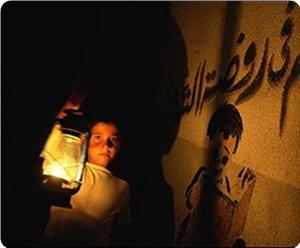
GAZA, (PIC)– The Palestinian Centre for Human Rights (PCHR) expressed in a statement deep concern over the deterioration of humanitarian conditions of the civilian population due to the aggravation of the electricity crisis in the Gaza Strip.
PCHR is deeply concerned that the current crisis may impact the access of 1.7 million Palestinians to vital services, including the supply of drinking water, and that this crisis may result in the suspension of work in some vital sectors, such as health, sanitation and education, according to the statement.
According to PCHR’s follow-up of the chronic power crisis in the Gaza Strip, the Palestinian Energy Authority in Gaza announced that the operation of the Gaza Power plant was totally stopped on Friday morning, 01 November 2012.
PCHR confirmed that the shutdown of the Gaza plant power has left serious consequences on the humanitarian conditions of the Gaza Strip’s population due to the deficit in daily needs of power in Gaza. The Electricity Distribution Company (GEDCO) in Gaza was forced to increase the hours of power outages on houses and vital facilities from 8 to 12 hours daily.
PCHR is deeply concerned over further deterioration of civilians’ humanitarian conditions as the power crisis has affected all civilians’ daily life needs and violated their right to access to basic and necessary services, including access to health facilities and to treatment, access to educational institutions, including schools and universities, and access to water services, including drinking water in homes and all other vital services, the statement added.
“About 1.7 million inhabitants of the Gaza Strip are facing deficiencies in all walks of their daily life, which have affected their basic needs, including health services, access to water, environmental health services and ability to meet the educational needs of school and university students.”
The center warned of the deterioration of health conditions in the health facilities of the Gaza Strip due to inability to compensate the shortage of electricity for long hours on the one hand, and their inability to provide fuel needed to run the alternative generators in these facilities on the other hand, in addition to breakdown of many machines and medical equipment at hospitals and health facilities of the Gaza Strip.
The statement pointed out to hundreds of patients in the hospitals of the Gaza Strip face serious health risks as the medical equipment are not run regularly, especially in the intensive care units and other medical units like heart and kidney units.
PCHR said that local bodies, including municipalities and village councils, are unable to provide alternative fuel to ensure the workflow of their vital facilities serving the population of the Gaza Strip, including water and sanitation facilities. Citizens’ complaints started to resound because of their inability to get water in their houses, especially in high buildings.
Different bakeries in the Gaza Strip said that they partially stopped working due to the long hours of power outage and the shortage of the fuel needed to run the machines. One can notice overcrowding for long hours in front of bakeries in order to get the basic needs, PCHR’s statement said.
Educational facilities in universities and educational institutions are suffering serious disorder, which led to the inactivity of many educational laboratories and the postponement of some educational assignments due to electricity shortage and lack of alternative power sources.
The aggravation of electricity crisis has coincided with the mid-term exams that started about a week ago in the schools and universities of the Gaza Strip. The majority of governmental schools is still without electricity and cannot provide the students with alternatives, the statement added.
Hundreds of institutions and associations in the Gaza Strip had to postpone their activities and programs due to the electricity shortage all day and their inability to provide alternative power sources to run their machines and equipment.
The suffering of the population of the Gaza Strip has seriously aggravated, especially those living in high buildings and who depend on elevators in the ascending and descending from their apartments. Dozens of residents, including elderly people and patients with chronic diseases have been greatly affected.

Wednesday, November 2, 2011

ACT NOW!! BOATS SAILING NOW TO GAZA! SPREAD THE WORD.

Israel and the US outsourced the siege of Gaza to Athens last summer by preventing 8 boats in the Freedom Flotilla 2-Stay Human from sailing from Greek ports to Gaza. Despite this we were able to bring world-wide attention to the blockade of the Gaza Strip. Our efforts in Greece only fueled our determination to challenge the imprisonment of the people of Gaza. We said we would continue to sail and so we are!!!
 
At this moment, two boats are in international waters in the Mediterranean heading to Gaza.  One boat, the Saoirse from Ireland, includes parliamentarians among its passengers.  The other, the Tahrir, carries representatives from Canada, the U.S., Australia, and Palestine.  The U.S. Representative on the Tahrir, Kit Kittredge, was a passenger on the U.S. Boat to Gaza, The Audacity of Hope mission in Athens in July.  A journalist from Democracy Now is on the Tahrir also. Civil society organizations in Gaza await their arrival, and look forward to the delivery of letters collected from thousands of U.S. supporters in the To Gaza With Love campaign.  
 
We need your help to make this mission a success. Please take these actions immediately.
 
1. Check these websites for updates:  US to Gaza, Irish Ship to Gaza and Canadian Boat to Gaza,  watch  or listen to Democracy Now for live coverage from the Tahrir.. Look for twitter hashtag #Freedomwaves.
 
2. Spread the word far and wide – send this alert to your contacts.
 
3. Call the State Department  and the White House- demand that they take immediate action to ensure the safe passage of these boats and to put an end to the siege of Gaza.
 
Call the State Department:
      Secretary of State Hillary Clinton 202-647-5291
      U.S. Ambassador to Israel Daniel Shapiro 011-972-3-519-7575
      Office of Israel/Palestinian Affairs Paul Sutphin 202-647-3672
      Office of Consular Affairs, Kim Richter 202-647-8308
 
 and the White House: 202-456-1414
  
      email President Obama at http://www.whitehouse.gov/contact
 
Here are some talking points or suggested messaging: 
 
Gaza has been under siege since mid-2006, depriving 1.6 million people of their liberty and basic human rights.  Although the siege has been condemned by the United Nations, the Red Cross, and many national governments, nothing has been done to ease the plight of these civilians.  Civil society has had to act where governments would not.  Two ships with 27 passengers from 5 countries are sailing to Gaza to confront the Israeli naval blockade, and to bring medical supplies and letters of support. 
 
As Americans we insist that our government (which sends Israel $3 billion in military aid every year), demands that Israel insures the ships’ safe passage and ends its illegal blockade of Gaza. There is absolutely no excuse to subject 1.6 million people to collective punishment. Ask your local press to cover this story.  Up-to-date information will be available at www.ustogaza.org, www.irishshiptogaza.org  andwww.tahrir.ca

Palestinian youth join boats set to challenge Israel’s siege of Gaza


2 November 2011
 FOR IMMEDIATE RELEASE   

Palestinian youth join boats set to challenge Israel’s siege of Gaza
  • Irish and Canadian boats in international waters on their way to challenge illegal siege policy
  • Palestinian activists call for end to international complicity in Israel’s crimes
  • Support actions taking place throughout the West Bank and inside Israel
[Ramallah] Two civilian boats, the Canadian Tahrir (Liberation), and the Irish Saoirse (Freedom), carrying 27 people from nine countries, are currently in international waters making their way to the beleaguered Gaza Strip to challenge Israel’s ongoing criminal blockade of the territory. A Palestinian youth activist from Haifa has joined this renewed international mission to challenge Israel’s unrelenting stranglehold on Gaza via the sea. The message they carry is one of unity, defiance, and hope, in spite of Israel’s policies that have physically separated Palestinians from each other. The “Freedom Waves to Gaza” organizers chose not to publicize the effort in advance given Israel’s efforts to block and sabotage Freedom Flotilla II last July. The boats, which set sail from Fethiye, Turkey, are expected to arrive in Gaza on Friday afternoon, sailing from international waters straight into Gaza’s territorial waters without entering Israel’s waters. The boats carry symbolic cargo - $30,000 in medicines, along with a diverse group of passengers, all committed to nonviolent defense of the flotilla and Palestinian human rights.

“Israel has caged Palestinians in Gaza and the West Bank, prohibiting physical contact between us. We want to break the siege Israel has imposed on our people,” said Majd Kayyal, a Palestinian philosophy student from Haifa on board the Tahrir. Kayyal added, “The fact that we’re in international waters is already a victory for the movement. Israel’s siege of Gaza is untenable and it’s a moral responsibility to put an end to this injustice.”

Meanwhile, a statement signed by Palestinian youth urged the international community and the U.N. in particular “to take urgent action to protect this mission as well as to end its compliance with Israel’s criminal blockade of Gaza.” They condemned the U.N. Secretary General’s previous declarations calling for aid to Gaza to go through "legitimate crossings and established channels," despite the U.N.’s own admission that Israel’s failure to own up to its responsibilities has created an unprecedented crisis of human dignity.

Throughout the week Palestinian activists in the West Bank and inside Israel are organizing solidarity actions with the Freedom Waves mission, including a presence outside the UN compound (Tokyo Street, Ramallah) and rallies across West Bank towns.

This is the 11th attempt to break the siege of Gaza via the sea, with five missions arriving safely in Gaza between August and December 2008 and the remaining violently intercepted by Israel. On May 2010, Israel attacked passengers of the Freedom Flotilla in international waters, killing nine civilians and injuring over 50. Israel’s actions were widely condemned and led to protests around the world. Efforts to bring a second flotilla to Gaza were foiled by the government of Greece last July following pressure by Israel and Western governments, as well as by acts of Israeli sabotage.  

Israel has intensified in the past days its aerial bombardments on Gaza, underlining the need for international initiatives of deterrence similar to this one.

##

For more information contact:
+970-592-346-895
FreedomWaves4PAL @ gmail.com

Note to editors:
For up to the minute information on the Freedom Waves flotilla: http://witnessgaza.com/
Twitter: @PalWaves #FreedomWaves

--
PLEASE FORWARD THIS UPDATE WIDELY

DONATE @ http://palsolidarity.org/donate

WEBSITE: http://palsolidarity.org
YOUTUBE: http://youtube.com/user/ISMPalestine
TWITTER: http://twitter.com/ismpalestine
FACEBOOK: http://www.facebook.com/pages/International-Solidarity-Movement/56674479144

Friday, May 27, 2011

Support the Freedom Flotilla to Gaza


We are writing to ask for your support for the Gaza Freedom Flotilla scheduled to set sail in the second half of June to the besieged Gaza strip. You can help prevent an assault on the nonviolent activists aboard the Freedom Flotilla to Gaza by signing on to our petition.

At least ten ships with dignitaries, doctors, professors, artists, journalists, and activists, as well as construction supplies and humanitarian aid, will sail from ports in Europe to Gaza in an act of non-violent civil disobedience to persuade the international community to fulfill its obligations towards the Palestinian people and end Israel's four-year illegal blockade of Gaza.

This is the second, large-scale citizen-to-citizen flotilla to be launched by international grassroots groups. Organized by 14 national groups and international coalitions, the flotilla will carry approximately 1,000 passengers. It will include a US boat named The Audacity of Hope, which will have aboard dozens of dedicated social justice activists. Learn more about the US Boat to Gaza. 

The last Freedom Flotilla in May 2010 included seven vessels carrying nearly 700 passengers from 36 different countries. Israeli commandos attacked the boats, shooting and killing nine passengers, injuring over 50 and imprisoning all aboard.This tragedy opened the subject of Gaza on the world stage and put considerable pressure on Israel to ease the draconian siege on Gaza – something the international community had failed to do for 3 years. Learn more about the Free Gaza Movement and support their efforts.

We ask you to sign this petition to show the overwhelming public support for an end to siege of Gaza and the rights for Palestinians. We also demand that the American administration apply pressure on Israel to ensure that passengers are not violently attacked and to allow the flotilla to sail to Gaza.
READ PETITION LETTER & SIGN..

Wednesday, December 22, 2010

Break the Siege, #Gaza2 Campaign

Dear friends,
Palestine suffers injustice, and oppression, and apartheid more than ever before. Torn into pieces, settlements scattering it all, the Holy Land is assaulted and its people massacred and discriminated while the whole political world is watching, turning blind to Israel’s violations of human rights and international laws toward the Palestinians.
As you all know, we are approaching the 2nd anniversary of the offensive on Gaza by the Israeli Occupation Forces, a massacre among others perpetrated against the Palestinian people. During 22 days in 2008-2009, more than 1,400 Palestinians were slaughtered, over a third of them were children and women.
Many initiatives aimed to break the siege imposed by Israel since Hamas took over the Strip in 2006, one of which resulted in the assassination of 9 peace activists in international waters on last May, when Israeli Navy assaulted the Mavi Marmara. Since then, a blockade ease has been demanded by the international community, in vain, as Gaza still lacks medicines, basic food and electricity, and is daily bombed by Israeli F16s.
We, citizens of the world, demand more than just an ease. We, citizens of the world, demand freedom for all Gazans, freedom of movement, freedom of exportation and importation, we demand the complete lift of that inhuman siege, claiming more lives day after day. Till when will the Palestinians of Gaza suffer power shortage? Till when will the patients bear the lack of medicines? Till when will the children of Gaza wake up and sleep to the sound of aircrafts? When will the Strip live on its own agriculture, and stop being dependent from the humanitarian convoys?
There is a real awakening, we can all feel it from the multiplication of convoys and flotillas, from the wave of recognition of Palestine as a State by other countries, from the NGOs’ calls denouncing the misery Israel keeps Gaza in. And this is because the information is being spread better and better.
Hence, we decided to launch an online campaign officially starting onDecember, 27th 2010 to raise awareness and mark the massacre’s 2nd anniversary. The principle is simple:
- On Twitter, post/repost all the tweets concerning Gaza with the #Gaza2 hashtag. It can be links, news, facts, personal statements. @VEPalestine will be posting intensively, so you can use it as a bank of posts. You can also click herefor a real time feed of every mention of #Gaza2 on Twitter.
- Join here the #Gaza2 Campaigners twitter list and follow those in that group to be able to have a great variety of links to share and create a wide network.
- On Facebook, same principle. Post and repost the links you can find on Gaza. The aim, again, is to raise awareness.
- Add the Siege Counter to your blog/website:
”http://dreamyhaze.com/GazaCounter/GazaCounter.ashx“


””http://dreamyhaze.com/GazaCounter/GazaCounter.ashx“”

- Use the following picture in your different social media accounts as profile picture:
- Share this link to your contacts in order to get as many people as possible involved.
The best is that till the 27th, you spread the link as much as possible, and start using the hashtag #Gaza2 on the 27th. If you have any suggestion, if you want to translate this page in your language, please post a comment or send us an email at vepalestine[at]gmail.com.

Monday, August 17, 2009

Out in the cold from another world body: Israelis complain Palestinian names being used in Palestine

August 2009
World Archaeological Congress excludes Israelis from Ramallah
13th August 2009


Israel's Antiquity Authority bitterly condemned the World Archaeological Congress for failing to invite Israelis to a conference in the West Bank city of Ramallah. This follows the departure of the Israeli Journalists from the international body recently.

The Israeli State normally excludes all Israelis from visiting Ramallah, but consistency has never been a Zionist trait (save for dispossession and theft)

In a letter to WAC President Clair Smith Thursday, the IAA protested the organization of the conference, "which relates specifically to the conduct of Israeli archaeology, but, to our knowledge, Israeli archaeologists were not invited nor were they informed."

Dahari was angry at the use of Palestinian names for the sites such as Haram al-Sharif for the Temple Mount, since Israel is in the middle of a long-term programme of obliterating Palestinian names, history and memory, with the active connivance of the Israeli Antiquities Authority.

"It would be best if the WAC would focus on archaeology and not on politics," said Dahari, on behalf of the highly politicised IAA, without a doubt one of the most politicised archaeological associations in the world.

Report from UPI here

See related articles:Corrupt Israeli archaeology in the service of ethnic cleansing

King David Recruited to Expel Palestinians When Archaeology Becomes a Curse


Le Monde diplomatique: Myths of Zionism shattered, Zionist political 'amnesia' challenged


Israeli archaeological vandalism - artefacts inconvenient to rabid Zionists were 'disappeared'


Challenges mounting to Zionist archaeology that ethnically cleanses the past


Join Scottish PSC - we are all volunteers with no paid staff - or make a financial donation to help us continue campaigning work:
Send a cheque to:
Scottish Palestine Solidarity Campaign
c/o Peace & Justice Centre
Princes Street
Edinburgh
EH2 4BJ
www.scottishpsc.org.uk
SPSC is affiliated to the Palestine Solidarity Campaign (UK) www.palestinecampaign.org

Nonviolent direct action, solidarity and struggle

Ramzi Kysia,
The Electronic Intifada,
17 August 2009
http://electronicintifada.net/v2/article10712.shtml

"You who stand in the doorway, come in...The siege is a waiting period

Waiting on the tilted ladder in the middle of the storm...It is up to the soul to come down from its mount

And on its silken feet walk

By my side, hand in hand, like two longtime friends...May we walk this road together"

(from "Under Siege," by Mahmoud Darwish)

A year ago, 44 ordinary people from 17 different countries sailed to Gaza in two small wooden boats. We did what our governments would not do -- we broke through the Israeli siege. During the last year the Free Gaza Movement has organized seven more voyages, successfully arriving to Gaza on five separate occasions.

Regardless of Israeli threats and intimidation, Free Gaza volunteers will continue sailing unarmed boats to Gaza. Ours remain the only international ships to reach the Gaza Strip in more than 42 years. By directly challenging the Israeli military with our small boats, we have concretely demonstrated that this siege has nothing whatsoever to do with security and is simply an illegal act of collective punishment.

But the siege of Gaza cannot be separated from the crisis of checkpoints and home demolitions in Jerusalem and the rest of the West Bank, nor from the oppression of Palestinian citizens of Israel, nor from the harsh and unjust conditions of the millions languishing in refugee camps across the Middle East, nor from the plight of the more than 11,000 political prisoners held by Israel, nor from the calamity of extra-judicial killings of Palestinians by Israeli forces, particularly the killings of Palestinian children, nor from Israel's ongoing theft of Palestinian natural resources, nor from the right of return for all Palestinians in the Diaspora. Gaza is but one bitter element of the struggle for justice for all of Palestine.

Contrary to its presentation in the mainstream media, this conflict is neither a righteous war against terrorism, nor a long-standing religious or ethnic dispute. The Israeli-Palestinian conflict is the struggle of two irreconcilable and unequal causes: the struggle of an oppressed people for freedom, justice and self-determination against their oppressors' struggle to maintain their domination.

The purpose of nonviolent direct action and civil resistance is to take risks and put our selves in the way of injustice. We take these risks well aware of what the possible consequences may be. We do so because the consequences of doing nothing are so much worse. Any time we allow ourselves to be bullied, every time we pass by an evil and ignore it, we lower our standards and allow our world to be made that much harsher and unjust for us all.

Other international solidarity and action campaigns preceded ours, such as the European Campaign to End the Siege on Gaza, and more have begun in recent months, such as Viva Palestina, the International Movement to Open Rafah Border, Code Pink's delegations to Gaza, and the Gaza Freedom March.

These campaigns are all important. Working together, we have been able to complement and multiply our efforts, drawing the world's attention to the suffering caused by Israel's illegal blockade. We have been able to bring in limited amounts of needed aid, and bring out of Gaza a handful of Palestinian students, medical patients and others. These are worthwhile labors, but they are not enough. As the great Indian resistance leader Mahatma Gandhi stated on 11 September 1924: "[The people] are as yet untouched by [our] politics ... Their politics are confined to bread and salt ... We must share their sorrows ... Then and not till then shall we truly represent [them] ..."

The truth is that all our work combined has yet to significantly impact the daily lives of the Palestinian people.

As solidarity campaigners, it's our job to take our direction from comrades already struggling inside occupied Palestine. But as internationals we should also remind ourselves that our primary work lies in our own communities. In the end, our struggle is not about charity; the Palestinian people need justice and political action, not charity.

Viva Palestina's journey through North Africa, on their first mission from Britain to Gaza, helped mobilize countless individuals. Their planned journey through Europe this December will mobilize countless more. Volunteers working and traveling with Viva Palestina have begun dozens of twinning projects between their communities in the West and communities inside Palestine. The fruits of these efforts are unknowable. However, there are tremendous possibilities for not only providing concrete assistance to those in need, but also for politicizing and mobilizing individuals across the world to get involved in the struggle for justice in Palestine.

Similarly, the Free Gaza Movement is working to mobilize individuals through the Right to Read campaign, and through direct lobbying of governments and the international community to actually enforce international law in regards to Palestine. We are reaching out to existing social movements and labor unions in the West, complementing existing efforts to establish and broaden boycott, divestment and sanctions campaigns against apartheid Israel.

The continuing failure of the international community to enforce its own laws and protect the Palestinian people demands that we as private citizens directly intervene to take action commensurate with the crisis. What is needed in our world today is not simply protest against the violence of occupation and oppression. What we need is a greater resolve -- a new militancy rooted in the profound respect for human life, and sustained by profound disrespect for any government or group that terrorizes our sisters and brothers around the world.

More than at any time in recent memory, ordinary people around the world seem to be answering this call.

-----
Ramzi Kysia is an Arab-American essayist and an organizer with the Free Gaza Movement. If you would like to support these efforts, please visit www.FreeGaza.org, or email donations[at]freegaza.org. If you would like to volunteer with Free Gaza, please send an email to volunteer[at]freegaza.org

Important Websites:

PALESTINIAN ORGANIZATIONS
* Al-Awda, the Palestine Right to Return Coalition
http://al-awda.org

* Palestinian BDS National Committee
www.BDSmovement.net

* Palestinian Campaign for the Academic and Cultural Boycott of Israel
www.pacbi.org

* The Palestinian Centre for Human Rights
www.pchrgaza.org

* Al-Haq, an independent Palestinian non-governmental human rights organization
www.alhaq.org

The Palestinian Initiative for the Promotion of Global Dialogue & Democracy
* www.Miftah.org

* ADDAMEER, Prisoners' Support & Human Rights Association
http://addameer.info/

SOLIDARITY ORGANIZATIONS
* The European Campaign to End the Siege on Gaza
www.SaveGaza.eu

* Viva Palestina
www.VivaPalestina.org

* International Movement to Open Rafah Border
www.facebook.com/group.php?gid=9986479902

* The Free Gaza Movement
www.FreeGaza.org

###

Friday, July 17, 2009

Malnutrition begins to bite

Eva Bartlett | Inter Press Service

15 July 2009

“There are some people who buy frozen meat, because it’s much cheaper: 20 shekels (five dollars) per kilo versus 60 shekels for fresh beef.”

According to the 45-year-old father of ten, while business is in general terrible, the better days are early in the month, when those with salaried jobs often receive their pay.

“On average, I might make 200 shekels a day in the first five days of the new month. Before the siege, it was 450 shekels a day. I do have some more regular customers. But they have no money. They keep a tab, and pay when they can.”

Like many Palestinians, Jerjowi used to work in Israel. “When Israel closed the borders, I had no work. So I opened a butcher shop.”

On a normal day, Jerjowi says he only earns at best 100 shekels, not enough to cover the rent of his shop – 4,000 dollars a year – nor that of his family’s homes. “My three sons are all married. Together, our house rents are 200 shekels per month. We’re not earning that money. And there are daily expenses, like electricity and water.”

With unemployment rates at 50 percent in Gaza, and 80 percent of Gazan Palestinians dependent on food aid hand-outs, it’s no wonder that Jerjowi’s business isn’t booming. But the problem lies not only with Gaza’s siege-shattered economy and the great poverty this has created; it is also the scarcity of beef.

After the three weeks of the Israeli air, land and sea bombardment which killed over 1,400 people, Gaza’s agricultural sector is devastated, and that includes the beef farmers. The United Nations Development Project reports that 17 percent of Gaza’s livestock and nearly ten percent of the poultry were killed during the war. And even
before the Israeli attacks, in November 2008 Gaza’s Ministry of Agriculture was already warning of a “real food disaster” due to the siege on animal feed and livestock, directly affecting the well-being of what livestock did exist in Gaza.
Gazan Palestinians have tried to make up for the deficit of cattle by bringing calves and sheep through the tunnels from Egypt. Yet, the prices are high, above the budgets of most. On Jun. 19, for the first time since Oct. 31 2008, Israel allowed
livestock into Gaza: 15 trucks. This number falls far below not only the nutritional needs of Gaza’s residents, but also the capacity of the border crossing to receive trucks.

In 2008 and 2007, according to the Office for Coordination of Humanitarian Affairs (OCHA) the monthly total of livestock trucks entering Gaza varied from 20 to 207, keeping with the trend of severely restricting Gaza’s livestock imports under the Israeli-led siege.

Prior to Jun. 19, the only cattle shipment overland into Gaza was on Oct. 31 2008, with a monthly total 78 trucks…to last nearly nine months. The Coordinator of the Israeli Government Activities in the Territories (COGAT) previously suggested an amount of 300 cows weekly as the minimum for the nutrition of Gaza’s 1.5 million people.

According to the UN and various non-governmental organisations, the trickle of goods entering Gaza now is just a quarter of that prior to the siege, the majority of which is limited to basic food aid items. The aid-dependent families have moved from a balanced diet to one consisting mainly of sugar and carbohydrates, lacking in vitamins and proteins.

The World Health Organisation (WHO) cites an increase in growth-stunting malnourishment, now at over 10 percent of children, attributed to a chronic lack of protein, iron, and essential vitamins. The WHO further warns of increasing anaemia rates: 65 percent among children below 12 months of age, and 35 percent among pregnant women.

The United Nations Children’s Fund (Unicef), the World Health Organisation (WHO), and Gaza’s Ard Al-Insan centre for nutrition, among various bodies, note the link between malnutrition and a deficiency of protein and vegetables in the diet.

An International Committee of the Red Cross (ICRC) June 2009 report notes that the effects of a restricted diet also include “difficulty in fighting off infections, fatigue and a reduced capacity to learn.” The ICRC warns of the long-term ramifications on Gaza’s malnourished children.

In June 2009, 38 NGOs, including Oxfam, Care World Vision, and UN bodies, called for an end to the siege, citing the need for normalised trade with Gaza. The ICRC June report likewise called for resumption of imports and exports, but warned that the situation has deteriorated to an extent that Gaza will need years to recover.

For Yousef al Jerjowi, who has scaled down his opening hours due to the lack of customers, the siege couldn’t end soon enough. Jerjowi’s three sons work in his shop, saving him 40 shekels daily wages for an employee. “If my sons didn’t work here, I’d have to close the shop.”
____________________

Wednesday, June 24, 2009

Audio: A reporter tries to buy new equipment in Gaza


EI contributor Rami Almeghari conducts an interview with a man whose home was destroyed by Israel in the southern Gaza Strip, February 2009. (Matthew Cassel)

Exporting and importing goods in most countries around the world is usually a smooth process, but not in Gaza. For two years now, there have been complete restrictions on people and goods alike from entering or leaving Gaza, due to the ongoing Israeli siege.

Among those essential items that Israel is denying entry into the coastal territory, are raw materials for building and reconstruction, medical supplies, food products, electronics and many other items. The siege has made life for all Palestinians in Gaza, including myself, extremely difficult in every way. It has affected my work as a Gaza-based radio reporter and writer for international publications based outside Gaza. I am always in need of upgrading my reporting tools to make sure I can do my work.

For the past three years I have been a correspondent for the US-based Free Speech Radio News (FSRN). Until recently, I had been using a minidisc recorder that was sent to me from a friend in the West Bank before the total closure of Gaza began in 2007.

In late 2008, I needed to replace my old recording equipment that had poor sound quality and purchase a new audio recorder. Unfortunately, with the ongoing Israeli siege, this simple task of obtaining a new recorder was nearly impossible.

The following audio diary tells the story of my efforts to receive a new audio recorder from the US so that I could continue documenting the many untold stories of the people of Gaza.


Download [MP3 - 5.7 MB]