
Faiza Al-Tanboura had not spoken for 21 days since a missile strike destroyed her home. In the early hours of this morning she found her voice: “The children. Don't let them kill the children,” she shouted as she ran out into the playground of a UN school under Israeli tank fire.
Boycott israHell!

Бойкот на израел и печелещите от окупацията! Boycott israHell and those who profit from occupation!
Showing posts with label murder. Show all posts
Showing posts with label murder. Show all posts
Thursday, July 31, 2014


Monday, July 28, 2014
Remembering the Victims of Israeli Operation ‘Protective Edge’ on #Gaza 1,030 Palestinians as of 7/27/14
Remembering the Victims of Israeli Operation ‘Protective Edge’ on Gaza 1,030 Palestinians as of 7/27/14
http://www.beyondthenumber.org/
Monday, July 21, 2014
Israeli sniper killing wounded civilian
20/7/14: International and Palestinian volunteers accompanied Civil Defense and other rescue crews, as well as family members, into Shujaya, in an attempt to locate survivors of overnight and ongoing shelling by the Israeli army. A young Palestinian man, in a green t-shirt, who hoped to reach his family's home, was shot by an Israeli soldier while crossing an alley between buildings. Two additional rounds struck him as he lay injured on the ground.
Sunday, July 20, 2014
#Gaza #Pray4Gaza All family in Jannah in sha ALLAH!

Sajy and Kenan, their father and their pregnant mother were killed today after IOF targeted their home!
Inna Lillahi wa inna ilayhi raji'un...
Sunday, November 10, 2013
15 Palestinians killed since the resumption of negotiations
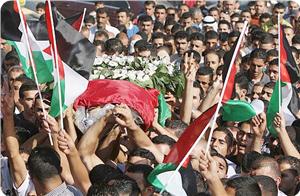
AL-KHALIL, (PIC)– A statistics report prepared by Quds Press International news agency showed that fifteen Palestinians died since the resumption of the negotiations, three months ago.
The negotiation between the Palestinian Authority and the Israeli occupation was resumed in Washington on July 30, for the first time after it had been frozen for three years. Yet the Israeli violations and attacks against Palestinian civilians and their properties and sanctities have continued.
The statistical report said that three Palestinians from the Jenin refugee camp died a few days after the resumption of the negotiating sessions, after being shot by Israeli forces.
The Israeli occupation forces continued killing and attacking the citizens and destroying the Palestinian properties, indifferent to the ongoing negotiating sessions. On August 26, the IOF special forces committed a massacre in the Qalandiya refugee camp in Ramallah, wounding about 20 Palestinians and killing 3 others.
After the resumption of the negotiations, the Israeli army assassinated 4 Palestinian resistance fighters from the Qassam Brigades.
Quds Press’ report also pointed out that 3 Palestinian youths were killed during the last three months: Ahmed Tzazaah from the town of Qabatiya in Jenin after clashes with the occupation army, and Anas al-Atrash and Bashir Hababin after being shot by Israeli soldiers at Container and Za’atara checkpoints
The deliberate policy of medical neglect has also continued in the occupation jails and recently led to the death of patient captive Hassan al-Turabi from Nablus.
The PA ignored Palestinian factions’ calls for ending the negotiations, in response to the occupation persistent crimes which led in the past three months to the death of 15 Palestinians, detention of hundreds and displacement of large numbers of residents from their homes that had been confiscated or demolished, not to mention the Judaization projects that continued in Jerusalem unabated and the settlement plans which included the construction of more than 1,700 new housing units.
Sunday, June 2, 2013
Mass Palestinian grave found in Tel Aviv
 |
| mwcnews.net |
The remains of dozens of Palestinians killed by Israelis in fighting during the war of 1948 which led to the creation of the state of Israel have been found in a mass grave in Tel Aviv's Jaffa district.
An official at the Muslim cemetery there told AFP news agency that the grisly find occurred on Wednesday when ground subsided as workers carried out renovations, revealing six chambers full of skeletons.
Jaffa fisherman Atar Zeinab, 80, says that as a teenager during the final months of fighting in 1948, he helped to collect the Arab dead in the area south of Jaffa and bring them for hasty burial in the cemetery, the area's main graveyard.
"I carried to the cemetery 60 bodies during a period of three or four months," he told AFP. "We used to find the people in the street and most of the time we didn't know who they were."
He said that the danger of being hit by flying bullets or grenade fragments was such that bodies were dumped one on top of the other in existing family crypts in the cemetery, contrary to Muslim custom.
"We carried them early in the morning or in the night," he added. "We put women, children and men in the same place...nobody prayed for these people."
Jaffa was at the time a Palestinian town, but there was a forced exodus of most of its Arab population when it fell to the fledgling Israeli army and rightwing Jewish armed gangs.
In 1950 it was incorporated into the city of Tel Aviv which was renamed Tel Aviv-Jaffa.
Today it has a mixed Arab and Jewish population.
Around 760,000 Palestinians fled or were forced from their homes in what they call the "Nakba" or "catastrophe" of 1948.
Wednesday, November 21, 2012
#MURDER | Israelis kill Palestinian worker Ahmed Eid, 22 years old in cold blood just for being Palestinian
NOVEMBER 21, 2012
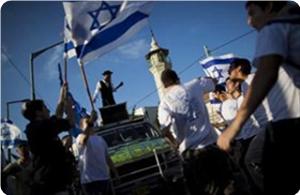
JENIN, (PIC)– Three Israelis abducted a Palestinian worker from his workplace in Yarka village, in 1948 occupied Akka province, on Tuesday night and killed him in cold blood.
Relatives told the PIC that three Israelis took Ahmed Eid, 22, from his sleeping bed in the village to nearby groves and shot him to death just because he is a Palestinian.
They said that his brother Mahmoud, who went to inquire about his brother, miraculously escaped from the Israelis but was detained by the police along with his brother’s body.
They said that both brothers, from Jenin, worked in a carton factory in the village.
Monday, November 19, 2012
Gaza conflict: family's four children buried as bombardment continues
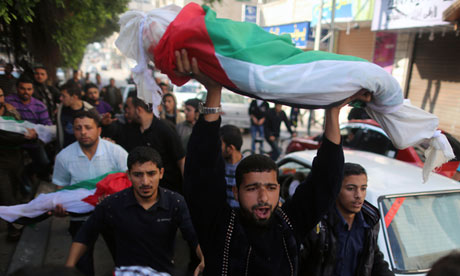
Palestinians carry the bodies of the Dalou children to their funeral in Gaza City. Photograph: Wissam Nassar/Xinhua Press/Corbis
The bodies of four children wrapped in Palestinian flags were carried above a huge crowd from the rubble of their home, destroyed in an Israeli air strike, to their graves on Monday amid mounting anger over the sharply rising toll of civilians in the six-day-old war in Gaza.
Bulldozers, which were clearing concrete and twisted metal from the site of the Dalou family's home in the hope of finding two bodies still trapped beneath the ruins, stopped work to allow the funeral procession to pass.
"Do these children look like terrorists?" asked grief-stricken relatives and neighbours of the dead. Eight members of the Dalou family, including four children aged between one and seven, were killed when a missile struck their three-storey home at around 2.30pm on Sunday. Two family members are still missing, and two neighbours were also killed.
The funeral took place amid a heavy Hamas presence, although the family had no known affiliations with any militant group.
"There has been a drastic change since the beginning of this conflict," said Hamdi Shaqqura of the Palestinian Centre for Human Rights (PCHR) in Gaza. "There is now a complete disregard for human life, shown by the attack on the Dalou family home in the middle of a residential area. This was not the home of a militant."
According to the PCHR, there were 31 civilian deaths in the 24 hours to noon on Monday, whereas in the previous four days there had been a total of 27 civilian deaths. "There has definitely been a big acceleration," said Shaqqura.
At least 18 children have been killed since the start of the conflict last Wednesday, and more than 600 civilians have been injured, he said. The Gaza health ministry said 24 children had been killed.
The total death toll in Gaza topped 100 on Monday following another day of intense bombardment. According to Ashraf al-Kidra of the Gaza ministry of health, the most recent victims included a child killed by flying shrapnel and five farmers. Elsewhere it was reported that a father and son were killed while the man was repairing a water tank on the roof of his home.
Israeli fighter planes targeted a high-rise building containing the offices and studios of local and international media organisations in the centre of Gaza City for a second time. Ramez Harb, the head of Islamic Jihad's media operations, was killed and at least six were wounded.
Black smoke billowed from the building after it was struck by three missiles. Witnesses reported chaotic scenes as paramedics tried to reach the injured while firefighters tackled the blaze.
The Israeli Defence Forces (IDF) said the building was a "hideout" used by Islamic Jihad. In a statement it said: "The Palestinian Islamic Jihad operatives, who were involved in firing rockets at Israel, were inside the media building when it was targeted."
The IDF spokeswoman Avital Liebovich tweeted: "The presence of senior Islamic Jihad militants in media building in Gaza demonstrates the ongoing tactic of using civilian [buildings] as shield."
The reason for the targeting of the Dalou family home remained unclear. Two Israeli papers reported that the IDF had targeted the wrong house, while a third said it was targeted in the belief that a Hamas militant was inside.
Neighbours told reporters that the Dalou family had no connections with militant organisations and that the father – who was not at home at the time of the air strike – owned a grocery shop.
Israeli intelligence tracks militants by their use of mobile phones, informants and evidence gathered by unarmed surveillance drones.
In the first two days of the offensive, Israel focused its firepower on military training grounds, rocket-launching sites and weapons stores. It has since turned to targeting the homes of militants, increasing the likelihood of killing civilians in the densely populated residential areas of Gaza City.
The IDF said it had struck 80 targets in Gaza on Monday. More than 120 rockets had been launched from Gaza, with 42 landing in Israel, it said. Three Israelis were slightly injured
.
.
Al-Dalou family murder by the most moral army in the world...
Gaza: four children killed in single Israeli air strike
Attack believed to be aimed at Hamas official wipes out 11 members of a single family as onslaught continues
At least 11 members of one family, including five women and four children, were killed when Israel bombed a house in Gaza City on Sunday as the five-day-old war claimed more civilian lives with no sign of a let-up in the intense bombardment.
The air strike flattened the home of the Dalou family in the Sheikh Radwan district of Gaza City, causing the biggest death toll in a single incident since the offensive began last Wednesday.
On Monday morning the Israeli defense force appeared to admit the family had been killed by mistake. The Haaretz website quoted the army as saying their house was either incorrectly pinpointed or a missile malfunctioned.
Elsewhere in the city early Monday an air strike leveled two houses belonging to a single family, killing two children and two adults and injuring 42 people, including children, said Gaza heath official Ashraf al-Kidra. Rescue workers were frantically searching for 12 to 15 members of the Azzam family under the rubble. Shortly afterwards, Israeli aircraft bombarded the remains of the former national security compound in Gaza City. Al-Kidra said flying shrapnel killed one child and wounded others living nearby.
After the Dalou family home was destroyed, the bodies of the children were pulled from the rubble and taken to the morgue at Shifa hospital. The dead also included an 80-year-old woman.
Ismael Haniyeh, the Hamas prime minister, described the deaths as an "ugly massacre" and the Hamas military wing, al-Qassam Brigades, said: "The massacre of the Dalou family will not pass without punishment."
Diggers at the scene of the explosion were scooping rubble from flattened buildings as rescuers tried to locate survivors.
Witnesses said there were chaotic scenes as the dead and injured were brought to the Shifa hospital, which has been on emergency footing since the start of Operation Pillar of Defense.
The bodies of four young children lay on two metal trays in the morgue, covered in dust and blood. A crowd of onlookers outside became increasingly distressed as the body of the children's mother was wheeled in, covered in blankets.
The strike was originally thought to have been aimed at a Hamas official, Mohamed Dalou.
In all, 84 Palestinians, about half of them civilians, have been killed in the five-day onslaught and 720 have been wounded. Three Israeli civilians have died from Palestinian rocket fire and dozens have been wounded.
After an overnight lull in rocket fire from Gaza, Hamas and other groups renewed their attacks on Sunday. Sirens were activated in Tel Aviv for the third day running. Israel Army Radio reported that two rockets fired at the city were shot down by Iron Dome defense system. Late night, there were reports of renewed shelling in Gaza by Israeli navel vessels.
The tactic of targeting militants' homes carries the risk of further high casualties in the densely populated areas of Gaza's main cities. Many militants have moved their families to safer areas before going into hiding themselves. The Israeli military has also expanded the scope of its targets to take in Hamas-run government offices and compounds.
Some families living near militants or government buildings are leaving their homes to move in with relatives in signs of increasing internal displacement within the small and crowded Gaza Strip.
Israel claims it is carrying out "surgical strikes" and making strenuous efforts to avoid civilian casualties. "It is our intention to avoid what is called collateral damage," Moshe Yaalon, minister for strategic affairs, told a press conference in Jerusalem. "We operate slowly, identify the target and clean the area around it," he added, referring to warnings issued via dropped leaflets and text messages to civilians to stay away from individuals and locations likely to be targeted.
"But when they use civilians as human shields, what is our choice?" he said. "If they position rockets in densely populated areas, such as mosques and schoolyards, we should not be blamed for the outcome."
The World Health Organisation warned that Gaza's medical facilities were being overwhelmed as the number of people injured in air strikes topped 400, about one-third of whom are children.
"Many of those injured have been admitted to hospitals with severe burns, injuries from collapsing buildings and head injuries," the WHO said in a statement issued in Geneva. The UN body appealed for $10m (£6.3m) in immediate international support to help them cope with the casualties.
Sunday's death toll came after a night of heavy bombardment, including repeated and intensive fire from gunboats stationed off the Gaza coast.
Two buildings housing media organisations were struck in the early hours, injuring eight Palestinian journalists including a cameraman who lost a leg.
The al-Shawa building, which includes the studios of al-Quds television, which is associated with Islamic Jihad, and the al-Shuruq building, housing Sky News, al-Arabiya news network, Dubai TV and an office of al-Aqsa TV, which is affiliated with Hamas, were hit.
In a statement, the IDF said: "A communications antenna used by Hamas to carry out terror activity against the state of Israel, was ... targeted." The IDF denied that journalists were targeted.
Israel opened the Kerem Shalom crossing to Gaza briefly to allow humanitarian aid to enter and 26 patients and their families to leave for medical treatment.
Sunday, July 22, 2012
Palestine: Remembering Political Cartoonist Naji Al Ali
Today, [July, 22] marks the 25th anniversary of the assassination of Palestinian political cartoonist Naji Al Ali, famous for his criticism of Arab autocratic regimes, and Israel.
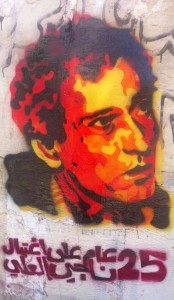
” 25 years over the assassination of Naji Al Ali”
photo: Facebook Page Handala
photo: Facebook Page Handala
Al Ali was born in Al-Shajara village in either 1936 or 1937. During the 1948 Arab-Israeli war, which resulted in the creation of the State of Israel, Al Ali was among hundreds of thousands of Palestinians to be expelled from their homes. With his family, he moved to a refugee camp in Southern Lebanon.
On this same day in 1987, Al Ali was shot in the face in London. As a result, he spent five weeks in a coma before passing away.
On this 25th anniversary, netizens from Palestine, and the entire Arab region have been paying tribute to Al Ali, by sharing his caricatures and quotes.
Handala:
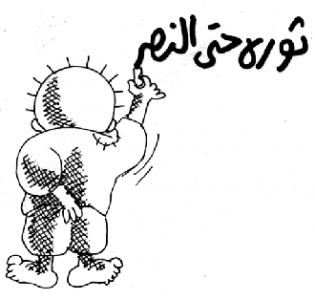
Handala writing on the wall: “Revolution until Victory”
Caricature by Naji Al Ali
Caricature by Naji Al Ali
Handala is undeniably Naji Al Ali's timeless star. Through Handala, Al Ali criticized and ridiculed Arab leaders, and societies, Israel, and US involvement in the Arab region.
Twitter user Yousef M. Aljamal tweeted Naji Al Ali's quotes on Handala. Here are some of these tweets:
@YousefAljamal:
“I drew him as a child who is not beautiful; his hair is like the hair of a hedgehog who uses his thorns as a weapon”, #Handala #NajiAlAli
@YousefAljamal: “His hands are clasped behind his back as a sign of rejection at a time when solutions are presented to us the American way.” #Handala
@YousefAljamal: “Handala was born ten years old, and he will always be ten years old.”
@YousefAljamal:
“At that age, I left my homeland, and when he returns, Handala will still be ten, and then he will start growing up”
@YousefAljamal:”The laws of nature do not apply to him. He is unique. Things will become normal again when the homeland returns.”
@YousefAljamal: “I presented him to the poor and named him Handala as a symbol of bitterness.”
@YousefAljamal: “At first, he was a Palestinian child, but his consciousness developed to have a national, global and human horizon.”
Timeless Caricatures:
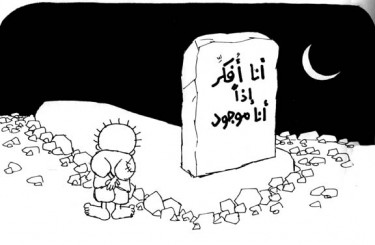
Handala turning his back to the viewer. At the grave “I think therefore I am” is written. Another immortal Caricature by Naji Al Ali- shared by twitter user @CultureofFear
Al Ali might be dead, but his caricatures have proved to be immortal, and timeless.
@iFalastenya: قتلوه ولكن حنظلة ما زال حيٌ يرزق. #ناجي_العلي
They killed him [Naji Al-Ali] but Handala is still alive
@ZahretTshreen #ناجي_العلي أصبح بتنبؤاته قائدا لكل شباب #فلسطين حتى بعد رحيله بربع قرن .. مازالت رسوماته تحكي واقعنا المريرpic.twitter.com/WO6C17WR
@ZahretTshreen: With his predictions, Naji Al Ali has become a leader of the Palestinian youth a quarter of a century after his death…His drawings still tell the story of our bitter reality
Over the years, Handala has stood as a symbol for Palestinian resistance and the right to return.
@occupytheory: #Handala continues resisting / حنظلة لا يزال يقاوم / #OWS #globalsolidarity #Syria #Egypt #Palestine #Bahrain #Yemen #Libya #Tunisia #Greece
@__Hossam: رحم الله من رسم حنظلة … حنظلة يا #ناجي_العلي مازال ينتظر العودة , ومازال ينتظر القدس , ومازال ينتظر وطن محرراً يحتضنه …
May the one who created Handala rest in peace…O Naji Al Ali, Handala still awaits returning [home]…still awaits Jerusalem, and still awaits a liberated home that embraces him
The 10-year-old boy also stands by the side of ordinary Arabs.
Mohamed Diaa from Egypt tweets:
#Handala was reflecting the suffering of Arab people under the dictatorship regimes. RIP #NajiAlAli
Who Killed Naji Al Ali?
It is still unknown who assassinated Al Ali, but there have been speculations about the involvement of Israel.
#Israel is not afraid of those holding a weapon as much as of those holding a pen. RIP Naji Al Ali. #Palestine
However, Al Ali did not only criticize Israel. Criticism of autocratic Arab rulers, and the Palestine Liberation Organization were common themes in his cartoons.
“He criticized everyone, I was told, Israelis, the PLO [The Palestine Liberation Organization] , Arab regimes. No one knows who killed him. Everyone had reason”, said comics artist and journalist Joe Sacco on Naji Al Ali in the introduction for the book A Child in Palestine.
The world may never know who was behind the assassination of Naji Al Ali, but the world will always remember him, and his imperishable character, Handala.
For more information about Naji Al Ali, and his work in English, check out this PDF document prepared by Arab American artist Fayeq Oweis.
Thursday, May 31, 2012
Avaaz.org - The World in Action
 This picture shows the bloodied bodies of dozens of innocent children, brutally murdered by the Syrian regime. As a parent, these images are almost unbearable, but I know we must not look away -- and that we can help end this slaughter. Our governments are deciding what to do right now. But they will settle for hand wringing diplomacy unless we demand firm action. Sign the urgent petition to send in thousands of UN monitors to protect the Syrian people in every region now:  |
Dozens of children lie covered with blood, their faces show the fear they felt before death, and their innocent lifeless bodies reveal an unspeakable massacre. These children were slaughtered by men under strict orders to sow terror. Yet all the diplomats have come up with so far is a few UN monitors 'observing' the violence. Now, governments across the world are expelling Syrian ambassadors, but unless we demand strong action on the ground, they will settle for these diplomatic half-measures.
The UN is discussing what to do right now. If there were a large international presence across Syria with a mandate to protect civilians, we could prevent the worst massacres while leaders engage in political efforts to resolve the conflict. I cannot see more images like these without shouting from the rooftops. But to stop the violence, it is going to take all of us, with one voice, demanding protection for these kids and their families. Click to call for UN action now and send this to everyone:
http://www.avaaz.org/en/syria_will_the_world_look_away_c/?vl
A child's death is tragic in any circumstance. The UN says 108 people were killed in the onslaught, 49 of them children under the age of 10, and the youngest was a 2 year old girl. 90% of the population of Al Houla has now fled their homes. As I put my daughter to bed last night, I tried to consider what the mothers and fathers and grandparents of these children feel. The sheer pain and desperation is unimaginable, but there will also be deep anger and hate for those that did this. Until all of us stop these attacks on the people of Syria, the cycle of violence will not end.
Let's not forget -- this bloodbath began over a year ago with thousands of people peacefully protesting on the streets -- calling, like their brothers and sisters across the region, for freedom and democracy. But the regime responded with brutality and violence -- murdering, torturing, abducting and laying siege to entire cities. The international community did not intervene, letting geopolitical concerns obstruct our responsibility to protect. Then, in desperation to protect their families and fight back against the repression, some took up arms. Now it is an armed conflict -- and if the world continues to do nothing it will become a full blown sectarian war that may last for generations and breed the kind of terrorist attacks we have yet to imagine in our worst nightmares.
When dozens of children are murdered in cold blood by the army and their militias -- it is time for serious action. Assad, his henchmen and his murderous army must be held to account and the people of Syria protected. Nothing the international community has done yet has pried Assad from his murderous grip on power. The few UN monitors on the ground were powerless to stop the Al Houla killings -- they only served to count the tiny bodies. But if we sent in hundreds of monitors to each of the fourteen regions of Syria, Assad's assassins would think twice.
The world looked away with Srebrenica, and with Rwanda. If all of us respond today -- we can make sure that these children's tragic deaths act as the tipping point for all of us everywhere to say NO MORE! But if we turn away, so will our leaders. Let's join voices from every corner of the earth and make it impossible for our leaders to ignore our cry. In respect for these dear children and their families, click to join the global call to demand a massive UN presence on the ground now!
http://www.avaaz.org/en/syria_will_the_world_look_away_c/?vl
The Avaaz community has stood with the people of Syria for fifteen months, denouncing the Syrian regime, calling for sanctions, supporting communities across the country with aid, and giving equipment to citizen journalists to get the word out about the violence. Let's today make the Al Houla massacre the watershed moment for change and insist that our governments no longer stand by shaking their heads and turning their backs.
With deep sadness and determination,
Alice and the whole Avaaz team
MORE INFORMATION
Annan: 'Bold steps' needed for Syria peace (Al Jazeera)
http://www.aljazeera.com/news/middleeast/2012/05/2012528104471849.html
UN envoy 'horrified' by Syria massacre, 108 dead (AP)
http://www.google.com/hostednews/ap/article/ALeqM5gw9VNSp1tkeq-qmR22Q6QZ7j2hcg?docId=a73e47f7c8e546ab8094ad08ecacb939
Fresh violence in Syria despite Annan warning (BBC)
http://www.bbc.co.uk/news/world-middle-east-18260992
Exclusive dispatch: Assad blamed for massacre of the innocents (The Independent)
http://www.independent.co.uk/news/world/middle-east/exclusive-dispatch-assad-blamed-for-massacre-of-the-innocents-7791507.html
Syrian Ambassadors expelled (The Guardian)
http://www.guardian.co.uk/world/2012/may/29/syrian-ambassadors-expelled-britain-france
Friday, February 24, 2012
Injured protester 'dies in surgery'

Talat Ramia, 25, suffered a gunshot wound to the chest and five others were injured, medics at the Palestine Medical Complex said. Ramia died during emergency surgery, they said.
Israeli forces were seen firing tear gas and both live and rubber bullets at the protesters gathering near the Qalandia checkpoint after hearing rumors of a raid on a holy site in Jerusalem.
An Israeli military spokesman did not immediately return a call seeking comment.
Tuesday, December 20, 2011
Critically Injured Mustafa Tamimi of Nabi Saleh Dies of His Wounds
Mustafa Tamimi, who was fatally injured yesterday during a demonstration in the West Bank village of Nabi Saleh passed away earlier today. Tamimi was hit in the face by a tear-gas projectile shot directly at him, from only a few feet away.
Mustafa Tamimi, a 28 year old resident of Nabi Saleh, was shot in the face yesterday, during the weekly protest in the village of Nabi Saleh. He sustained a critical head injury, under his right eye, and was evacuated to the Belinson hospital in Petah Tikwa. The severe trauma to Tamimi's brain, caused by the shooting, left the doctors with little to do to save his life, and he eventually passed away at 09:21 AM today.
Tamimi's funeral will take place tomorrow, leaving Ramallah at 10:00 AM towards Nabi Saleh, where it is expected to reach at around 11:00 AM.

Mustafa Tamimi (left) a moment before his injury. Circled in red are the barrel of the gun and the projectile that hit him. Picture credit: Haim Scwarczenberg
A photo of the incident shows Tamimi at a distance of less than 10 meters behind the semi-open door of an armored military jeep with the gun aimed directly at him. Clearly visible in the photo is also the tear-gas projectile flying in his direction.
The incident took place in the West Bank village of Nabi Saleh today, when dozens gathered for the weekly demonstration in the village, protesting the theft of village lands by the adjacent Jewish-only settlement of Nabi Saleh. After the army dispersed the peaceful march, minor clashes erupted followed by a severe response from the Israeli forces. Several people were hit with rubber-coated bullets and directly shot tear-gas projectiles. Three were evacuated to the Ramallah hospital for further treatment, including a 14 year-old. One protester was arrested.
In complete disregard to the army’s own open fire regulations, soldiers often shoot tear-gas projectiles directly at groups of protesters or individuals. Rubber-coated bullets are indiscriminately shot at protesters from short distances on a regular basis. The Israeli army also resumed the use of high velocity tear-gas projectiles in NabiSaleh, despite the fact that they have been declared banned for use, after causing the death of Bassem Abu Rahmah in the neighboring village of Bil’in, in April 2009, and the critical injury of American protester Tristan Anderson in Ni’ilin in March of the same year.
The demonstrations, which have been held regularly for the past two years have seen hundreds of injuries to protesters by Israeli forces, as well as dozens of arrests carried out by Israel with the aim of suppressing dissent.
Background
Late in 2009, settlers began gradually taking over Ein al-Qaws (the Bow Spring), which rests on lands belonging to Bashir Tamimi, the head of the Nabi Saleh village council. The settlers, abetted by the army, erected a shed over the spring, renamed it Maayan Meir, after a late settler, and began driving away Palestinians who came to use the spring by force - at times throwing stones or even pointing guns at them, threatening to shoot.
Late in 2009, settlers began gradually taking over Ein al-Qaws (the Bow Spring), which rests on lands belonging to Bashir Tamimi, the head of the Nabi Saleh village council. The settlers, abetted by the army, erected a shed over the spring, renamed it Maayan Meir, after a late settler, and began driving away Palestinians who came to use the spring by force - at times throwing stones or even pointing guns at them, threatening to shoot.
While residents of Nabi Saleh have already endured decades of continuous land grab and expulsion to allow for the ever continuing expansion of the Halamish settlement, the takeover of the spring served as the last straw that lead to the beginning of the village’s grassroots protest campaign of weekly demonstrations in demand for the return of their lands.
Protest in the tiny village enjoys the regular support of Palestinians from surrounding areas, as well as that of Israeli and international activists. Demonstrations in Nabi Saleh are also unique in the level of women participation in them, and the role they hold in all their aspects, including organizing. Such participation, which often also includes the participation of children reflects the village’s commitment to a truly popular grassroots mobilization, encompassing all segments of the community.
The response of the Israeli military to the protests has been especially brutal and includes regularly laying complete siege on village every Friday, accompanied by the declaration of the entire village, including the built up area, as a closed military zone. Prior and during the demonstrations themselves, the army often completely occupies the village, in effect enforcing an undeclared curfew. Military nighttime raids and arrest operations are also a common tactic in the army’s strategy of intimidation, often targeting minors.
In order to prevent the villagers and their supporters from exercising their fundamental right to demonstrate and march to their lands, soldiers regularly use disproportional force against the unarmed protesters. The means utilized by the army to hinder demonstrations include, but are not limited to, the use of tear-gas projectiles, banned high-velocity tear-gas projectiles, rubber-coated bullets and, at times, even live ammunition.
The use of such practices have already caused countless injuries, several of them serious, including those of children - the most serious of which is that of 14 year-oldEhab Barghouthi, who was shot in the head with a rubber-coated bullet from short range on March 5th, 2010 and laid comatose in the hospital for three weeks.
Tear-gas, as well as a foul liquid called “The Skunk”, which is shot from a water cannon, is often used inside the built up area of the village, or even directly pointed into houses, in a way that allows no refuge for the uninvolved residents of the village, including children and the elderly. The interior of at least one house caught fire and was severely damaged after soldiers shot a tear-gas projectile through its windows.
Since December 2009, when protest in the village was sparked, hundreds of demonstration-related injuries caused by disproportionate military violence have been recorded in Nabi Saleh.
Between January 2010 and June 2011, the Israeli Army has carried 76 arrests of people detained for 24 hours or more on suspicions related to protest in the village of Nabi Saleh, including those of women and of children as young as 11 years old. Of the 76, 18 were minors. Dozens more were detained for shorter periods.
Subscribe to:
Posts (Atom)