Boycott israHell!

Boycott israHell!
Бойкот на израел и печелещите от окупацията! Boycott israHell and those who profit from occupation!
Showing posts with label Ramallah. Show all posts

Wednesday, October 8, 2014

Ние сме с вас/ 'إحنا معكم'/ We are with you

الإغاثة الزراعية تعلن حملة (إحنا معكم) التطوعية لمساعدة المزارعين في قطف زيتونهم
شعار وملصق حملة 'إحنا معكم' التطوعية
رام الله 7-10-2014 - اعلنت جمعية الإغاثة الزراعية عن حملة (احنا معكم) التطوعية لمساعدة المزارعين في قطف زيتونهم.
وقال المنسق العام لحملة (إحنا معكم) خالد منصور: إن الحملة التطوعية اداة من ادوات تعزيز صمود الانسان الفلسطيني في ارضه وخصوصا المزارعين حراس الارض.
وتوجه منصور باسم الاغاثة الزراعية لكل الاتحادات الشعبية وطلاب المدارس والجامعات والجمعيات والاطر النسوية والعاملين في المؤسسات الاهلية والرسمية للانخراط بأوسع حملة تطوعية لإنجاح موسم القطاف، ولإفشال مخططات المستوطنين الاجرامية الهادفة لإفشاله والحاق افدح الخسائر بالمزارع الفلسطيني طمعا في دفعه لترك ارضه لتكون لقمة سائغة للمستوطنين.
ولفت منصور الى انه سيجري العمل في 28 قرية وبلدة فلسطينية مجاورة للمستوطنات وجدار الفصل العنصريي، لخدمة 117 مزارعا وبمشاركة 1200 متطوع محلي واجنبي. وستكون عناوين الاتصال للمشاركة في هذه الحملة هي مقرات الإغاثة الزراعية في عموم المحافظات.

Дружество "Аграрна помощ" обявява доброволческа кампания "Ние сме с вас" - за подпомагане на палестинските зеведелци при прибирането на реколтата от маслини. 
Това е официалният лозунг и плакат на кампанията. 
Главният координатор на кампанията "Ние сме с вас" Халед Мансур казва: "Доброволческата кампания е един от инструментите за укрепване твърдостта на палестинеца върху неговата земя, и в частност палестинските земеделци пазители на земята. 
От името на Дружество "Аграрна помощ" Мансур се е обърнал към всички народни организации, учениците, студентите, женските дружества, работещите в неправителствените организации и официаланите институции да се включат в кампанията, за да бъде прибирането на реколтата успешно и да бъдат осуетени престъпните планове на заселниците, които целят нейното проваляне и нанасяне на максимални вреди на палестинските земеделци, стремейки се да ги тласнат да напуснат земята си и тя да с епревърне в лесна плячка за заселниците.
Мансур обяви, че ще се работи в 28 палестински села и градчета в съседство със заселническите колонии и стената на апартейда, като ще бъдат подпомогнати 117 земеделци с участието на 1200 местни и чуждестранни доброволци. 

Sunday, November 10, 2013

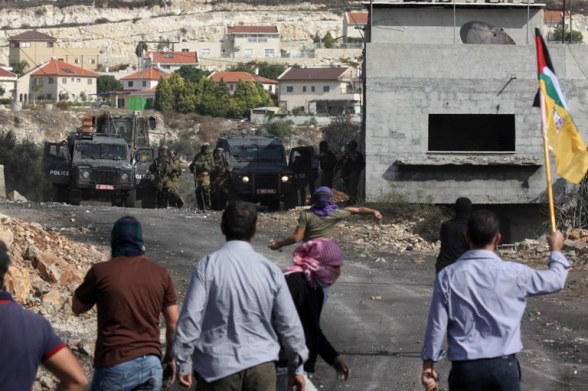
PHOTOS | Israeli forces open fire on West Bank protests, injuring dozens

(Photo MaanImages)
RAMALLAH (Ma’an) — Israel forces injured dozens of Palestinians and international activists after opening fire on demonstrations in four cities across the West Bank on Friday afternoon.
Israeli forces dispersed protests in Nabi Saleh, al-Masara, Bilin, and Kafr Qaddum protesting the killing of two Palestinians by Israeli forces on Thursday and marking the 9th anniversary of the death of former President Yasser Arafat.
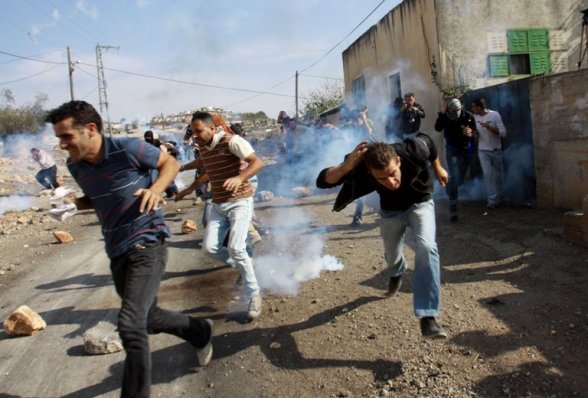
Israeli forces fired tear gas, rubber-coated steel bullets, and stun grenades at the various protests in order to disperse them, causing dozens of injuries.
In Nabi Saleh, Israeli forces dispersed demonstrators who marched throughout the village raising Palestinian flags and pictures of late President Yasser Arafat.
Demonstrators chanted songs calling for the opening of all roads, dismantling of checkpoints, and condemnation of the killing of two Palestinians on Thursday.
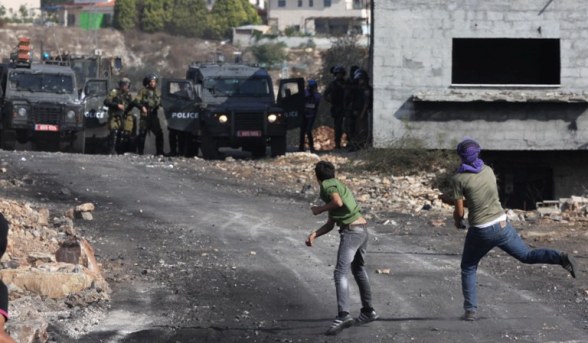
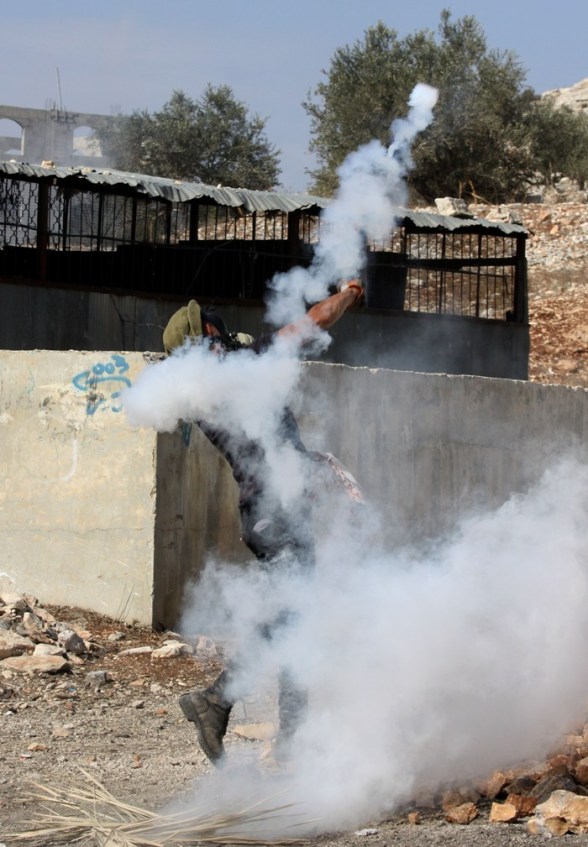
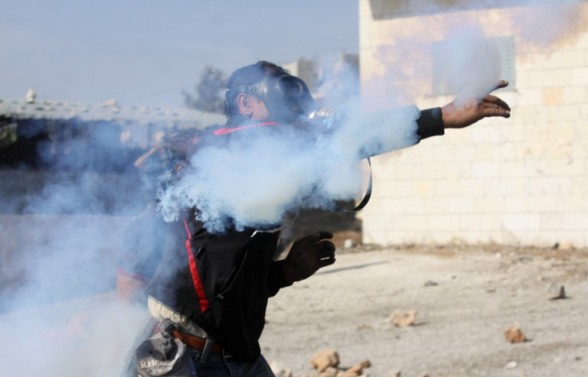
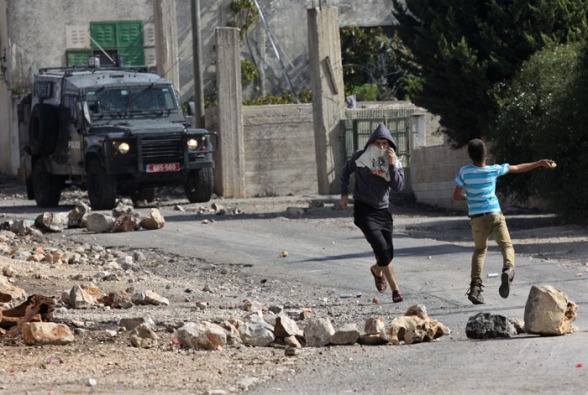
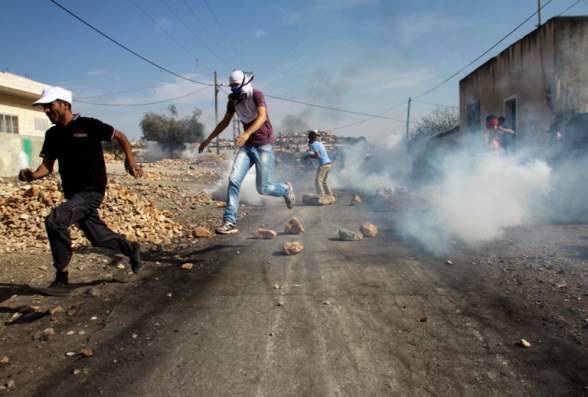
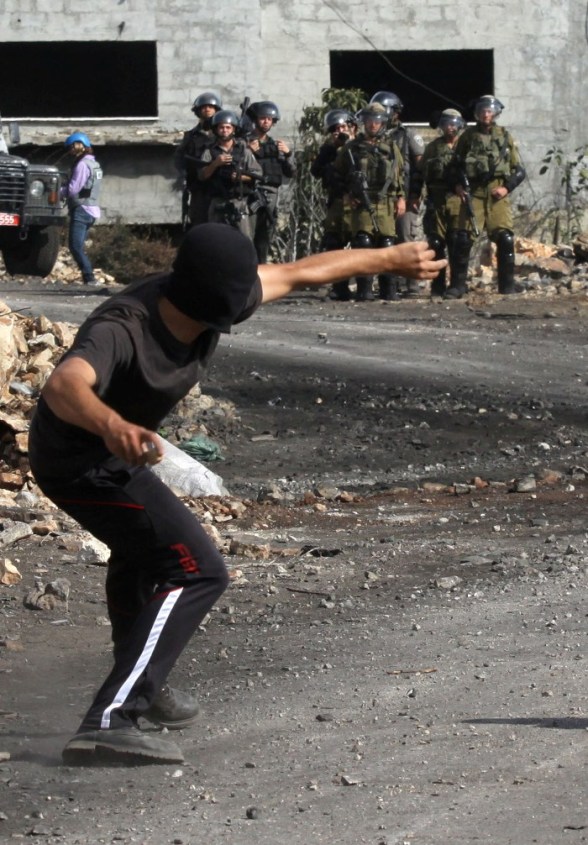
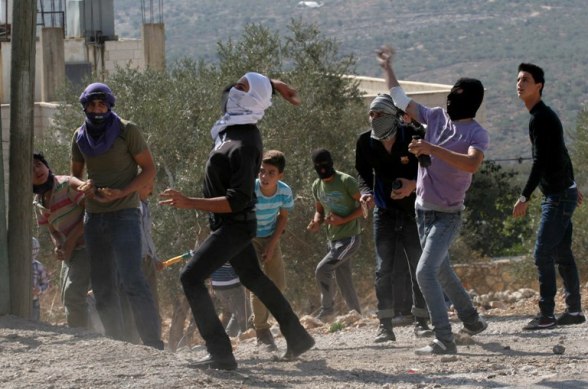
Clashes then broke out as Palestinians threw rocks at Israeli soldiers near the village, who in turn fired tear gas.
The Israeli army had declared the village a closed military zone in the early hours of the morning and restricted movement in an attempt to quash the weekly demonstration.
The people of Nabi Saleh have been protesting weekly for four years, demanding that their lands confiscated by Israeli forces to build the separation wall be returned.
In al-Masara, a village south of Bethlehem, a French activist was detained and dozens suffered from excessive tear gas inhalation as Israeli forces dispersed the weekly protest on Friday.
Protesters, including a German solidarity group, marched from the center of the village toward the Israeli separation wall and raised Palestinian and German flags.
Popular Struggle Committee Coordinator in Bethlehem Hassan Brejia said that Israel was trying to “drag Palestinians into violence.”
Since 2006, the residents of al-Masara have protested on a weekly basis, demanding Israeli authorities return village lands confiscated in order to build the separation wall as it crosses through their town.
In Bilin, near Ramallah, dozens suffered from excessive tear gas inhalation as Israeli soldiers dispersed the weekly demonstration.
Israeli forces fired rubber-coated steel bullets, stun grenades, and tear gas at protesters as they marched near their confiscated lands near the wall.
Palestinian, Israeli, and international activists participated in the protest. They raised Palestinian flags, and a large poster of late President Yasser Arafat while chanting songs for unity and resistance against the Israeli occupation.
Since 2005, Bilin villagers have protested on a weekly basis against the Israeli separation wall that runs through their village on land confiscated from local farmers. Previous protests by Bilin activists have forced the Israeli authorities to re-route the wall, but large chunks of the village lands remain inaccessible to residents because of the route.
Clashes between Israeli forces and protesters also broke out on Friday in Kafr Qaddum.
Israeli forces raided the village during the clashes, firing tear gas andstun grenades, and causing dozens to suffer from excessive tear gas inhalation including seniors, children, and international activists.
Hundreds participated in the protest, chanting national songs and songs for late president Yasser Arafat.
Murad Eshtewi, spokesman of the local protest committee, said that Israel is diminishing Palestinian dreams of freedom and independence by continuing their settlement activity, which weakens the possibility of a two-state solution.
Protests are held every Friday in Kafr Qaddum against Israel’s closure of a main road linking the village to its nearest city, Nablus.
In 2004, the International Court of Justice called on Israel to stop construction of the separation wall within the occupied West Bank.
When completed, 85 percent of the wall will run inside the West Bank.
Palestinian officials demanded a global probe into the “killing” of Yasser Arafat on Thursday, a day after it emerged that Swiss forensic tests showed he probably died from polonium poisoning.
The internationally recognized Palestinian territories of which the West Bank and East Jerusalem form a part have been occupied by the Israeli military since 1967.
Qalqiliya – confrontations between youths and Israeli soldiers, during the weekly anti-settlement protests Photos by Ayman Nubana (WAFA):
15_42_15_8_11_2013115_42_15_8_11_2013215_42_15_8_11_2013315_42_15_8_11_2013444_39_15_8_11_2013144_39_15_8_11_2013244_39_15_8_11_2013344_39_15_8_11_2013444_39_15_8_11_20135


Thursday, May 19, 2011

IOF kidnap six Palestinians today in W. Bank


[ 19/05/2011 - 03:03 PM ]


RAMALLAH, (PIC)-- The Israeli occupation forces (IOF) have kidnapped at dawn Thursday six Palestinian citizens in different West Bank areas.
Local sources said the IOF violently knocked at the doors of homes causing panic among children and women during the raids.
The detainees were taken blindfolded and handcuffed to interrogation centers.
In another development, the Palestinian prisoners in Nafha jail called in a letter addressed to all Palestinian spectra especially the resistance factions to support their protest steps which they take every once in a while to demand an end to the violations committed against them by Israeli jailers.
The prisoners said they demand the prison administration to end its solitary confinement policy, improve incarceration conditions and stop the punitive measures taken against them lately because of their protest steps.

Sunday, May 15, 2011

Ramallah medics put injured count at 150 during Nakba Day protests


[ 15/05/2011 - 06:58 PM ]


RAMALLAH, (PIC)-- Medics have put the count of those injured during Nakba Day protests in Ramallah and Al-Bireh in Ramallah province at 150.
20 of them were injured critically, 30 were hit by gunfire, and dozens suffered severe breathing difficulties after inhaling tear gas, sources in the Ramallah central hospital have said.
Dozens have been arrested by Israeli special units.
Witnesses said that the most volatile clashes took place at the Kalandia military crossing south of Ramallah, the main entrance leading to Jerusalem.
Violent clashes erupted there as Israeli soldiers opened fire at Palestinians.
Several areas across the West Bank are inflamed with clashes as Israel has deployed more than ten thousand soldiers and imposed a tight military cordon on the West Bank.
Tens of thousands of protesters took to the streets on Sunday in Ramallah to mark the 63rd Nakba Day carrying Palestinian flags and banners emphasizing the right of Palestinian refugees to return.
The march began at the tomb of late Palestinian president Yasser Arafat and headed for Manara Square downtown Ramallah, where vast ceremonies were held.

Palestinian Info Center

Wednesday, March 17, 2010

Newly dedicated Rachel Corrie Street in Ramallah.


Newly dedicated Rachel Corrie Street in Ramallah.

On March 16th 2003, an Israeli bulldozer killed the American activist Rachel Corrie in Rafah, Gaza. Today, in Kafr Sur, near Tulkarem, and in Ramallah, family, friends and supporters gathered together to commemorate the anniversary of her murder.

Students of Kafr Sur Secondary School, who have been working on a research project about Rachel’s life and death, today marked the anniversary with a march to a memorial stone at the entrance to the village. The students were joined by children from the nearby primary school, as the stone was unveiled and speeches were delivered by the headmaster, one of the students, and an ISM activist.


A boy in Tulkarem smiles and holds photos of Rachel.

Approximately fifty Palestinians, Internationals and media then joined Craig and Cindy Corrie, Rachel’s parents, for the inauguration ceremony of Rachel Corrie Street in Ramallah. Speeches were delivered by both the Mayor and Governor of Ramallah, the Minister of State, National Parties’ Coordinator, an ISM activist and Rachel’s parents.

At both events, speakers talked of the lasting impact left by Rachel, as an inspiration to those involved with the non-violent resistance in Palestine and across the world. Rachel’s mother spoke about how her daughter has become a symbol for the anti-Occupation movement, and of how grateful she and her family are to the Palestinians they have come to know and love over the past seven years for their unfailing support, despite the suffering they themselves continue to experience.

The coming weeks also mark the seventh anniversaries of the shootings of the British activist Thomas Hurndall, who was shot in the head whilst shielding children in Rafah from Israeli sniper fire, and who died in hospital nine months later, and Brian Avery, an American who was shot in the face in Jenin, but who mercifully survived. Last weekend saw the one year anniversary of Tristan Anderson being hit in the head with a high velocity tear gas canister in Nilin. Tristan is still recovering in an Israeli hospital.

Saturday, August 8, 2009

Action Alert: Tell Amnesty International, No Amnesty for Apartheid Israel

The Palestinian Campaign for the Academic and Cultural Boycott of Israel (PACBI) and groups around the world have been calling for months for musician Leonard Cohen to cancel his planned September concert in Israel. With the international community failing to take action to stop Israeli oppression of the Palestinian people, and inspired by the international boycott movement that helped bring an end to apartheid in South Africa, Palestinian civil society has launched calls for Boycott, Divestment and Sanctions (BDS) against Israel, including an academic and cultural boycott of Israel. Ninety-three artists, writers and other cultural workers have signed onto the Palestinian cultural boycott call. Many dignitaries signed the “No Reason to Celebrate” pledge and refused to participate in any artistic or literary event during Israel’s year-long 60th anniversary celebrations.

Feeling the heat of the protests, Cohen and his PR staff tried to schedule a small concert in Ramallah to “balance” his concert in Israel. However, Palestinians rejected the Ramallah concert and any claimed symmetry between the occupying power and the people under occupation.

Now Cohen and his PR staff are trying to whitewash the concert in Israel by using Amnesty International USA’s good name. According to a July 28th article in the Jerusalem Post, Amnesty International USA will serve as sponsor of a new fund. The fund will launder the money raised at Cohen’s concert in Israel by using it to finance programs for “peace.”

In response, sixteen groups and coalitions issued a July 30th Open Letter to Amnesty International calling on Amnesty to be true to its values and immediately withdraw support for Leonard Cohen’s ill-conceived concert in Israel. The groups noted that by supporting Cohen’s concert, Amnesty International is undermining a successful effort by Palestinian and international civil society to end Israel’s occupation and other violations of international law and human rights principles. Amnesty International also is partnering in the initiative with Israeli institutions that undermine peace, including a bank directly involved in supporting Israeli settlement construction. The only alleged Palestinian partner has announced it is not taking part.

TAKE ACTION

Please email Amnesty International, calling on Amnesty to withdraw from support for Cohen’s concert. Amnesty International is recognized by many as defending human rights worldwide, so please be respectful and courteous in your message.

You can write and email your own letter, or use the sample letter below and email it, or send an editable form letter from here. For reference, here is the full Open Letter to Amnesty International.

If you send your own email, please email your letter to:
lcox[at]aiusa.org, cgoering[at]aiusa.org, ZJanmohamed[at]aiusa.org, ikhan[at]amnesty.org, msmart[at]amnesty.org, ccordone[at]amnesty.org, drovera[at]amnesty.org

-Larry Cox, Executive Director of Amnesty International USA
-Curt Goering, Senior Deputy Executive Director of Amnesty International USA
-Zahir Janmohamed, Advocacy Director for the Middle East and North Africa at Amnesty International USA
-Irene Khan, Amnesty International Secretary General
-Claudio Cordone, Amnesty International (UK) Senior Director
-Malcolm Smart, Amnesty International (UK) Middle East Director, Research and Regional Programs
-Donatella Rovera, Amnesty International (UK) Researcher on Israel and the Occupied Palestinian Territories)

If you email your own letter, please cc it to: noamnesty4israeliapartheid[at]gmail.com so that we can keep track of the responses.

SAMPLE LETTER TO AMNESTY INTERNATIONAL

Dear Amnesty International,

I hold Amnesty International’s worldwide work for human rights and international law in high esteem. For this reason, I was very troubled to learn that Amnesty International has agreed to manage a fund that will disburse the proceeds from Leonard Cohen’s planned concert in Israel in September. I call on Amnesty International to be true to your values, distance yourself from efforts to normalize Israel’s occupation and apartheid, and immediately withdraw support for Leonard Cohen’s ill-conceived concert in Israel.

By supporting Cohen’s concert, Amnesty International will be subverting the worldwide movement to boycott Israel, a non-violent, effective effort by Palestinian and international civil society to end Israel’s violations of international law and human rights principles. Accepting funds from the proceeds of Cohen’s concert in Israel is the equivalent of Amnesty accepting tainted funds from a concert in Sun City in apartheid South Africa.

Ninety-three artists, writers and other cultural workers have signed onto the Palestinian cultural boycott call. Many dignitaries signed the “No Reason to Celebrate” pledge and refused to participate in any artistic or literary event during Israel’s year-long 60th anniversary celebrations.

In his protest resignation from Amnesty International over this issue, Irish author and composer, Raymond Deane, wrote: “By assisting Cohen in his ruse to bypass this boycott, Amnesty International is in fact taking a political stance, in violation of the premise of political neutrality with which it so regularly justifies its failure to side unambiguously with the oppressed. Amnesty is telling us: resistance is futile, the voice of the oppressed is irrelevant, international humanitarian law is a luxury.”

Furthermore, the Israeli partners in the concert, the Peres Center for Peace and Israel Discount Bank, actively hinder efforts to achieve a just peace. A columnist in Israel’s Ha’aretz Daily called the Peres Center for Peace patronizing and colonial organization that is in the business of training “the Palestinian population to accept its inferiority and prepare it to survive under the arbitrary constraints imposed by Israel.” According to research by Who Profits, a project of Israel’s Coalition of Women for Peace, Israel Discount Bank is deeply involved in supporting Israel’s settlement enterprise. Israeli settlements violate the very tenets of international law that Amnesty International works to uphold.

Finally, the only Palestinian organization falsely reported in the July 28th Jerusalem Post article as being a partner in this project, the Palestinian Happy Child Center, has confirmed that it is not taking part. There is no Palestinian organization participating in this whitewash.

Thank you for your attention to this vital human rights issue. I look forward to learning of Amnesty International’s withdrawal of its support for the Leonard Cohen concert in Israel.

Sincerely,
Your name

Your city and country of residence
ISSUED BY:
The Palestinian Campaign for the Academic and Cultural Boycott of Israel (PACBI)
Adalah-NY: The Coalition for Justice in the Middle East
Boycott! Supporting the Palestinian BDS Call from Within (Israel)
British Committee for the Universities of Palestine (BRICUP)
International Jewish Anti-Zionist Network
Jews Against the Occupation-NYC
Jews for Boycotting Israeli Goods (UK)
New York Campaign for the Boycott of Israel (NYCBI)
New York City Labor Against the War
Palestine Solidarity Campaign (UK)
US Campaign for the Academic & Cultural Boycott of Israel


--------------------------------------------------------------------------------

Tuesday, March 10, 2009

Palestinian Villages Become Israeli Playgrounds

Palestinian Villages Become Israeli Playgrounds

Memoricide in the West Bank

Similar parks across Israel have been established on the ruins of other Palestinian villages but, in those cases, the destruction was a result of the war of 1948 that founded Israel. Ilan Pappe, an Israeli historian, has referred to this massive erasure of Palestinian history as state-organised “memoricide”.


By JONATHAN COOK..


As spring sets in early, Israelis have been pouring into one of the country’s most popular leisure spots. Visitors to Canada Park, a few kilometres north-west of Jerusalem, enjoy its spectacular panaromas, woodland paths, mountain-bike trails, caves and idyllic picnic areas.

A series of signs describe the historical significance of the landscape, as well as that of a handful of ancient buildings, in terms of their Biblical, Roman, Hellenic and Ottoman pasts. Few, if any, visitors take notice of the stone blocks that litter sections of the park.

But Eitan Bronstein, director of Zochrot (Remembering), is committed to educating Israelis and foreign visitors about the park’s hidden past – its Palestinian history.

“In fact, though you would never realise it, none of this park is even in Israel,” he told a group of 40 Italians on a guided tour this past weekend. “This is part of the West Bank captured by Israel during the 1967 war. But the presence of Palestinians here – and their expulsion – is entirely missing from the signs.”

Zochrot also seeks to remind Israelis of the Nakba, the uprooting of hundreds of thousands of Palestinians during Israel’s creation in 1948.

Its tours are not popular with most Israelis, suggesting, he says, how far they still are from understanding the territorial compromises needed to reach the kind of peace agreement with the Palestinians currently being promoted by the new US administration.

An impressive building a short way into the park, signposted as a Roman bathhouse, is all that is recognisably left of a Palestinian village once known as Imwas, itself built on the ruins of the biblical village of Emmaus.

There are traces of a cemetery, as well as scattered rubble from the village’s houses, a coffee shop, a church, two mosques and a school.

The 2,000 Palestinians living there, along with the 3,500 inhabitants of two other villages, Yalu and Beit Nuba, were expelled as the Israeli army captured this area of the West Bank from Jordan. Today, they and their descendants live as refugees, mostly in East Jerusalem and near Ramallah.

In place of the three villages, a park was created by an international Zionist organisation, the Jewish National Fund, paid for with $15 million in charitable donations from Canadian Jews.

The park entrance is only a minute’s drive from the busiest motorway in the country, linking Jerusalem and Tel Aviv.

Similar parks across Israel have been established on the ruins of other Palestinian villages but, in those cases, the destruction was a result of the war of 1948 that founded Israel.
Ilan Pappe, an Israeli historian, has referred to this massive erasure of Palestinian history as state-organised “memoricide”.

But Canada Park is far more sensitive for Israel because it lies outside the country’s internationally recognised borders. The Palestinian inhabitants’ expulsion, Mr Bronstein said, was a premeditated act of ethnic cleansing of villagers who put up no resistance.

“We have photographs of the Israeli army carrying out the expulsions,” he told the group of tourists, holding up a series of laminated cards.

Yosef Hochman, a professional photographer, captured scenes that included columns of fleeing Palestinians carrying possessions on their heads, army officers arguing with an elderly woman who refuses to leave her house and bulldozers moving in to destroy the villages.

According to Mr Bronstein, the wrecking spree can be explained by the Israeli army’s failure in the 1948 war to capture the area, which juts out into what is today Israel and was once known as the Latrun salient.

“In 1948, Israeli commanders regarded conquest of the salient as vital for widening the safe passage from Tel Aviv to Jerusalem. They were desperate to make amends in 1967 when they got a second chance.”

Uzi Narkiss, a leading general in the 1967 war, vowed that the Latrun salient would never be returned. Establishing Canada Park was Israel’s way of secretly annexing the territory, Zochrot says.

Since 2003, Mr Bronstein has been demanding that the Jewish National Fund post additional signs highlighting the park’s Palestinian history.

The Roman bathhouse, he notes, is visible only because the foundations were subsequently excavated. For centuries, the structure – a shrine to Obeida Ibn al Jarah, an Arab warrior who helped conquer Palestine in the seventh century – served as an important Palestinian holy place.

The Jewish National Fund and the Civil Administration, the military government in the West Bank, agreed to post two new signs, marking the centres of Imwas and Yalu, only after Zochrot petitioned the courts. The experiment in openness was shortlived, however. After a few days, black paint was used to conceal part of the sign at Imwas, and soon afterwards both signs disappeared.

“We were told that scrap-metal dealers were probably responsible for stealing the signs,” Mr Bronstein said. “That’s a little hard to believe, since the official signs close by are there to this day.”

Zochrot is considering widening its campaign by alerting Canadian donors to the fact that their money has been used – in contravention of international law – effectively to annex a section of the West Bank to Israel. Mr Bronstein believes many are unaware of the use their donations have been put to.

He is preparing to take the Jewish National Fund back to court to demand it replaces the missing signs and erects similar signs in parks inside Israel to commemorate the Palestinian villages razed by the army after the 1948 war.

According to Zochrot, 86 Palestinian villages lie buried underneath JNF parks. A further 400 destroyed villages had their lands passed on to exclusively Jewish communities. Zochrot’s several hundred activists regularly select a destroyed village, taking Palestinian refugees with them as they place a handmade sign detailing the village’s name in Arabic and Hebrew. Within days, the signs are removed.

But Mr Bronstein said he believes signs erected by official bodies may have a greater impact in opening Israeli minds.

“In a recent newspaper interview, a senior JNF official admitted that it would be hard to stop our campaign,” he said. “Slowly we believe Israelis can be made to appreciate that their state exists at the expense of another people. Only then are Israelis likely to be ready to think about making peace.”

Jonathan Cook is a writer and journalist based in Nazareth, Israel. His latest books are “Israel and the Clash of Civilisations: Iraq, Iran and the Plan to Remake the Middle East” (Pluto Press) and “Disappearing Palestine: Israel's Experiments in Human Despair” (Zed Books).

His website is www.jkcook.net.

A version of this article originally appeared in The National (www.thenational.ae), published in Abu Dhabi.

Wednesday, March 4, 2009

Clinton: Israel’s East Jerusalem home demolitions "unhelpful"

Clinton: Israel’s East Jerusalem home demolitions "unhelpful"
04/03/2009

Ramallah – Ma’an – US Secretary of State Hillary Clinton on Wednesday said Israel’s plan to demolish dozens of Palestinian homes in East Jerusalem is “unhelpful.”

"Clearly this kind of activity is unhelpful and not in keeping with the obligations entered into under the Road Map," Clinton said at a Ramallah news conference on Wednesday afternoon.

Israel’s Jerusalem Municipality is moving to demolish over 100 houses and remove the 140 families who live in the Palestinian neighborhood of Silwan in East Jerusalem. The decision is expected to lead to the forced displacement of more than 1,000 Palestinians from their family residences.

"It is an issue that we intend to raise with the government of Israel and the government at the municipal level in Jerusalem," she added, shortly after meeting with Palestinian President Mahmoud Abbas.

The US secretary of state said she would bring up the issue with the new Israeli government, likely to be headed by Likud Party chair Benyamin Netanyahu.

Clinton met earlier with Palestinian Prime Minister Salam Fayyad at the headquarters of the Council of Ministers in Ramallah, but no remarks were immediately available from that meeting.

Clinton arrived in Israel on Monday, where she met with the Israeli president, prime minister-designate and foreign minister, and insisted that America's policy remains a two-state solution to the Palestinian struggle for self-determination.

The US secretary of state said America’s assessment is “that eventually, the inevitability of working towards a two-state solution is inescapable."

The remarks came following meetings alongside both Israeli Prime Minister-designate Benyamin Netanyahu and Foreign Minister Tzipi Livni in Jerusalem on Tuesday.

On Wednesday Clinton reiterated that the United States would be “vigorously engaged” in the peace process, and that she would be “personally engaged.”

“I hold this mission in my heart, not just in my portfolio,” she said.

Netanyahu has historically rejected the creation of a Palestinian state, which would involve Israel withdrawing from Gaza, the West Bank and East Jerusalem, but of late has offered limited expressions that Palestinians ought to rule themselves. The charter of Netanyahu’s Likud party calls for Israel to maintain control over all the land occupied in 1967.

The issue of an increasingly right wing government in Israel also came up during the Ramallah news conference. Abbas said that “we respect the choice of the Israeli people” but that the Israeli government must commit to the two-state solution and to the Road Map.

Clinton said that the US would wait for Netanyahu to finish forming a ruling coalition before sending Special Envoy George Mitchell back to the region for another round of peace talks.

http://www.maannews.net/en/index.php?opr=ShowDetails&ID=36217

Friday, February 27, 2009

Declaration of the State of Palestine

Declaration of the State of Palestine


A declaration of a "State of Palestine" was approved on November 15, 1988, by the Palestinian National Council, the legislative body of the Palestinian Liberation Organization (PLO). The proclaimed "State of Palestine" is not an independent state, as it has never had sovereignty over any territory. Moreover, the declaration was ignored, and eventually rejected, by the State of Israel. Israel controls the territories since 1967 Six-Day War when it captured them from Egypt and Jordan.

Currently, the Palestinian National Authority (PNA) envision the establishment of a State of Palestine to include all the West Bank, the Gaza Strip, and East Jerusalem, living in peace with Israel under a democratically elected and transparent government. The PNA, however, does not claim sovereignty over any territory and therefore is not the government of the "State of Palestine" proclaimed in 1988.

The 1988 declaration was approved at a meeting in Algiers, by a vote of 253-46, with 10 abstentions. The declaration invoked the Treaty of Lausanne (1923) and UN General Assembly Resolution 181 in support of its claim to a "State of Palestine on our Palestinian territory with its capital Jerusalem". The proclaimed "State of Palestine" was recognized immediately by the Arab League, and about half the world's governments recognize it today. It maintains embassies in these countries (which are generally PLO delegations). The State of Palestine is not recognized by the United Nations, although the European Union, as well as most member states, maintain diplomatic ties with the Palestinian Authority, established under the Oslo Accords.

The declaration is generally interpreted to have recognized Israel within its pre-1967 boundaries, or was at least a major step on the path to recognition. Just as in Israel's declaration of establishment, it partly bases its claims on UN GA 181. By reference to "resolutions of Arab Summits" and "UN resolutions since 1947" (like SC 242) it implicitly and perhaps ambiguously restricted its immediate claims to the Palestinian territories and Jerusalem. It was accompanied by a political statement that explicitly mentioned SC 242 and other UN resolutions and called only for withdrawal from "Arab Jerusalem" and the other "Arab territories occupied." Yasser Arafat's statements in Geneva a month later were accepted by the United States as sufficient to remove the ambiguities it saw in the declaration and to fulfill the longheld conditions for open dialogue with the United States.

The Palestinian National Charter of 1964 stated "This Organization does not exercise any territorial sovereignty over the West Bank in the Hashemite Kingdom of Jordan, on the Gaza Strip or in the Himmah Area."

Capital Jerusalem (proclaimed), Ramallah (currently)

Official languages: Arabic

Declaration of Independence: November 15, 1988

President: Mahmoud Abbas (2005-)

Prime Minister: Ismail Haniya (2006)

Palestinian National Authority


Palestinian National Authority
Interim governing body appointed July 1994 to take over the management of
Palestinian affairs from Israel in newly liberated Gaza Strip and Jericho. It is headed by Yasser Arafat, chairman of the PLO. The PNA has jurisdiction over the whole of the formerly occupied areas, except Israeli settlers and nationals, Israel retains responsibility for external defence and foreign affairs.
Palestinian Legislative Council (PLC)
The first elected Palestinian Legislative Council (PLC) was initially conceptualized with the Declaration of Principles (DOP). The idea was further developed in the Israel-Palestinian Interim Agreement (Oslo II) in which the structure, jurisdiction, functions, size, and responsibilities of the Council were determined.

The PLC, is to replace the Palestinian Authority upon it inauguration. As such, the Council is expected to act as the highest authority in the interim phase. The PLC is the body responsible for legislation and from it the majority (80% of the cabinet) of the Executive Authority is appointed.
Committees of the Council
The Council established eleven permanent committees at its second meeting on April 4, 1996. Under Title III of the Standing Rules, the committees review and propose amendments to legislation, report to the Council, receive constituent complaints, and study and review plans, programs, agreements, and treaties submitted to the Council by the Executive Authority. The committees discuss and report to the Council on any proposals referred by the Council or by the Speaker. The committees usually meet twice a week and may hold additional meetings at the call of the chairman, or by request of the Speaker or a majority of the members of the committee, with at least 24 hours notice. The committees meet in secret but can decide to hold public meetings. The quorum for a committee meeting is a majority of its members and decisions of the committees require a simple majority. Each committee has a chairman and a secretary elected from among its members. A committee may request, through the Speaker, that any relevant Minister or responsible person within the Palestinian National Authority give information or clarify any issue within the committee’s mandate. A committee may also ask the Speaker to request, through the President of the Authority, the attendance of any relevant Minister at a committee meeting.
Anthem
The Palestinian national anthem, Biladi ("My Country"), is the national anthem of the State of Palestine, adopted in 1996 in accordance with Article 31 of its declaration of independence in 1988. It was written by Said Al Muzayin, and its music was composed by Egyptian maestro Ali Ismael, and it was known as the "Anthem of the Palestinian revolution".

Since 1936, Mawtini ("My homeland") was unofficially the anthem used by Palestinians, it was written by Ibrahim Towqan and composed by the Lebanese composer Mohammad Flaifel. This should not be confused with Biladi, the official anthem.
My country, my land, land of my ancestors

My country, my country, my country

My people, people of perpetuity

With my determination, my fire and the volcano of my revenge

With the longing in my blood for my land and my home

I have climbed the mountains and fought the wars

I have conquered the impossible, and crossed the frontiers

My country, my country, my country

My people, people of perpetuity

With the resolve of the winds and the fire of the guns

And the determination of my nation in the land of struggle

Palestine is my home, Palestine is my fire, Palestine is my revenge and the land of endurance

My country, my country, my country

My people, people of perpetuity

By the oath under the shade of the flag

By my land and nation, and the fire of pain

I will live as a fida'i*, I will remain a fida'i, I will end as a fida'i - until my country returns

My country, people of perpetuity.

fida'i = one who risks his life voluntarily; one who sacrifices himself; fedayeen
Main cities in Palestine
Jenin
Tulkarm
Rafah
Khan Yunus
Gaza Strip
Gaza, (Arabic Ghazze), city and port near the Mediterranean Sea, about 32km north of the Egyptian border. This ancient city has given its name to the Gaza Strip, a territory that was occupied by Israeli forces from 1967 until 1994. The Gaza Strip covers about 378 sq km (about 146 sq mi) and extends northeast from the Sinai Peninsula along the Mediterranean for about 40 km (about 25 mi).

Gaza was an important city in the 15th century BC, when the Egyptian king Thutmose III made it a base for his army in a war with Syria. In biblical times Gaza was one of the five royal cities of the ancient Philistines.

In the 8th century BC it was conquered by the Assyrians; from the 3rd to the 1st century BC, Egyptian, Syrian, and Hebrew armies fought for its possession. During Roman occupation it was called Minoa.

In the 7th century AD it became a sacred Muslim city, but the Crusaders found it almost deserted in the 12th century. Gaza fell to the French general Napoleon Bonaparte during his Egyptian campaign.

In 1917, during World War I, the city was taken from Turkey by British forces under General Edmund Henry Hynman Allenby.

By the terms of the United Nations (UN) plan of 1947 providing for the partition of Palestine into a Jewish state and an Arab state, Gaza was to have been included in the Arab area. In 1948, during the war between Jewish the Arabs, Egyptian forces retained Gaza and the surrounding area, which came to be called the Gaza Strip. This territory came under the control of Egypt by the terms of the Arab Israeli armistice agreement of 1949. In the course of the war some 200,000 Palestinian refugees from the Palestinian occupied land by Israel settled in the strip, doubling the population. Although the city of Gaza has bazaars and markets and some light industry, and the Gaza Strip is an established citrus producing area, the economy cannot support the large population , which has been aided by the United Nations Relief and Works Agency for Palestinian Refugees in the Near East.
West Bank
West Bank, territory in southwestern Asia, in the Middle East, located west of the Jordan River, occupied by Israel since 1967. It covers an area of about 5879 sq km and supports a population of about 973,500. All of the people are Palestinian Arabs. There is some Jews who have settled in the area since 1967. The West Bank was part of the British League of Nations Palestine mandate from 1922 to 1948, after the first Arab Israeli war in 1948, Jordan took control of the region in 1949. In 1967 the area was seized by Israel during the Six Day War.

Under accords reached in the late 1970s between Egypt and Israel, the latter agreed to give the Palestinians of the West Bank more self rule, but subsequent negotiations failed to determine what the exact nature of government in the territory would be.

Beginning in December 1987, Intifada started in West Bank and Gaza Strip demanding Palestinian autonomy in Palestinian lands occupied by Israel. In November 1988 the PLO proclaimed a Palestinian state that included the West Bank and Gaza Strip based on UN resolution no 242 and other UN resolution related the Arab Israeli conflict.

After decades of violence between Arabs and Israeli in the West Bank, leaders of the PLO and Israel agreed to the signing of an historic peace treaty. On September 13, 1993, PLO leader Yasser Arafat and Israeli prime minister Yitzhak Rabin met in the United States for the signing of the accord, which pledged to establish limited Palestinian self rule, beginning with the Gaza Strip and the West Bank town of Jericho. In May 1994 Israeli troops left Jericho, and a Palestinian authority took control of the city.
Al-Qouds
Jerusalem (Arabic al-Quds) largest city in the West Bank, situated between the Mediterranean Sea and the Dead Sea. Jerusalem is a holy city for the world's major religions: Islam, and Christianity. In 1948 Jerusalem was under Israel occupation (West Jerusalem), and Jordan controlled the other part of Jerusalem (East Jerusalem) including the Old City. In 1967 Israel occupied East Jerusalem in the Six-Day War, Since then, both west and east Jerusalem has been under Israeli occupation.

Points of Interest Jerusalem's Old City is divided into Muslim, Armenian, Christian and Jewish sections and is enclosed by walls with gates. The Christian section, in the northwest, contains the New Gate, shares the Jaffa Gate with the Armenian section on the southwest, and the Damascus Gate with the Muslim section on the north. The Muslim section, in the northeastern portion of the Old City, contains Herod's Gate, Saint Stephen's Gate, and the Golden Gate, east of which is located the Mount of Olives and the garden of Gethsemane.

The Jewish section, occupying the southeastern portion, contains the Zion Gate, south of which is Mount Zion was created in place of an Islamic area called Harat Al-Shurafa (or Harat al-Magarbah) after the Israeli occupation in 1967 (all the houses and the building in Harat al-Magarbah were deomlished by Israeli forces and new houses for Jeiwsh setllers were build). It also contains Dung Gate. Around the Old City is the New City, developed since the middle of the 19th century. The population of Jerusalem (1990 estimate) is 524,500.

The Old City is sacred to Christians as the site where Jesus Christ spent his last days on earth, and it is sacred to Muslims as the site of the ascent into heaven of the Prophet Muhammad. Notable structures include the Christian Church of the Holy Sepulcher, built over the 4th-century, the Muslim Dome of the Rock, built upon the site where Muhammad have ascended to heaven, the Mosque of Al Aqsa one of Islam's most sacred shrines; and the Citadel, a 14th-century structure on the site of Herod's fortress.
Hebron
Hebron, city in the West Bank, near Jerusalem. Israel has occupied Hebron since 1967, when it captured the West Bank and other territories in the Six-Day War. Hebron is one of oldest communities in the world. Among the interesting features of Hebron are the narrow, winding streets, the flat-roofed stone houses, the bazaars, and the mosque of al-Haram al-Ebrahimi. The mosque is built on top of the cave that is believed to hold the tombs of Abraham and his family. In the top of this cave is al-Ebrahimi mosque.

Hebron's population is Arab Muslim, although Israelis have settled in the city since 1967. A large Israeli settlement called Qiryat Arba lies on the outskirts of Hebron. Hebron has a number of small scale industrial establishments that produce cotton goods, leather, water containers, glass bracelets, rings, lamps, and ceramics.

British troops occupied Hebron in December 1917, during World War I. Hebron was part of the British mandate for Palestine from 1923 until 1948. In
1949 Jordan controled Hebron and the rest of West Bank. In June 1967, following the Six-Day War between Israel and Arab countries, Israeli troops took control of the West Bank.

In February 1994 an Israeli settler massacred at least 29 Palestinians in al-Haram al-Ebrahimi mosque.

Population (estimated) 75,000.
Bethlehem
Bethlehem (pop. 16,313) is the birthplace of Jesus Christ. It lies about 5 miles (8 kilometers) south of Jerusalem in a region of the Middle East called the West Bank.

The Arabic name is Bayta lahm, which means house of meat. Bethlehem is chiefly a religious shrine. It has many houses of worship and other religious institutions.

In 1917, during World War I, British forces led by General Edmund Henry Hynman Allenby took the town. It became under Jordan control in 1948 after the first Arab-Israeli war in 1948. Israel occupied the West Bank, including Bethlehem, during the Six-Day War of 1967. In 1995, Israel withdrew from Bethlehem and gave control to Palestinian based on self-rule agreement between PLO and Israel.
Gaza City
Principal city of the Gaza Strip. Gaza is located on the coast of the Mediterranean Sea, north of the Sinai Peninsula and southwest of Jerusalem. A city of historical and religious importance, Gaza has been disputed since ancient times. Along with the rest of the Gaza Strip, Gaza came under Israeli occupation in 1967. In May 1994 the city became the headquarters of the new Palestinian Authority, which administers Palestinian areas in the Gaza Strip and West Bank.

Gaza is the economic center for a region in which citrus fruits and other crops are grown. The city contains some small industry, including textiles and food processing. A variety of wares are sold in Gaza's street bazaars, including carpets, pottery, wicker furniture, and cotton clothing; commercial development in the city is minimal. Gaza serves as a transportation hub for the Gaza Strip, and contains a small port that serves a local fishing fleet. Points of interest in Gaza include the Great Mosque and Al Jundi, or the Square of the Unknown Soldier, built by the Egyptian army.

Gaza's population is composed entirely of Muslim Palestinian Arabs. A massive influx of Palestinian refugees swelled Gaza's population after the 1948 Arab Israeli war. By 1967 the population had grown to about six times its 1948 size. The city's population has continued to increase since that time, and poverty, unemployment, and poor living conditions are widespread. Gaza has serious deficiencies in housing and infrastructure, and an inadequate sewage system has contributed to serious problems of hygiene and public health.

Strategically located on the Mediterranean coastal route, ancient Gaza was a prosperous trade center and a stop on the caravan route between Egypt and Syria. The city was occupied by Egypt around the 15th century BC. Philistines settled the area several hundred years later, and Gaza became one of their chief cities.

Gaza was captured by Arabs in the AD 600s. Believed to be the site where the Prophet Muhammad's great grandfather was buried, the city became an important Islamic center. In the 12th century Gaza was taken by Christian Crusaders, it returned to Muslim control in 1187. The city fell to the Ottomans in the 16th century and was taken by the British during World War I (1914 - 1918).

Following World War I, Gaza became part of the British mandate for Palestine. After the first Arab Israel war in 1948, Egypt took control over Gaza and its surrounding area. Israel occupied the city and the Gaza Strip during the 1967 Six Day War, and Gaza remained under Israeli administration for the next 27 years.

With the onset of the Palestinian uprising known as the intifada in 1987, Gaza became a center of political unrest and confrontation between Israelis and Palestinians, and economic conditions in the city worsened.

In September 1993 leaders of Israel and the Palestine Liberation Organization (PLO) signed a peace agreement calling for Palestinian administration of the Gaza Strip and the West Bank town of Jericho, which was implemented in May 1994. Most of the Israeli forces left Gaza, leaving a new Palestinian Authority to administer and police the city, along with the rest of the Gaza Strip and Jericho. The Palestinian Authority, led by Yasser Arafat, chose Gaza as its first provincial headquarters. In September 1995 Israel and the PLO signed a second peace agreement extending the Palestinian Authority to some West Bank towns. The agreement also established an elected 88-member Palestinian Council, which held its inaugural session in Gaza in March 1996.
Jericho
Excavations at ancient Jericho, identified as Tell al-Sultan, 10 km (6 mi) north of the Dead Sea, have revealed remains of the oldest city yet discovered by archaeologists. The earliest occupation of the site, dating from the 10th millennium BC, consists of remains of the NATUFIAN culture and includes what may have been a shrine. During the 8th millennium BC the site was greatly expanded under a culture known as the Aceramic, or Prepottery Neolithic, and a wall standing 5.2 m (17 ft) high was erected around the settlement. On the west side were found remains of a round tower that stood 7 m (23 ft) high and included an internal flight of steps.

Following a break the next city was populated by a culture known as the Prepottery Neolithic (7th - 6th millennium BC). Houses of this phase were rectangular and had beaten earth floors. That the two cultures represent different groups is shown by significant changes in both the architectural tradition and in the flint tools. Extraordinary finds of this period included plastered skulls with shells replacing the eyes. These skulls, found beneath the floors of houses.

In the ceramic stage of the Neolithic (6th-4th millennium BC) the dwellers lived in pits and produced a characteristic painted pottery.

Early Bronze Age occupation (3100-2100 BC) was extensive and consisted of large, well-built homes. Tombs were constructed for mass burials, and in one such grave about 100 skulls were counted. Following the destruction of the Early Bronze Age settlement, occupation was resumed by people who have been identified with the AMORITES. They did not build a permanent settlement and buried their dead in shaft tombs, the variety of whose grave deposits may indicate tribal differences.

During the Middle Bronze Age (c.1900-1550 BC) houses consisting of small irregularly shaped rooms were built. Mass burials were excavated in a cemetery off the mound in shaft graves. The remains of wooden beds on which the deceased lay as well as pottery vessels containing food and drink have been found next to several of the bodies. The city was destroyed, probably about the end of the Middle Bronze Age (1550BC).
Nabulus
Market town on the West Bank of the river Jordan, North of Jerusalem, the largest Palestinian town, after east Jerusalem, in Israeli occupation, population (1971) 64,000 The British field marshal Allenby's defeat of the Turks here 1918 completed the conquest of Palestine.
Ram Allah
Also spelled RAMALLAH, town, central Palestine, adjacent to the town of Al-Birah (east) and north of Jerusalem. Ram Allah has since the Six-Day War of 1967 been under Israeli occupation as part of the West Bank territory.

Situated on the crest of the Judaean Hills, at an elevation of 2,861 feet (872 m) above sea level, Ram Allah has fine summer breezes and has long been a popular Arab resort. The surrounding area is fertile, olives and viticulture are important. Birzeit University was founded at Ram Allah in 1924.

The demographic makeup of the town changed drastically between 1948 and 1967, formerly Ram Allah was predominantly Christian and twice as large as Al-Birah, a Muslim town. In 1967, Ram Allah's population was 12,134, only slightly more than half Christian, while Al-Birah, including a large refugee camp, was 13,037. Pop.